3D Drape Analysis for Chinese Fashion History Research 2026
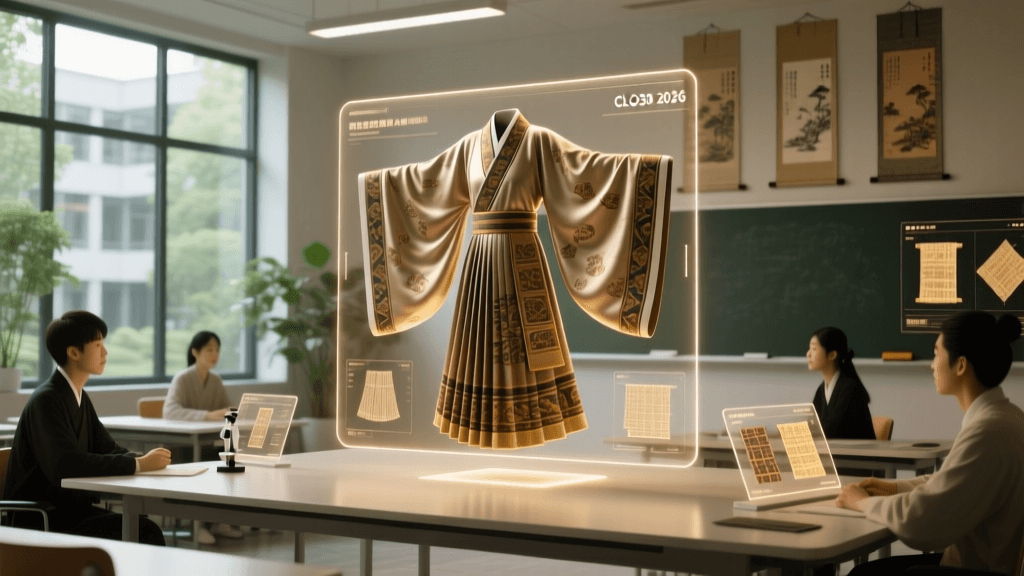
The Digital Shift in Chinese Fashion History Education
The landscape of Chinese fashion history education has undergone a radical transformation in 2026. Academic institutions and textile researchers are no longer relying solely on fragile physical archives and two-dimensional pattern drafting. Today, the integration of 3D drape analysis and digital twin technology has revolutionized how scholars study, preserve, and reconstruct historical Asian garments. This shift is particularly evident in the academic research surrounding Ming and Qing dynasty textiles, where the complex physics of traditional silk weaving require advanced computational simulation to be fully understood.
As the Xin Zhongshi (new Chinese style) movement continues to dominate global runways and domestic markets in 2026, the demand for historically accurate reconstructions has surged. Universities are responding by embedding digital archiving and 3D simulation software into their core fashion history curriculums. This ensures that the next generation of designers and historians can interact with priceless artifacts virtually, preserving the integrity of the originals while unlocking new insights into ancient tailoring techniques.
Understanding Ming Dynasty Textile Physics in 3D
To accurately simulate historical garments, researchers must first understand the unique physical properties of traditional Chinese textiles. Unlike modern mass-produced fabrics, historical silks such as Yunjin (cloud brocade) and Kesi (silk tapestry) possess distinct structural characteristics that drastically affect how they drape on the human body.
The Challenge of Heavy Brocades
Ming dynasty garments, particularly the iconic Mamianqun (horse-face skirt) and formal Daoshan (robes), were often constructed using heavily weighted silks and metallic thread brocades. In a 2026 academic setting, students use the FAST (Fabric Assurance by Simple Testing) system to measure the bending stiffness, shear stiffness, and surface friction of surviving textile fragments. These physical metrics are then translated into digital material parameters within 3D simulation environments.
- Bending Length: Historical Zhuanghua silk exhibits a high bending length due to its dense warp and weft structure, requiring higher stiffness values in digital material editors.
- Shear Stiffness: The interlocking tapestry weave of Kesi creates a fabric with minimal bias stretch, which must be manually restricted in 3D software to prevent unrealistic digital draping.
- Weight and Gravity: The incorporation of gold and silver threads in imperial brocades adds significant gram-per-square-meter (GSM) weight, altering the gravitational pull and fold formation of the skirts.
By inputting these precise measurements, researchers can observe how a 15th-century Mamianqun would have moved during traditional court rituals, providing invaluable context that static museum displays simply cannot convey.
2026 University Curriculum: Digital Reconstruction Module
Leading Asian traditional garment programs have restructured their syllabi for the 2026 academic year to include comprehensive digital reconstruction modules. Below is a breakdown of a standard 12-week graduate seminar focused on Ming dynasty textile drape analysis.
| Week | Module Focus | Practical Application | Software / Tools |
|---|---|---|---|
| 1-2 | Historical Context & Archival Research | Analyzing primary sources and museum archives for Ming court dress codes. | Digital Archives, The Met Asian Art Collection |
| 3-4 | Textile Physics & Material Testing | Conducting FAST tests on modern replica brocades to gather drape coefficients. | FAST Testing Rig, Excel Data Modeling |
| 5-7 | 2D Pattern Digitization | Translating flat historical patterns into scalable digital vectors. | Adobe Illustrator, CLO3D Pattern Editor |
| 8-10 | 3D Drape Simulation & Fitting | Applying material physics to 3D avatars; adjusting particle distance for accuracy. | CLO3D Education Portal, Blender |
| 11-12 | Kinetic Analysis & Final Rendering | Simulating movement (walking, bowing) to analyze stress points and fold behavior. | Marvelous Designer, Unreal Engine 5 |
Essential Software and Hardware for 2026 Researchers
The toolkit for the modern fashion historian has expanded far beyond the magnifying glass and measuring tape. In 2026, academic labs are equipped with a blend of high-fidelity scanning hardware and advanced physics engines.
3D Scanning and Photogrammetry
Before a garment can be simulated, its current physical state must be captured. Researchers utilize handheld 3D scanners, such as the Artec Leo, to create sub-millimeter accurate topographical maps of surviving garments. For fragile pieces that cannot be moved, multi-angle photogrammetry rigs are employed. The China National Silk Museum has been at the forefront of this technology, partnering with universities to create open-access 3D meshes of their most delicate Qing dynasty robes.
Simulation Engines
CLO3D remains the industry standard for academic drape analysis due to its robust material editor and precise collision detection. However, for complex kinetic studies involving wind or rapid movement, researchers are increasingly exporting their CLO3D simulations into Unreal Engine 5. This allows for real-time rendering and virtual reality (VR) integration, enabling students to 'step inside' a historical garment and view the drape from a first-person perspective.
Step-by-Step Guide to Digital Drape Analysis
For independent researchers and graduate students beginning their digital archiving projects, following a structured workflow is critical to maintaining academic rigor.
- Archival Acquisition: Secure high-resolution photogrammetry data or physical access to the garment. Always cross-reference with historical texts to ensure the garment has not been altered by later restorations.
- Material Proxy Creation: Since testing original artifacts is often impossible, source or weave a modern proxy fabric that matches the historical thread count, weave structure, and GSM. Test this proxy to gather your digital material values.
- Avatar Calibration: Historical body ideals and undergarments differ vastly from modern standards. Calibrate your 3D avatar to reflect the specific posture and foundational garments (such as the Zhongyi or inner robes) of the target era.
- Particle Distance Refinement: In your 3D software, lower the particle distance to 5mm or less for the final simulation. This increases computational load but is mandatory for capturing the micro-folds of stiff silk brocades accurately.
- Kinetic Stress Testing: Run animation cycles to observe how the Mamianqun pleats open and close during movement. Document any areas where the digital fabric clips through itself, which often indicates an error in the historical pattern drafting or seam allowance.
The Impact of Xin Zhongshi on Academic Funding
One cannot discuss the state of Chinese fashion history education in 2026 without addressing the Xin Zhongshi (new Chinese style) movement. What began as a niche subculture has evolved into a massive commercial and cultural force, driving unprecedented funding into academic textile research.
'The commercial success of Xin Zhongshi has provided the financial scaffolding necessary for universities to build state-of-the-art digital preservation labs. Brands are actively funding academic chairs to ensure their modern designs are rooted in verifiable historical accuracy.' — Journal of Asian Textile Studies, 2026
This influx of capital has allowed universities to purchase enterprise-grade server farms dedicated solely to rendering complex drape simulations. Furthermore, it has bridged the gap between academia and the commercial fashion industry. Students who master 3D drape analysis of historical garments are highly sought after by heritage brands looking to integrate authentic Ming and Qing dynasty silhouettes into their 2026 ready-to-wear collections.
Conclusion: Preserving the Past Through Digital Innovation
The integration of 3D drape analysis into Chinese fashion history education represents a monumental leap forward for the preservation of Asian traditions. By combining the meticulous research methods of traditional historians with the cutting-edge physics engines of modern software, academics in 2026 are breathing new life into ancient textiles. As digital archives continue to expand and simulation technology becomes increasingly accessible, the rich sartorial history of China will not only be preserved but will continue to inspire and educate generations to come.