3D Drape Analysis Tools for Chinese Fashion History Research 2026
The Digital Renaissance in Chinese Fashion History Education
The landscape of Chinese fashion history education has undergone a radical transformation by 2026. No longer confined to dusty archives and fragile physical artifacts, the study of traditional Asian garments has entered a highly advanced digital era. At leading academic institutions, graduate researchers and undergraduate students alike are leveraging sophisticated 3D drape analysis tools to reconstruct, analyze, and preserve centuries of sartorial heritage. This technological shift is not merely about preservation; it is actively fueling the explosive growth of the Xin Zhongshi (New Chinese Style) movement, bridging the gap between rigorous historical academia and contemporary global fashion design.
Traditional Chinese garments, particularly those from the Han, Tang, and Song dynasties, rely on a fundamentally different structural philosophy than Western tailoring. The concept of pingmian caijian (flat-pattern cutting) utilizes straight grain lines, zero-waste geometric layouts, and intricate gussets rather than darts and curved seams. Simulating how these flat pieces of silk, ramie, or hemp drape over the human body requires highly specialized physics engines. In 2026, academic programs dedicated to Chinese fashion history rely heavily on advanced 3D simulation software to teach these complex structural nuances without risking damage to priceless museum artifacts.
Why 3D Drape Analysis Matters for Historical Garments
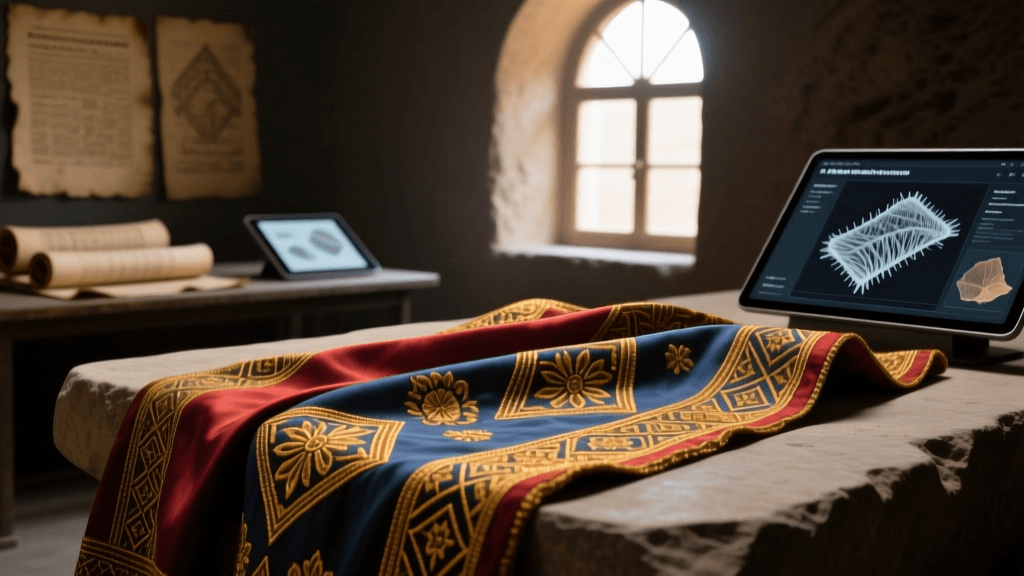
Physical handling of ancient textiles is strictly limited due to the degradation of protein-based fibers like silk. Exposure to light, humidity, and the physical stress of mounting a garment on a mannequin can cause irreversible damage. According to conservation guidelines published by the China National Silk Museum, digital archiving and virtual reconstruction have become the gold standard for academic research and exhibition planning in 2026.
For students of fashion history, 3D drape analysis provides an interactive learning environment. Researchers can adjust the warp and weft density of a virtual textile, alter the momme weight (a unit of measure for silk fabric weight), and observe how a Tang dynasty banbi (half-sleeve jacket) behaves when constructed from heavy brocade versus lightweight gauze. This level of empirical testing was impossible a decade ago. Today, academic syllabi integrate these digital tools to teach the physics of historical textiles, allowing students to understand the exact structural mechanics of the cross-collar right lapel (jiaoling youren) and the voluminous drape of Song dynasty pleated skirts.
Top Software Platforms for Academic Researchers in 2026
Universities such as the Beijing Institute of Fashion Technology and Donghua University have integrated specialized 3D fashion software into their core research methodologies. Below are the primary platforms driving Chinese fashion history education this year.
1. CLO 3D (2026 Academic Edition)
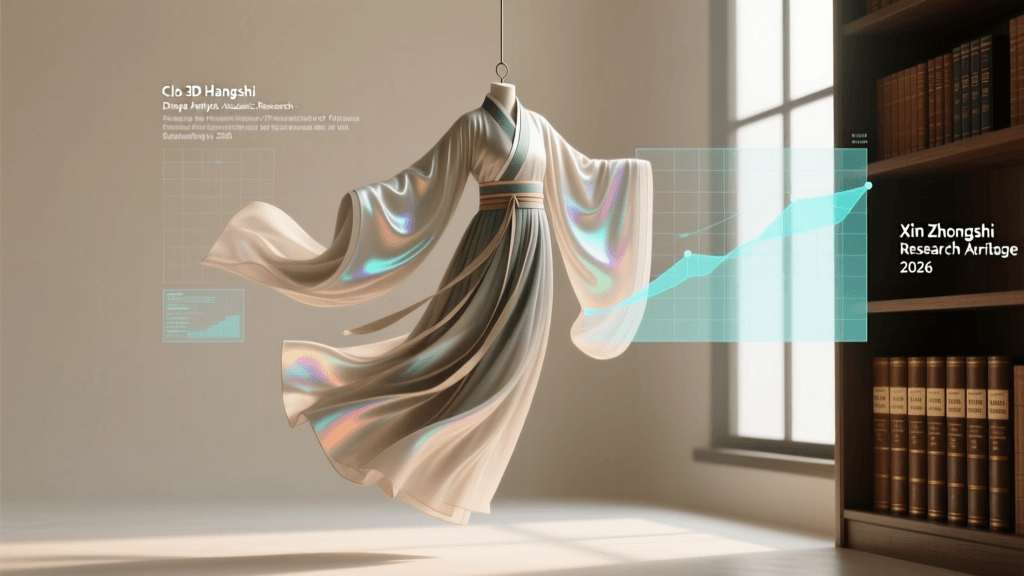
CLO 3D remains the undisputed leader in academic textile simulation. The 2026 update introduced a highly refined 'Silk Organza' and 'Ramie' physics preset, specifically calibrated for the unique stiffness and light-reflective properties of traditional Asian fibers. For researchers studying Hanfu, CLO's particle distance engine allows for the precise simulation of ultra-lightweight silk gauzes, accurately calculating the gravitational pull and wind resistance on wide, flowing sleeves. The software's ability to map historical 2D patterns onto 3D avatars while maintaining strict adherence to traditional zero-waste seam placements makes it indispensable for academic thesis work.
2. Marvelous Designer 2026
While often associated with the gaming and CGI industries, Marvelous Designer has found a robust niche in historical pattern drafting. Its 2026 iteration features enhanced tools for drafting complex, multi-layered garments, which is crucial for studying the layered aesthetics of the Ming dynasty mamianqun (horse-face skirt). Researchers use Marvelous Designer to test historical hypotheses regarding the depth of pleats and the placement of weighted hems, which were traditionally used to ensure the skirt draped correctly during movement.
3. VStitcher by Browzwear
Browzwear's VStitcher is heavily utilized in the commercial Xin Zhongshi sector, but its academic licensing program has made it a staple in university labs. VStitcher excels in its true-to-life fabric testing, allowing researchers to input exact tensile strength and shear data from surviving historical textile fragments. This empirical approach allows students to validate whether a newly discovered historical pattern draft would have actually functioned as a wearable garment or if it was purely ceremonial.
Software Comparison Chart for Textile Simulation
| Software Platform | 2026 Academic License Cost | Silk Gauze Simulation Accuracy | Flat Pattern Drafting Tools | Best Academic Use Case |
|---|---|---|---|---|
| CLO 3D | $499 / year | Exceptional (Advanced Particle Engine) | Advanced (Historical Seam Mapping) | Hanfu drape analysis and virtual museum exhibitions |
| Marvelous Designer | $399 / year | Good (Optimized for CGI Rendering) | Intermediate (Complex Layering) | Ming dynasty pleated skirt mechanics and digital media |
| VStitcher | $599 / year | Very Good (Empirical Data Input) | Advanced (Commercial Grading) | Xin Zhongshi commercial translation and tensile testing |
Case Study: Reconstructing the Mawangdui Plain Gauze Gown
One of the most prominent case studies in contemporary Chinese fashion history education is the virtual reconstruction of the Susha Danyi (Plain Gauze Gown) unearthed from the Mawangdui Han Tombs. The original artifact is a marvel of ancient engineering, weighing a mere 49 grams despite its expansive dimensions. Physical reproduction is incredibly difficult due to the loss of ancient sericulture techniques that produced such ultra-fine silk threads.
In 2026, graduate students utilize CLO Virtual Fashion Education modules to tackle this exact challenge. By inputting the precise historical data of the original textile—specifically a warp density of 58 to 64 threads per centimeter and a weft density of 40 to 50 threads per centimeter—students can simulate the exact drape of the 49-gram gown. The software's 2026 physics engine calculates the micro-interactions between the warp and weft threads, revealing how the ancient garment achieved its ethereal, floating silhouette without modern synthetic stiffeners. This digital reconstruction allows students to study the garment's structural integrity and seam allowances in a 360-degree virtual environment, providing insights that are invisible to the naked eye when viewing the artifact behind museum glass.
Bridging Academia and the Xin Zhongshi Movement
The academic rigor applied to 3D drape analysis is directly influencing the booming Xin Zhongshi (New Chinese Style) market. As modern consumers demand greater historical authenticity combined with contemporary wearability, fashion brands are increasingly collaborating with university research labs. The data generated by students analyzing Song dynasty minimalism or Tang dynasty structural volume is translated into modern commercial patterns.
For instance, understanding the exact drape and bias-cut behavior of historical silk crepes allows modern Xin Zhongshi designers to engineer garments that flatter contemporary body types while strictly adhering to traditional aesthetic philosophies. The academic research conducted in 2026 ensures that the Xin Zhongshi movement is not merely a superficial application of traditional motifs (like embroidery or frog buttons), but a deep, structural revival of Asian sartorial engineering. Universities are now offering specialized incubator programs where fashion history researchers and commercial design students co-create 3D-verified Xin Zhongshi collections, ensuring historical integrity from the digital prototype to the final physical garment.
Conclusion
The integration of 3D drape analysis into Chinese fashion history education represents a monumental leap forward for the preservation and evolution of Asian traditions. By treating historical garments as complex engineering marvels rather than mere static objects, academic researchers in 2026 are unlocking the secrets of ancient textile physics. As software capabilities continue to advance, the line between historical preservation and contemporary design will only blur further, ensuring that the profound legacy of Chinese fashion history remains a living, breathing, and highly relevant force in the global sartorial landscape.