Silk Road Textile Exchanges: 2026 Astana Samite AI Analysis
The Astana Cemetery: A Time Capsule of Silk Road Exchanges
The Silk Road was not merely a conduit for spices, precious metals, and philosophical texts; it was a vibrant, living artery of textile innovation and cross-cultural exchange. Among the most extraordinary archaeological sites illuminating this history is the Astana Cemetery, located in the arid Turfan Depression of Xinjiang, China. Serving as the necropolis for the ancient oasis city of Gaochang, Astana has yielded thousands of artifacts preserved in near-perfect condition by the extreme desert climate. For researchers and historians in 2026, Astana remains the ultimate time capsule, offering unparalleled insights into the garments, burial shrouds, and everyday textiles of the Sogdian merchants, Tang Dynasty officials, and local populations who traversed and settled along these legendary routes.
Unlike the humid environments of southern China that rapidly degrade organic materials, the Turfan basin's hyper-arid conditions have preserved delicate silk weaves, hemp sandals, and cotton blends for over a millennium. In 2026, the focus of archaeological textile research has shifted heavily toward the Sogdian samite silks found in these tombs. Samite, a luxurious weft-faced compound twill, represents a fascinating technological and aesthetic collision between Persian weaving traditions and Chinese silk production. Understanding these textiles is no longer just about cataloging fragments; it is about reconstructing the globalized economy of late antiquity and the early medieval period.
2026 Breakthroughs: AI and Multispectral Imaging in Textile Conservation
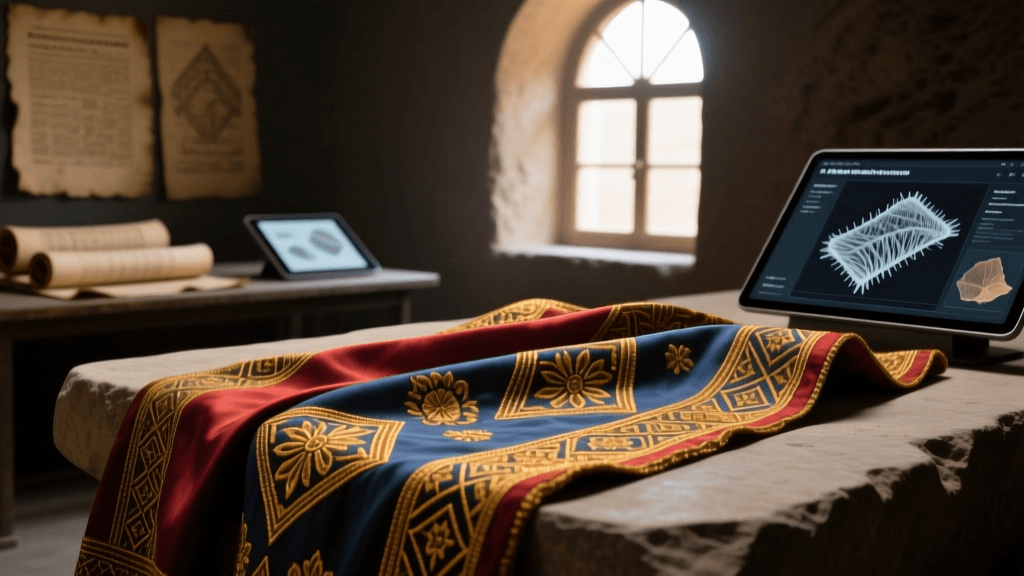
The year 2026 has marked a watershed moment in how we interact with fragile archaeological textiles. Traditional conservation methods, while vital for physical stabilization, often fall short when dealing with heavily fragmented or faded samite pieces. Today, leading conservation labs are deploying advanced Artificial Intelligence (AI) paired with multispectral imaging to digitally reconstruct lost patterns and identify faded dyes without touching the physical artifacts.
Multispectral imaging captures data across the electromagnetic spectrum, including ultraviolet and infrared wavelengths. When fed into specialized generative adversarial networks (GANs) trained on historical loom mechanics and Sogdian iconography, this software can predict and reconstruct missing sections of a textile with astonishing accuracy. For instance, a fragmented piece of samite featuring a partial 'pearl roundel' motif can be digitally completed, revealing the symmetrical confronting beasts or floral medallions that were originally woven into the fabric. This non-invasive digital restoration allows museums to exhibit the 'complete' visual impact of a garment alongside its fragile physical remains, providing the public with a vivid window into Silk Road fashion.
Decoding Sogdian Samite: Weave Structures and Motifs
To truly appreciate the textile exchanges of the Silk Road, one must understand the structural differences between indigenous Chinese silks and the imported or adapted Western weaves. Traditional Han Dynasty silks were predominantly warp-faced, meaning the longitudinal threads dictated the pattern and color. In contrast, Sogdian and Sasanian Persian weavers favored weft-faced structures, where the horizontal threads created the design. When Chinese weavers in the Tang Dynasty began producing samite to meet the demands of international trade and local elites, they had to fundamentally re-engineer their drawlooms.
| Feature | Traditional Han Warp Silk | Sogdian/Tang Samite (Weft-Faced) |
|---|---|---|
| Structural Basis | Warp-faced compound tabby or twill | Weft-faced compound twill |
| Pattern Visibility | Determined by warp threads | Determined by weft threads |
| Loom Requirements | Standard drawloom | Modified drawloom with multiple weft shuttles |
| Common Motifs | Cloud scrolls, geometric lattices, dragons | Pearl roundels, confronting boars, simurghs |
| Drape and Weight | Lightweight, fluid, high drape | Heavier, structured, stiffer drape |
The motifs found on Astana samites are a visual lexicon of Silk Road syncretism. The iconic 'pearl roundel'—a border of overlapping pearls enclosing a central figure—originated in Sasanian Persia but was eagerly adopted and adapted by Chinese weavers. Inside these roundels, one might find Central Asian boar heads, Hellenistic-inspired floral scrolls, or indigenous Chinese phoenixes, all woven into the same garment.
Fabric Drape Analysis: Samite vs. Traditional Warp Silks
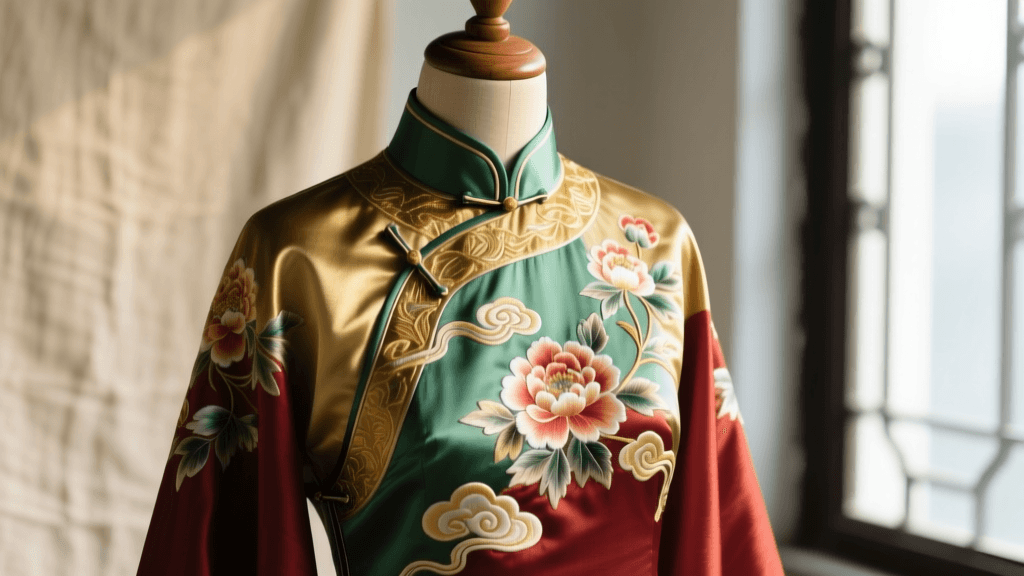
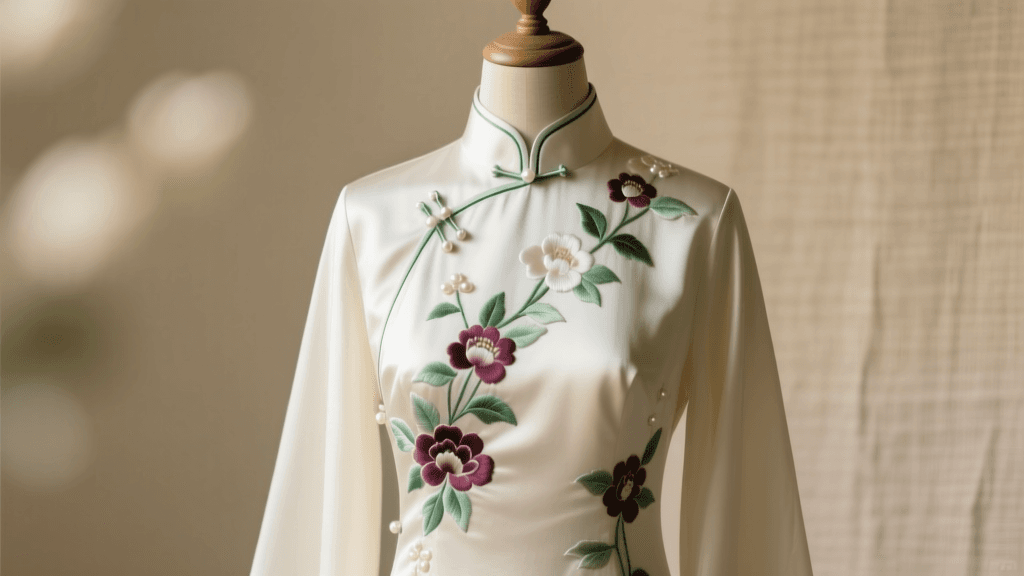
For modern designers and historians studying the Xin Zhongshi (new Chinese style) movement, understanding the fabric drape of ancient textiles is crucial for accurate historical reproduction and modern adaptation. In 2026, 3D physics engines used in digital fashion design allow us to simulate the exact drape of Astana samites compared to traditional warp silks.
Because samite utilizes a dense weft-faced twill structure, often incorporating metallic threads or thick, multi-ply silk yarns, it possesses a significantly higher grammage (weight per square meter) than standard habotai or charmeuse. This results in a structured, architectural drape. When used in traditional garments, samite does not cling or flow like water; instead, it holds its shape, creating pronounced folds and stiff silhouettes. This physical property made it highly desirable for heavy winter robes, formal court attire, and structured burial shrouds, as it conveyed a sense of monumental authority and wealth.
Tracing the Dyes: Madder, Indigo, and the Lapis Lazuli Trade
Beyond the weave, the colors of Astana textiles map the geographical reach of the Silk Road. In 2026, portable Raman spectroscopy and high-performance liquid chromatography (HPLC) are routinely used in the field to identify ancient dyestuffs. The vibrant reds found in many Astana samites are frequently traced to madder root (Rubia tinctorum), a dye native to the Mediterranean and Central Asia, rather than the indigenous Chinese safflower. Similarly, deep blues are often linked to true indigo, while rare, brilliant yellows and purples indicate the use of exotic resins and insect dyes traded from the Indian subcontinent.
Furthermore, the presence of lapis lazuli pigments in associated burial paintings and occasionally in specialized textile printing pastes highlights the deep economic ties between Turfan and the Badakhshan mines of modern-day Afghanistan. These chemical signatures prove that the Silk Road was not a single route, but a complex, multi-nodal web of resource exchange.
Travel Packing and Field Research: A 2026 Guide for Textile Historians
For researchers, conservators, and academic students planning to visit the Turfan region or the Xinjiang Regional Museum in Urumqi in 2026, proper preparation is essential. The extreme temperature fluctuations and high UV index of the Turfan basin require specialized travel packing to protect both yourself and your research equipment.
- Climate-Controlled Gear Cases: When transporting portable multispectral cameras or macro-photography lenses, use hard-shell cases with active humidity control. The ambient humidity in Turfan can drop below 10%, which can cause leather camera straps and certain rubber seals to crack.
- UV-Protective Field Wear: Pack lightweight, UPF 50+ linen or hemp blend clothing. These natural fibers offer excellent breathability and UV protection, aligning with the historical use of hemp in the region while providing modern sun safety.
- Digital Archiving Redundancy: Internet connectivity in remote archaeological sites can be unreliable. Always pack ruggedized, high-capacity SSDs (Solid State Drives) for daily backups of your high-resolution textile scans, ensuring your data is safe from both physical damage and cloud-sync failures.
Storage Maintenance for Modern Samite Reproductions
As the Xin Zhongshi movement continues to popularize historical garments, many collectors and enthusiasts are commissioning modern reproductions of Astana samite. Maintaining these heavy, structured textiles requires specific storage protocols to prevent fiber degradation and motif distortion.
- Avoid Hanging Heavy Weaves: Due to the high grammage of samite, hanging the garment on standard hangers will cause severe stress on the shoulder seams and warp threads over time. Always store heavy samite robes flat or rolled.
- Acid-Free Rolling: If rolling the garment, use an acid-free, archival-quality cardboard tube. Wrap the textile in unbleached, washed cotton muslin to allow the fibers to breathe while protecting them from dust and light.
- Climate Control: Store the textiles in an environment with a stable temperature of 65-70°F (18-21°C) and a relative humidity of 45-55%. Fluctuations in humidity can cause the silk fibers to expand and contract, leading to the eventual snapping of the tight weft threads.
Conclusion and Further Research
The Astana Cemetery continues to yield secrets, and the 2026 integration of AI and advanced spectroscopy ensures that these ancient Silk Road textiles are understood not just as beautiful relics, but as complex data points in a vast, ancient global network. For those looking to dive deeper into the primary sources and digital archives, the following authoritative resources are indispensable:
- The UNESCO Silk Roads Programme offers extensive historical context, interactive maps, and research papers detailing the cultural intersections of the ancient trade routes.
- The Metropolitan Museum of Art's Heilbrunn Timeline of Art History provides brilliant, peer-reviewed essays on the evolution of silk production and the aesthetic impact of Sogdian motifs on Tang Dynasty art.
- The International Dunhuang Project (IDP) remains the premier digital database for accessing high-resolution images, conservation reports, and archaeological data concerning textiles and manuscripts from the broader Silk Road region, including Turfan and Dunhuang.