Choosing the Perfect Tai Chi Uniform: Fabrics, Cuts, and Tradition
The Intersection of Mind, Body, and Textile
Taijiquan, commonly known in the West as Tai Chi, is far more than a sequence of graceful movements; it is a profound martial art and a moving meditation. According to Harvard Medical School, Tai Chi is often described as 'medication in motion' due to its profound benefits for balance, cardiovascular health, and stress reduction. However, to truly unlock the biomechanical and energetic benefits of this practice, the clothing you wear must serve as an extension of your body, not a restriction. Traditional practice wear is engineered to facilitate the unhindered flow of Qi (vital energy), accommodate deep stances, and regulate body temperature during slow, deliberate forms.
Whether you are a beginner stepping into your first morning practice in the park or an advanced martial artist preparing for a competition, understanding the anatomy, textiles, and tailoring of a Tai Chi uniform is essential. This guide breaks down the practical elements of traditional Chinese martial arts clothing, helping you select garments that honor tradition while supporting your physical practice.
Historical Roots: The Evolution of the Tai Chi Suit
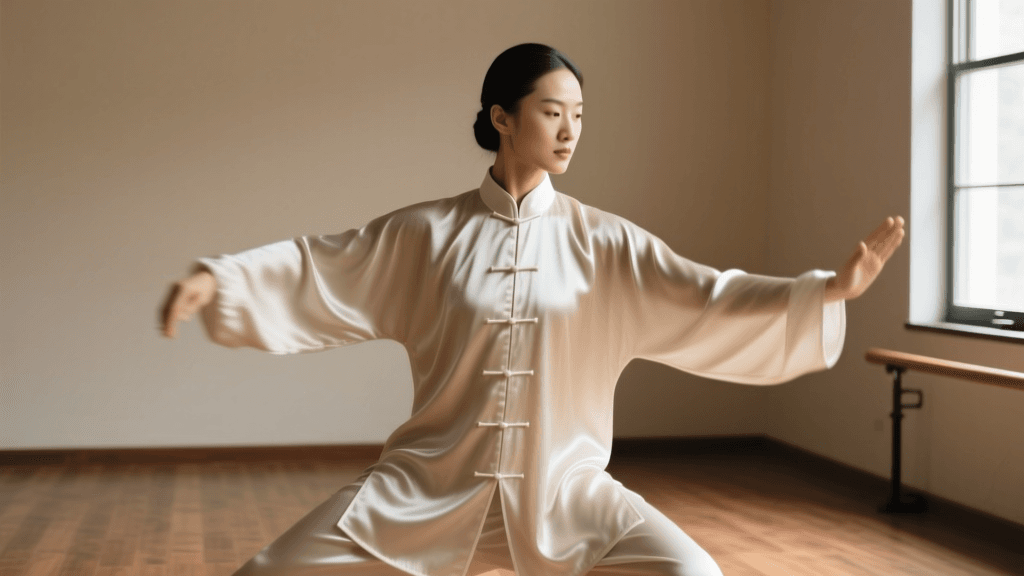
The modern 'Tai Chi suit' is not a direct replica of ancient battle armor or court dress, but rather a synthesis of traditional Chinese civilian clothing from the Qing Dynasty and early Republican eras. The iconic top, often featuring a mandarin collar and knotted frog buttons, is heavily influenced by the Tangzhuang (Tang suit) and the traditional Duijin (symmetrical front-opening jacket). These garments were designed for scholars and civilians, prioritizing comfort, modesty, and ease of movement over the rigid structures of formal court wear.
The National Center for Complementary and Integrative Health (NCCIH) notes that the slow, mindful movements of Tai Chi require a relaxed physical state to properly integrate breath and posture. Historically, Chinese martial artists trained in their everyday loose-fitting cotton or linen garments. Today, the standardized Tai Chi uniform retains this loose silhouette but incorporates modern tailoring techniques—such as reinforced seams and elasticized waistbands—to withstand the rigorous demands of daily practice, deep horse stances (Ma Bu), and sweeping leg kicks.
Fabric Analysis: Choosing the Right Material
The textile you choose directly impacts your thermoregulation and sensory feedback. While silk is the most visually striking and traditional choice, it is not always the most practical for heavy sweating or outdoor training in humid climates. Below is a comprehensive comparison of the most common fabrics used in Tai Chi and Wushu practice wear.
| Fabric Type | Weight / Specification | Pros | Cons | Best Use Case | Avg. Cost (USD) |
|---|---|---|---|---|---|
| Mulberry Silk | 16-19 Momme | Exceptional drape, temperature regulating, traditional aesthetic, glides over skin. | Requires delicate hand-washing, snags easily, expensive, shows sweat marks. | Indoor practice, demonstrations, competitions, morning forms. | $80 - $150+ |
| Ice Silk (Viscose/Spandex Blend) | 180-220 GSM | Cool to the touch, highly breathable, excellent stretch, machine washable. | Lacks the traditional matte texture, can cling when wet, less durable than cotton. | Summer outdoor practice, hot yoga studios, high-sweat sessions. | $35 - $60 |
| Brushed Cotton | 200-250 GSM | Durable, highly absorbent, softens with age, provides a grounded, heavy drape. | Retains moisture, slow to dry, can feel heavy in high humidity. | Winter practice, indoor dojo training, daily rigorous martial conditioning. | $40 - $75 |
| Ramie / Linen Blend | 150 GSM | Extremely breathable, naturally antibacterial, crisp traditional texture. | Wrinkles instantly, lacks stretch, can feel stiff against the skin initially. | Dry climates, meditative Qigong, casual park practice. | $50 - $90 |
The Biomechanics of the Cut: Why Fit Matters
As highlighted by the Mayo Clinic, the deep breathing and physical postures of Tai Chi require a relaxed body to maximize joint flexibility and muscle coordination. A poorly fitted garment can restrict the shoulder girdle or bind at the hips during deep stances, disrupting your alignment and focus.
The cut of a Tai Chi uniform is specifically designed to accommodate the unique biomechanics of Chinese martial arts. Unlike Western athletic wear, which often relies on compression and tight elastic to support muscles, Tai Chi wear relies on strategic volume and geometric tailoring.
Key Garment Features to Look For
- Dropped Shoulders and Wide Armholes: The shoulder seam should fall slightly off the natural shoulder line. This prevents the fabric from pulling up toward the neck when you raise your arms in postures like 'White Crane Spreads Its Wings'.
- Underarm Gussets: High-quality Tai Chi jackets and shirts feature diamond-shaped fabric inserts (gussets) under the armpit. This allows for a full range of overhead and lateral arm movement without lifting the entire hem of the shirt.
- Lantern Pants (Denglongku): Traditional Tai Chi trousers are wide through the thigh and seat to accommodate deep squats and sweeps, but they taper sharply at the ankle. This tapered cuff prevents the fabric from catching on your heel during stepping movements and helps visually 'ground' your stance.
- High Elastic Waistbands: Pants should sit at or slightly above the navel (the Dantian), secured by a wide, non-restrictive elastic band or a traditional drawstring. This keeps the lower back warm and supports the core without digging into the diaphragm during deep abdominal breathing.
Footwear: Grounding Your Practice
Your connection to the earth is paramount in Tai Chi. The transfer of force (Jin) begins at the feet, travels through the legs, is directed by the waist, and manifests in the hands. Therefore, wearing thick, cushioned running shoes is highly counterproductive; they dull your proprioception and destabilize your balance during single-leg stances.
Traditional Tai Chi shoes feature a flat, thin sole made of rubber or layered cloth, with a flexible canvas or leather upper. The lack of a heel drop ensures your spine remains naturally aligned and your weight is evenly distributed across the Yongquan (Bubbling Spring) acupressure point on the sole of the foot. For outdoor practice on rough concrete, look for modern martial arts sneakers with a thin, zero-drop rubber outsole (approx. 3mm-5mm thick) that offers abrasion resistance while maintaining ground feel. Indoor practitioners on smooth wood floors should opt for traditional cloth-soled shoes or specialized suede-bottom martial arts slippers to allow for safe pivoting without gripping the floor too aggressively.
Sizing, Measurements, and Cost Guide
Tai Chi uniforms are typically sized using Asian sizing standards, which run significantly smaller and shorter than Western equivalents. When ordering online, never rely on standard S/M/L designations. Instead, use a soft measuring tape to record the following:
- Chest/Bust: Measure around the fullest part. Add 4-6 inches to this measurement to ensure the jacket has the necessary 'ease' for chest expansion during deep breathing.
- Sleeve Length: Measure from the base of the neck, across the shoulder, and down to the wrist bone. Tai Chi sleeves should reach the wrist but not cover the hands.
- Inseam: Measure from the crotch to the ankle bone. Remember that Tai Chi pants are meant to rest just above the shoe, not bunch up on the floor.
Budgeting for Quality: A reliable, everyday cotton or ice-silk set will cost between $40 and $70. For competitions or formal demonstrations, invest in a 19-momme silk suit, which typically ranges from $100 to $180. Custom-tailored silk suits with hand-embroidered motifs (like dragons, plum blossoms, or Bagua symbols) can exceed $300.
Caring for Your Practice Wear
Proper maintenance extends the life of your garments and preserves their energetic integrity. Silk uniforms must be hand-washed in cold water using a pH-neutral detergent specifically designed for delicate fibers. Never wring silk; instead, roll it in a clean towel to absorb excess moisture and hang it to dry in the shade, as direct sunlight will degrade the protein fibers and cause fading. Cotton and ice-silk blends can generally be machine washed on a gentle cycle, but should always be air-dried to prevent the elastic waistbands and ankle cuffs from losing their recovery in the heat of a dryer. Store your practice wear folded neatly in a breathable cotton bag, treating the act of putting it on as a mindful transition from your daily life into your martial arts practice.