Nishijin-ori Silk: Crafting Traditional Kimono and Obi
The Legacy of Nishijin-ori Weaving
When exploring the rich tapestry of Asian traditions, few textile arts command as much reverence as Japanese silk weaving. At the pinnacle of this craft is Nishijin-ori, the legendary brocade weaving tradition of Kyoto. Originating over 1,200 years ago and solidified during the Onin War in 1467 when displaced weavers returned to the Nishijin district, this craft represents the zenith of kimono craftsmanship. According to the Nishijin Textile Center, the district remains the beating heart of Japan's luxury textile industry, producing the elaborate, multi-colored, and gold-threaded fabrics used for the most formal kimono and obi.
Unlike dyed textiles where patterns are applied to the surface of a finished cloth, Nishijin-ori is a yarn-dyed weaving technique. The threads are meticulously dyed before they ever touch the loom. This requires a master weaver to visualize the final pattern while managing thousands of individual warp and weft threads on complex Jacquard looms. The result is a reversible, deeply textured fabric that catches the light dynamically, making it the premier choice for high-end ceremonial garments.
Decoding Kimono Fabric Types: Chirimen, Tsumugi, and Rinzu
Understanding kimono craftsmanship requires a deep dive into the foundational silk weaves. While Nishijin produces elaborate brocades, the base fabrics of the kimono world generally fall into three distinct categories, each serving a specific aesthetic and functional purpose.
Tango Chirimen (Silk Crepe)
Chirimen is a lightweight, textured silk crepe characterized by its distinctive pebbled surface, known as shibo. This texture is created by using untwisted threads for the warp and highly twisted threads for the weft. When the fabric is woven and later washed in hot water, the weft threads contract, creating the signature crinkled surface. Tango Chirimen, produced in the Tango peninsula of Kyoto, is the gold standard for Yuzen dyeing. The texture absorbs dyes beautifully, resulting in the vibrant, painterly patterns seen on formal furisode and houmongi kimono.
Oshima Tsumugi (Pongee Silk)
At the opposite end of the spectrum is Tsumugi, a rustic, matte-finished pongee silk spun from silk noil or dupioni threads. The most famous iteration, Oshima Tsumugi from Amami Oshima, involves a grueling mud-dyeing process. Threads are bound with cotton according to a precise grid, dyed in iron-rich mud, and repeated dozens of times to achieve deep, colorfast blacks and browns. The Japan Kogei Association recognizes Oshima Tsumugi as a paramount traditional craft, noting that a single bolt can take up to a year to complete by hand.
Rinzu (Silk Damask)
Rinzu is a figured silk satin damask. It features a glossy, reflective surface with subtle, tone-on-tone woven patterns. Because the weave itself creates the design rather than surface dyeing, Rinzu exudes a quiet, understated luxury. It is heavily favored for wedding shiromuku and high-ranking formal wear, providing a luminous canvas that enhances the wearer's complexion.
Actionable Guide: Understanding the Tanmono (Fabric Bolt)
For collectors, tailors, and enthusiasts, understanding the tanmono (the standard kimono fabric bolt) is crucial for purchasing and alterations. Unlike Western tailoring, which cuts patterns from wide bolts of fabric and discards the scraps, the kimono is an exercise in zero-waste geometry.
- Standard Dimensions: A traditional tanmono measures approximately 36 to 38 centimeters (14.1 to 15 inches) in width and 11.5 to 12.5 meters (12.5 to 13.6 yards) in length.
- Construction: The kimono is constructed from straight, rectangular panels cut directly from this narrow bolt. Two body panels, two sleeve panels, two overlap panels, and a collar are sewn together using running stitches.
- Buying Advice: When purchasing vintage or new tanmono for custom tailoring, always verify the width. Modern Japanese demographics have shifted, and wider bolts (up to 40 cm) are sometimes produced for taller individuals. If the width is under 35 cm, it may only be suitable for children's garments or narrow accessories.
The Architecture of the Obi: Fukuro vs. Nagoya
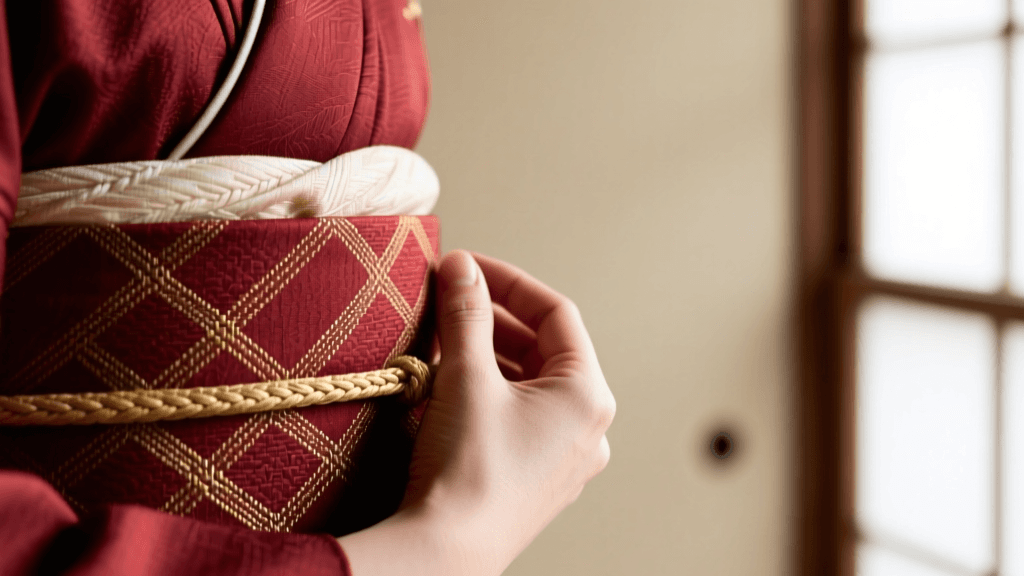
The obi is the sash that secures the kimono, but it is also the most expensive and heavily crafted component of the ensemble. Nishijin weavers dedicate their highest level of technical prowess to obi production, incorporating real gold and silver leaf, metallic threads, and intricate 3D relief weaving.
Fukuro Obi (The Formal Sash)
The Fukuro obi is the most formal sash worn today. It measures roughly 30 centimeters in width and 420 centimeters (over 13.7 feet) in length. Traditionally, it was woven as a tube (hence 'fukuro', meaning bag), but modern iterations are usually woven as a single, wide piece of heavy brocade and folded in half lengthwise, with a plain silk backing. A high-quality Nishijin Fukuro obi can weigh over a kilogram due to the density of the metallic threads and tight weave. It is essential for pairing with kurotomesode (married women's formal wear) and furisode (unmarried women's formal wear).
Nagoya Obi (The Semi-Formal Sash)
Invented in the 1920s for ease of wear, the Nagoya obi is pre-folded and stitched along one edge, measuring about 30 cm wide and 360 cm long. It is designed specifically to form the taiko musubi (drum knot) with minimal folding effort. While often less expensive than a Fukuro obi, Nishijin-woven Nagoya obi featuring tsuzure-ori (tapestry weave) remain highly prized collector's items.
Investment and Cost Breakdown
Investing in authentic Japanese silk requires an understanding of the market. Prices vary wildly based on the weaving technique, the purity of the silk, and the application of precious metals.
- New Nishijin Fukuro Obi: $1,500 to $8,000+. Pieces featuring kinkiran (gold leaf thread) and hand-punched Jacquard cards command premium prices.
- New Tango Chirimen Kimono (Undyed Bolt): $300 to $800, depending on the weight (measured in momme; 19 momme is standard, 25+ momme is luxury).
- Vintage Market: You can find exceptional, gently used Nishijin obi for $80 to $300 at specialized recyclers in Kyoto or online auction houses. Always check for 'shimi' (age spots) and weakened metallic threads.
Comparison Chart: Traditional Japanese Silk Weaves
| Fabric Type | Weave Structure | Surface Texture | Best Use Case | Relative Cost |
|---|---|---|---|---|
| Chirimen (Crepe) | Plain weave with twisted weft | Pebbled, matte, textured | Yuzen dyed kimono, everyday elegance | $$ |
| Tsumugi (Pongee) | Plain weave, spun silk noil | Slubby, rustic, matte | Casual wear, tea ceremony, winter | $$$ (High for Oshima) |
| Rinzu (Damask) | Satin weave with figured pattern | Glossy, smooth, reflective | Wedding kimono, formal undergarments | $$ |
| Nishijin Brocade | Complex Jacquard, multiple wefts | Heavy, raised, metallic | Fukuro obi, ceremonial outerwear | $$$$ |
| Sha / Ro (Gauze) | Leno weave, twisted warps | Sheer, breathable, open | Summer kimono (July/August) | $$$ |
Actionable Care and Storage Advice
Silk is a protein fiber that is highly susceptible to moisture, light, and improper storage. The Victoria and Albert Museum emphasizes that historical Japanese textiles require stringent climate control and specialized folding techniques to survive centuries. For modern collectors and wearers, the following actionable steps are mandatory:
- The Hon-Datami Fold: Never hang a kimono on a Western hanger. The weight of the wet or heavy silk will distort the shoulder seams. Always fold the kimono using the traditional hon-datami method, which aligns the seams and prevents permanent creasing.
- Tatoushi Paper: Store folded garments in tatoushi, which are acid-free, breathable paper envelopes specifically sized for tanmono dimensions. Never use plastic bags, as trapped humidity will cause rapid mold growth (kabi) and yellowing.
- Kiribako (Paulownia Boxes): For long-term storage, invest in a kiribako made of paulownia wood. Paulownia naturally regulates humidity and contains tannins that repel insects. Ensure the box is lined with acid-free paper.
- Airing Out (Mushiboshi): Twice a year, ideally during the dry, crisp days of late autumn or early winter, remove your kimono from storage. Unfold them and let them breathe in a shaded, well-ventilated room for a few hours. Never expose silk to direct sunlight, as UV rays will instantly degrade the protein structure and fade natural dyes.
- Stain Management: If you soil a chirimen or rinzu kimono, do not attempt to spot-clean it with water. Water leaves permanent rings on silk crepe. Take the entire garment to a specialized arai-hari (traditional kimono laundry) service, where the garment is completely unsewn, washed on wooden boards, stretched, and re-sewn.
By understanding the profound craftsmanship behind Nishijin-ori and the structural nuances of Japanese silk, collectors and practitioners can make informed investments. Whether you are acquiring a vintage Oshima Tsumugi for daily wear or commissioning a bespoke Nishijin Fukuro obi for a wedding, respecting the geometry, materials, and history of these garments ensures their survival for generations to come.