Authentic Chiton And Stola Reconstruction Guide 2026
Introduction to Classical Antiquity Garments in 2026
As we navigate the 2026 historical reenactment and classical festival season, the demand for meticulous, museum-quality garment reconstruction has never been higher. Whether you are preparing for a Hellenic cultural festival, a Nova Roma gathering, or an academic living history event, understanding the precise construction of ancient Mediterranean clothing is essential. The garments of ancient Greece and Rome were not merely functional; they were complex indicators of social status, citizenship, and cultural identity. This comprehensive guide focuses on the authentic reconstruction of the Greek chiton and the Roman stola and toga, providing actionable advice on textiles, measurements, and draping techniques tailored for modern enthusiasts and professional costumers in 2026.
The Greek Chiton: Doric and Ionic Variations
The chiton was the foundational garment for both men and women in ancient Greece. However, it is crucial to distinguish between the two primary styles: the Doric chiton (often associated with the peplos) and the Ionic chiton. According to the World History Encyclopedia, the transition between these styles reflected broader cultural shifts and trade influences across the Mediterranean.
The Doric Chiton (Peplos)
The Doric chiton is typically constructed from a single, large rectangular piece of heavy woolen fabric. The defining feature of the Doric style is the apoptygma—a deep overfold created by folding the top edge of the fabric down before draping it over the body. This overfold is pinned at the shoulders using large, straight bronze pins (fibulae) and belted at the waist. For an authentic 2026 reconstruction, avoid lightweight cottons. Instead, source a 100% wool flannel or a lightweight worsted wool weighing between 180 and 220 GSM (grams per square meter). The fabric must have enough body to hold the structural folds of the apoptygma without collapsing.
The Ionic Chiton
In contrast, the Ionic chiton is made from a much wider, lighter piece of fabric, traditionally linen. Rather than a single overfold, the top edge is pinned at multiple intervals along the shoulders and upper arms, creating the illusion of sleeves. This style requires a fine, semi-sheer linen, ideally in the 120 to 140 GSM range. When reconstructing the Ionic chiton for contemporary festivals, ensure the width of the fabric is at least twice the wearer's arm span to allow for the characteristic deep, flowing kolpos (the bloused effect created when the garment is belted and pulled up).
The Roman Stola and Toga: Symbols of Virtue and Citizenship
Roman dress was highly codified. While the tunica was the everyday base layer, the stola and toga carried immense legal and social weight. The Metropolitan Museum of Art notes that Roman garments were deeply tied to social status, with specific borders, colors, and draping styles reserved for distinct classes.
Reconstructing the Stola
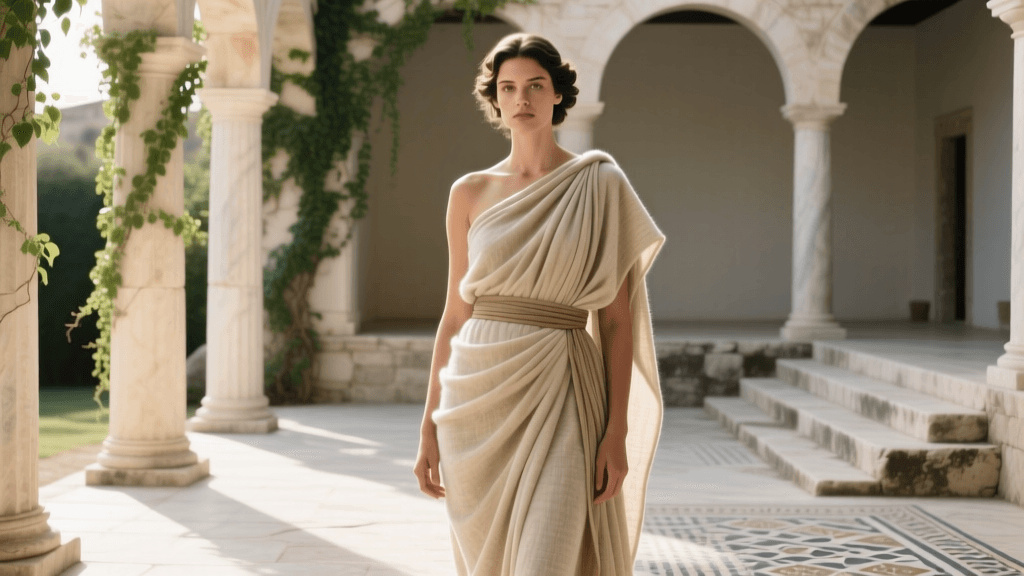
The stola was the traditional overdress of the respectable Roman married woman (matrona). It was worn over the base tunica intima and was characterized by its instita—the straps or bands that suspended the garment from the shoulders. To reconstruct a stola in 2026, use a medium-weight linen or a fine wool blend. The garment should be cut significantly wider than the wearer's hips to allow for deep folds. The bottom hem often featured a decorative border (limbus), which can be replicated using tablet-woven trim or a contrasting dyed wool band. Ensure the stola is long enough to reach the ankles, as a high-water hemline is a common anachronism in amateur reenactments.
The Complexity of the Toga
The toga is perhaps the most misunderstood garment in classical history. It is not, as often depicted in mid-century cinema, a simple rectangular bedsheet wrapped around the body. The authentic Roman toga was a massive, semicircular piece of woolen cloth, measuring up to 6 meters (20 feet) along its curved edge. World History Encyclopedia emphasizes the complex draping required to achieve the sinus (the deep curved fold across the chest) and the umbo (the decorative knot or pouch of fabric at the waist). For a 2026 reconstruction, you must cut your wool in a true semicircle. Use a lightweight, tightly woven wool suiting (around 200 GSM) to prevent the garment from becoming unbearably heavy and hot during summer festivals.
Textiles, Dyes, and Sourcing in 2026
Authenticity in classical dress extends beyond the cut of the fabric to its very fibers and colors. In 2026, the historical textile market has matured, making naturally dyed, period-accurate fabrics more accessible than ever.
- Wool: Seek out undyed, naturally pigmented sheep wool or wool dyed with madder root (for reds and oranges) and weld (for yellows). Avoid synthetic dyes, which reflect light differently and look artificial in outdoor sunlight.
- Linen: Opt for slubby, unevenly spun linen that mimics ancient hand-loomed textiles. Bleached, perfectly uniform modern linen looks distinctly out of place in a classical setting.
- Silk: While rare and incredibly expensive in antiquity, wild silk (tussah) is an acceptable substitute for elite Roman or Hellenistic reconstructions, provided it is left in its natural golden-brown hue.
Essential Accessories: Fibulae, Zonas, and Footwear
No classical garment is complete without its functional hardware. Modern safety pins are strictly forbidden in high-level 2026 reenactments. Instead, invest in cast bronze fibulae (brooches). For the Doric chiton, you will need large, sturdy bow brooches capable of piercing multiple layers of heavy wool. For the Ionic chiton, smaller penannular or simple ring brooches are more appropriate.
Belts, or zonas, were typically made of woven wool tape, leather, or tablet-woven bands. They were essential for creating the kolpos (the bloused overhang). Footwear should consist of leather krepides (strapped sandals) for Greek dress, or calcei (enclosed leather shoes) for Roman patrician dress. Ensure all leather is vegetable-tanned and dyed with natural oils or plant extracts, avoiding modern chrome-tanned leathers with plastic-like finishes.
Step-by-Step Draping Guide for the Ionic Chiton
Draping is an art form that requires practice. Follow these steps to achieve a historically accurate Ionic chiton drape:
- Preparation: Lay your wide linen rectangle flat. Fold the top edge down by about 10-15 cm if you desire a slight overfold, though this is optional for the Ionic style.
- First Pinning: Pin the top corners together at the wearer's shoulders, leaving a gap for the head. Use straight bronze pins, pushing them through the fabric and securing them with a small bead or leather stopper on the back to prevent tearing.
- Arm Openings: Continue pinning the front and back layers together at equal intervals along the upper arms, creating the signature 'sleeves'. Leave the final side seam open from the armpit down to allow for movement.
- Belt and Blouse: Tie a woven wool zona tightly around the natural waist. Pull the fabric up and over the belt to create the kolpos, adjusting the hemline so it falls evenly at the ankles or calves.
Garment Comparison Chart
Use the following table to quickly reference the core differences between classical garments when planning your 2026 festival wardrobe.
| Garment | Cultural Origin | Primary Fabric | Recommended GSM | Draping Complexity |
|---|---|---|---|---|
| Doric Chiton (Peplos) | Greek | Wool | 180 - 220 | Low |
| Ionic Chiton | Greek | Linen | 120 - 140 | Medium |
| Stola | Roman | Linen / Fine Wool | 150 - 180 | Low |
| Toga | Roman | Wool | 180 - 200 | Very High |
Conclusion
Reconstructing the chiton, stola, and toga requires a departure from modern tailoring conventions and an embrace of the draped, fluid aesthetics of antiquity. By prioritizing historically accurate textiles, mastering the geometry of the semicircular toga, and utilizing authentic bronze hardware, you can achieve a level of historical fidelity that honors the rich textile traditions of the ancient Mediterranean. As the 2026 festival season unfolds, let your garments serve as a living, breathing testament to classical craftsmanship.