Schuhplattler Dance Tracht 2026: Festival Costume Guide
The Kinetic Demands of the 2026 Folk Dance Festival Season
As the 2026 European folk dance festival circuit approaches—from the grand Gaufeste in Bavaria to international heritage showcases across North America—the demand for authentic Alpine Tracht (traditional dress) has reached new heights. However, for performers of the Schuhplattler, the vigorous and rhythmic slapping dance of the Alpine regions, wearing the correct garment is not merely a matter of historical aesthetics. It is an acoustic, kinetic, and structural necessity. The traditional costumes worn for this specific folk dance are known as Tanztracht (dance tracht), and they differ significantly from both everyday historical wear and the mass-produced tourist costumes found in Munich souvenir shops.
In 2026, the revival of authentic, region-specific Tracht is heavily supported by cultural preservation societies. According to the Bayerischer Trachtenverband (Bavarian Tracht Association), there has been a 30% increase in youth enrollment in traditional dance groups over the last three years, driving a renewed focus on historically accurate, movement-friendly garments. This guide breaks down the exact construction, materials, and sourcing requirements for authentic Schuhplattler dance costumes in 2026.
Men's Dance Tracht: The Acoustics of Lederhosen
The defining feature of the male Schuhplattler is the percussive slapping of the thighs, knees, and shoes. To achieve the sharp, resonant clack required for stage performances, the Lederhosen (leather breeches) must be constructed from very specific materials. Fast-fashion or tourist-grade Lederhosen are typically made from thick, chrome-tanned cowhide or pigskin. These materials are too stiff, absorb the impact of the slap, and produce a dull, muffled thud that is entirely unsuitable for folk dance competitions.
Leather Selection and Tanning
Authentic dance Lederhosen must be crafted from Hirschleder (deer leather) or Bocksleder (goat leather). More importantly, the leather must undergo Sämischgerbung, a traditional, labor-intensive brain-and-oil tanning process that yields a remarkably soft, breathable, and durable hide. For the Schuhplattler, the leather is typically milled to a thickness of 0.8mm to 1.0mm. This specific gauge allows the leather to act almost like a drum skin, amplifying the sound of the dancer's hands while remaining flexible enough for deep squats and high kicks.
In 2026, commissioning a bespoke pair of Sämischgerbung Hirschleder Kurze Lederhosen (short breeches) from master makers in regions like Miesbach or Garmisch-Partenkirchen will cost between €1,100 and €1,600. While this is a significant investment, these garments are designed to last a lifetime, molding to the dancer's body and developing a unique, irreplaceable patina through sweat and stage dust.
Embroidery and Suspenders
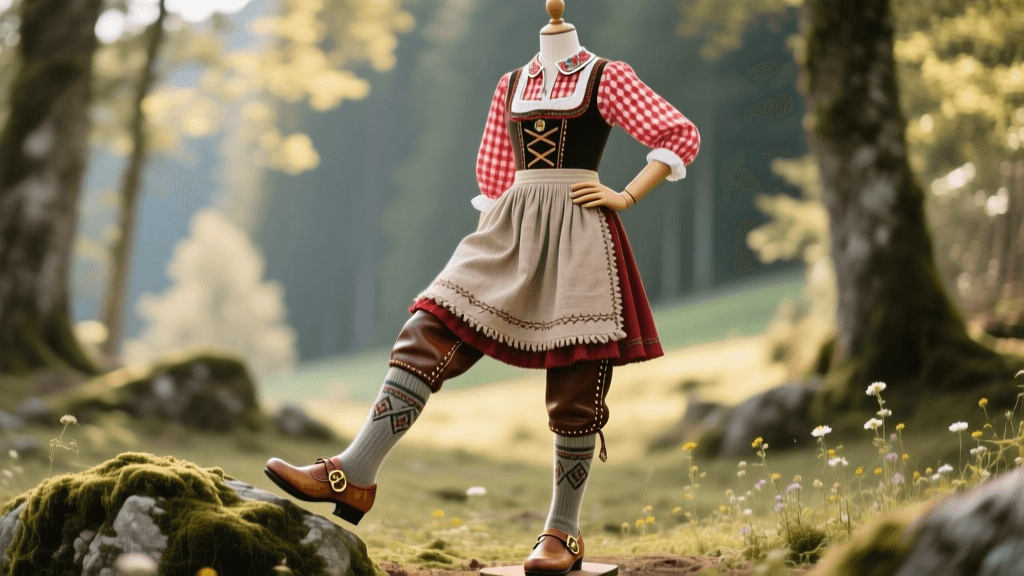
The embroidery (Stickerei) on dance Lederhosen is traditionally done with heavy silk or linen thread in floral or hunting motifs specific to the dancer's home valley (Gau). For dance, the suspenders (Hosenträger) must feature an H-back or cross-back construction with a secure leather cross-piece to ensure the heavy breeches remain perfectly positioned during leaps and spins, preventing the waistband from shifting and disrupting the dancer's center of gravity.
Women's Dance Tracht: Engineering the Spinning Dirndl
While the men provide the percussion, the women provide the visual spectacle of the Schuhplattler through the Drehen (the rapid spinning). The female dance costume is a masterclass in textile engineering, designed to create a perfect, gravity-defying bell shape when the dancer reaches top rotational speed.
The Skirt (Rock) and Hem Circumference
A standard fashion Dirndl skirt might have a hem circumference of 2 meters. A true Tanztracht skirt requires a minimum of 3.5 to 4 meters of hem circumference. The fabric—typically a lightweight, high-twist wool (Alpenwolle) or a fine cotton-linen blend—is heavily gathered or cartridge-pleated at the waistband. This immense volume is what allows the skirt to flare out horizontally during the spin. In 2026, master tailors emphasize cutting the skirt panels on the bias to ensure the drape remains fluid and doesn't tangle around the dancer's legs when she abruptly stops.
The Bodice (Miedl) and Petticoat (Unterrock)
The centrifugal force generated during a 30-second spin sequence is immense. The bodice of a dance Dirndl must be heavily structured. Unlike fashion Dirndls that rely on light seams, a Tanztracht bodice is reinforced with spiral steel boning and heavy canvas interfacing to provide torso support and prevent the garment from riding up. Beneath the skirt, a specialized cotton petticoat (Unterrock) with a stiffened ruffled hem is mandatory. The petticoat catches the air, pushes the outer wool skirt outward, and protects the expensive outer fabric from friction against the dancer's stockings.
Footwear and Stage Grip
Footwear is critical for safety and performance on the wooden stages typical of European folk festivals. Men wear Haferlschuhe, traditional Alpine shoes characterized by their side-lacing and low profile. For dance, the soles must be made of thick, uncoated leather or fitted with specific low-profile rubber grips to prevent slipping on polished wooden floors while still allowing the dancer to pivot. Women wear Trachtenschuhe with a moderate, sturdy block heel (no higher than 4cm) and a secure ankle strap. Pump-style Dirndl shoes are strictly forbidden in competitive dance due to the high risk of the shoe flying off during a spin.
Comparison: Authentic Tanztracht vs. Tourist Costumes
Understanding the difference between genuine performance wear and commercial costumes is vital for any dancer or festival organizer in 2026. Below is a structural comparison:
| Feature | Tourist / Party Costume | Authentic Tanztracht (Dance Tracht) |
|---|---|---|
| Men's Leather | Chrome-tanned cowhide/pigskin; stiff, dull sound. | Sämischgerbung deer/goat leather; 0.8mm thick, resonant clack. |
| Women's Skirt Hem | 1.5 to 2 meters; limited movement, tangles easily. | 3.5 to 4 meters; cartridge-pleated, engineered for centrifugal flare. |
| Bodice Structure | Lightweight seams, fashion boning; shifts during movement. | Heavy canvas interfacing, steel boning; anchors the torso securely. |
| Apron (Schürze) | Polyester; slippery, tied loosely for aesthetics. | Cotton or silk; tied tightly with a flat knot to prevent tripping. |
| 2026 Price Range | €80 - €250 (Full set) | €1,500 - €3,500+ (Full bespoke set) |
Commissioning Custom Tracht for the 2026 Season
If you are outfitting a dance group or commissioning a personal Tanztracht for the 2026 festival season, time is your most critical resource. Master tailors and leatherworkers in the Alpine regions are currently experiencing unprecedented demand. Lead times for bespoke Lederhosen and hand-pleated Dirndl skirts are averaging 7 to 9 months. To ensure your garments are ready for summer Gaufeste, orders must be placed by early autumn of the preceding year.
When taking measurements for a dance Dirndl, it is crucial to measure the dancer while she is in a seated position and while her arms are raised, ensuring the bodice does not restrict breathing or shoulder mobility. For Lederhosen, the inseam must be measured precisely to ensure the hem hits exactly at the knee cap, allowing the leather to be pulled up slightly above the knee during the thigh-slapping sequences. The Trachtenkulturzentrum Bezirk Oberbayern offers extensive regional guidelines and directories of certified Tracht tailors (Trachtenschneider) who adhere to historical construction methods.
Care and Maintenance of Performance Tracht
Performance Tracht endures extreme physical stress, sweat, and friction. Proper maintenance is essential to preserve the acoustic properties of the leather and the structural integrity of the wool. Sämischgerbung leather is uniquely washable—a trait born from its historical use in hunting and labor. After a heavy festival weekend, Lederhosen can be gently hand-washed in lukewarm water with a specialized leather soap or mild curd soap. They must never be exposed to direct heat or sunlight; instead, they should be massaged and stretched by hand while damp to maintain their softness, then air-dried in a shaded, well-ventilated room.
Wool skirts must be brushed with a natural bristle brush after every performance to remove stage dust and sweat salts, which can degrade the wool fibers over time. They should be stored on wide, padded hangers to maintain the pleat structure, never folded, as deep creases can weaken the fabric and disrupt the aerodynamic flow of the skirt during the spin. By respecting the engineering and history behind these garments, dancers in 2026 can ensure their performances are as authentic and visually breathtaking as the traditions they represent.