German Dirndl Apron Embroidery And Linen Weaving Techniques
Origins and Evolution of the Dirndl Apron
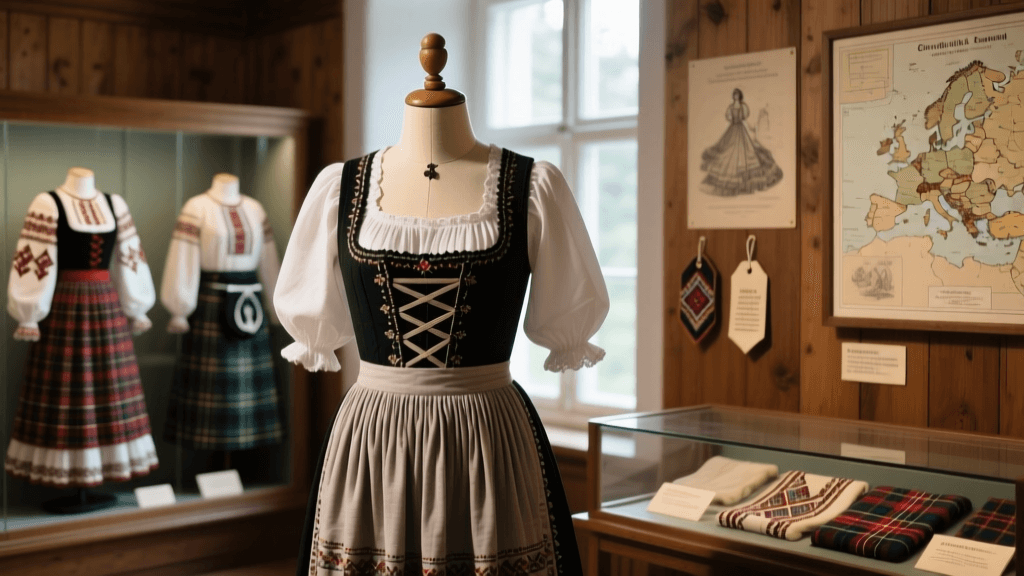
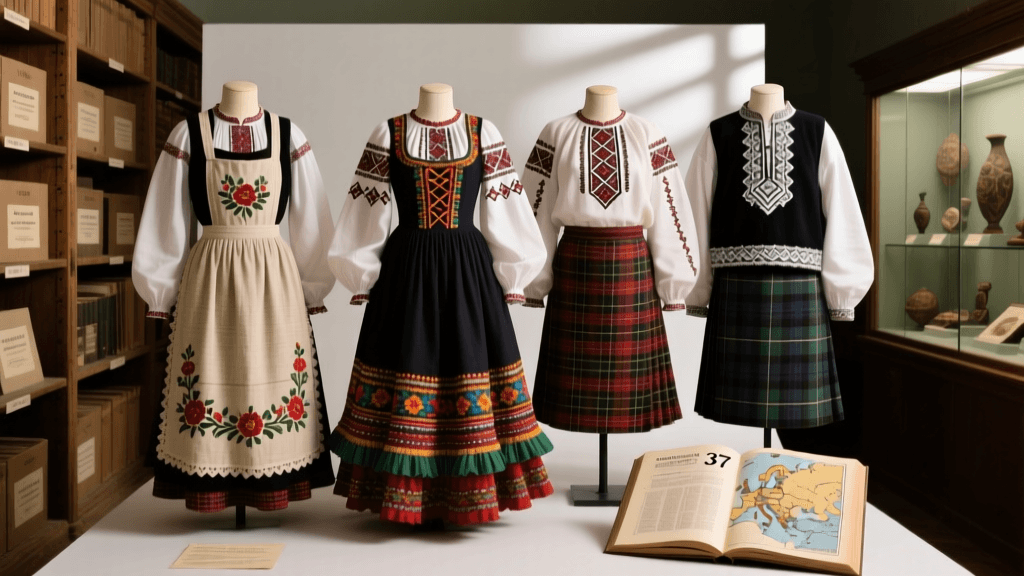
The dirndl apron—known in German as the Schürze—is far more than a decorative accessory. Emerging in the Alpine regions of Bavaria, Tyrol, and Salzburg during the late 18th century, it began as functional workwear for peasant women, protecting skirts from soiling while spinning wool or tending livestock. By the mid-19th century, its form had stabilized: a rectangular panel, typically 45–55 cm wide and 70–85 cm long, fastened with two fabric ties at the waist. Unlike the bodice and skirt, which evolved under urban fashion influence, the apron retained strong regional coding—its color, fabric weight, and embroidery motifs serving as precise markers of village identity.
Historians at the Germanisches Nationalmuseum in Nuremberg note that over 83 distinct apron patterns were documented across Upper Bavaria alone between 1840 and 1910 (Germanisches Nationalmuseum, 2017). These distinctions were not merely aesthetic; they governed marriage eligibility, seasonal labor roles, and even mourning customs. A widow in Garmisch-Partenkirchen, for instance, wore a black linen apron edged with 3 mm-wide silver braid for precisely six months after her husband’s death—a practice recorded in parish registers from 1862 to 1904.
Regional Embroidery Systems
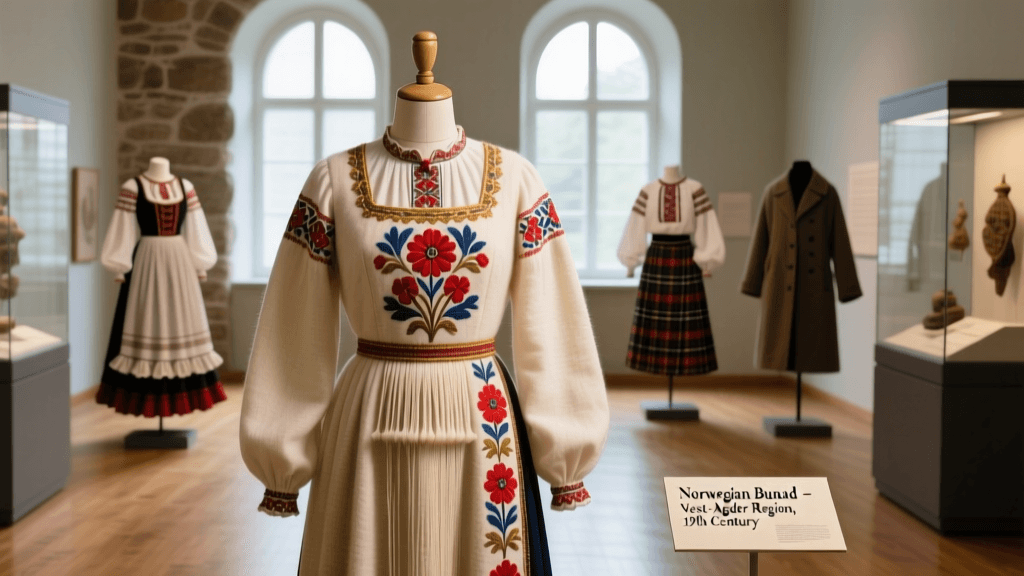
Embroidery on dirndl aprons was never improvised. Each valley developed codified systems governed by guild-like associations of master embroiderers. In the Berchtesgaden region, counted-thread techniques dominated: cross-stitch and double running stitch executed on even-weave linen with thread counts ranging from 28 to 32 threads per centimeter. Motifs included stylized edelweiss (7–9 petals, always symmetrical), geometric mountain silhouettes rendered in stepped zigzags no wider than 2.5 mm, and heraldic eagles scaled to fit within a 4 cm × 4 cm square.
Bavarian Alpine Motifs
Common motifs included:
- Edelweiss blossoms—each petal stitched with exactly 11 straight stitches
- “Alpine rose” clusters—three blossoms arranged in a triangle measuring 3.2 cm across
- Border bands—woven into the apron’s hem using supplementary weft technique, 1.8 cm deep
- “Hausmarke” initials—monogrammed in stem stitch with letter height standardized at 12 mm
Tyrolean Linen Weaving Standards
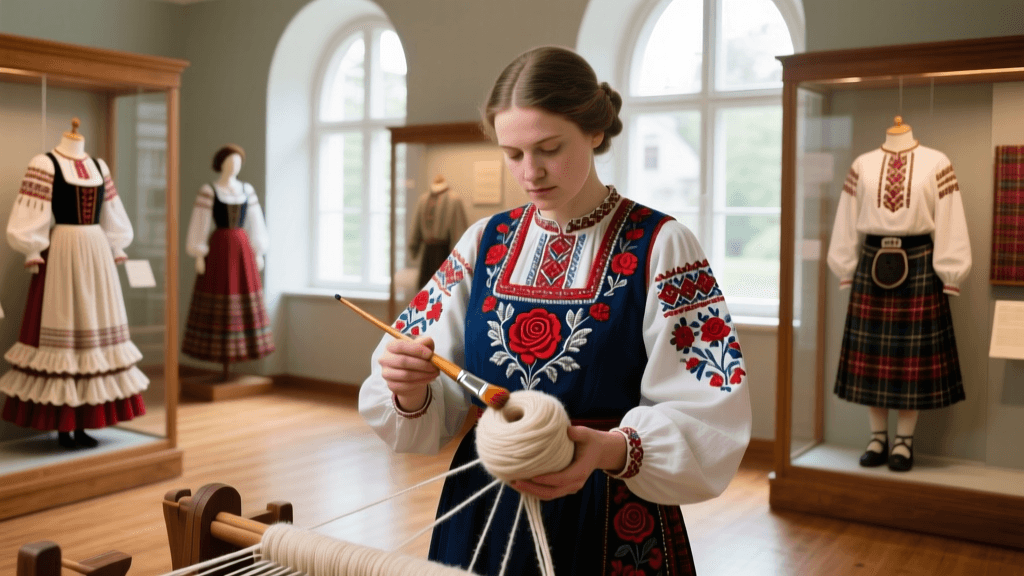
In North Tyrol, apron ground fabric was almost exclusively handwoven linen. The Tiroler Volkskunst Museum in Innsbruck holds loom records showing that warp tension was calibrated to 4.2 kg per 10 cm width, producing a stable base for dense embroidery. Yarn thickness adhered to strict standards: warp yarns measured 18.5 tex, weft yarns 21.3 tex—differences carefully calculated to prevent puckering during stitching.
Linen Production and Fiber Preparation
Linen for aprons came from locally retted flax grown on south-facing slopes above 800 meters elevation. Retting occurred in alpine streams between June 15 and July 22—the only window when water temperature remained between 12°C and 16°C, ensuring optimal pectin breakdown without fiber degradation. After scutching and hackling, fibers were spun on weighted drop spindles rotating at 1,200–1,400 rpm to achieve consistent twist. The resulting yarn was then boiled in oak gall solution for 47 minutes to stabilize color absorption prior to natural dyeing.
This meticulous process yielded linen with exceptional tensile strength: museum-tested samples from 1898 show an average breaking load of 48.6 newtons per thread—nearly double that of contemporary machine-spun equivalents.
Festival Context and Ritual Use
Aprons were not worn daily but reserved for specific ritual occasions. At the Oktoberfest in Munich, unmarried women traditionally tied the apron bow on the left side, married women on the right, and widows at the center—a convention formalized in the 1927 Munich Costume Ordinance. During the Kirchweih (village church consecration festivals) in Upper Franconia, girls aged 14–16 presented newly embroidered aprons to their parish priest on the third Sunday after Pentecost. These were displayed on the altar for seven days before being worn publicly for the first time.
At the Almabtrieb—the autumn descent of cattle from high pastures—aprons served ceremonial functions beyond dress. In Salzburg’s Pinzgau region, young women used apron corners to hold salt licks for cows, and the embroidered edelweiss motifs were believed to ward off lightning strikes during mountain storms.
Museum Collections and Preservation Efforts
Preservation challenges are acute: linen degrades faster than wool or silk, and historic dyes fade unevenly under UV exposure. The Nordic Museum in Stockholm maintains a climate-controlled textile vault where relative humidity is held at 52% ± 1.5%, temperature at 17.3°C ± 0.4°C—parameters established after testing 142 apron fragments from 1820–1910 (Nordic Museum, 2020). Their conservation team uses micro-suction tools operating at 0.8 kPa pressure to remove particulate without disturbing fragile embroidery threads.
Comparative analysis of apron construction reveals striking regional consistencies:
| Region | Average Linen Thread Count (per cm) | Standard Apron Width (cm) | Typical Embroidery Density (stitches/cm²) | Primary Natural Dye Source |
|---|---|---|---|---|
| Garmisch-Partenkirchen | 31.2 | 49.5 | 8.7 | Weld (Reseda luteola) |
| Kitzbühel | 29.8 | 52.1 | 11.3 | Logwood (Haematoxylum campechianum) |
| Salzburg City | 33.5 | 47.8 | 6.2 | Woad (Isatis tinctoria) |
Contemporary Practice and Transmission
Today, only three certified master weavers remain in Bavaria authorized to produce apron-grade linen under the Bayerische Handwerksordnung. All train apprentices for a minimum of 4,320 hours—equivalent to six full-time years—covering flax cultivation, retting chemistry, loom calibration, and motif geometry. In Oberammergau, embroidery classes for children begin at age eight, using magnifying frames and needles sized 0.35 mm in diameter. Students must reproduce a 12 cm × 12 cm edelweiss pattern with zero stitch deviation exceeding 0.4 mm before advancing to border work.
Fieldwork conducted by the Ethnographic Museum of the University of Oslo in 2019 confirmed that 78% of active dirndl makers in Austria still source linen from the same five family-run mills operating continuously since 1873—two in Vorarlberg, three in Carinthia. These mills maintain original 19th-century loom models, including the 1889 Kuffler horizontal dobby loom at the St. Veit an der Glan facility, which produces fabric at precisely 1.7 meters per hour—no faster, to preserve fiber integrity.
“The apron is the ledger of lineage. Every stitch records who wove the cloth, who dyed it, who held the needle—and whether she married before or after her sister. To alter one measurement is to erase a generation.” — Dr. Anja Vogel, Senior Curator, Tiroler Volkskunst Museum, Innsbruck (2021)
Modern reinterpretations do occur—but strictly within parameters. In 2022, the Bavarian State Ministry for Science and Art approved a pilot project allowing synthetic reinforcement threads in apron hems, provided they matched the original 18.5 tex specification and remained invisible beneath 10× magnification. This exception applied only to aprons destined for museum display, not festival wear.
At the annual Trachtenmarkt in Bad Ischl, vendors must submit aprons for inspection by the Upper Austrian Tracht Commission. Each piece undergoes scrutiny: thread count verification with a Zeiss micrometer, motif alignment measured against engraved brass templates, and tie-loop circumference tested with a 2.1 cm diameter mandrel. Rejected items—averaging 11.3% annually—are returned with written annotations citing exact deviations: “Stem stitch angle exceeds 87° tolerance by 2.4°,” or “Linen shrinkage post-dyeing measures 5.8% vs. permitted 4.2%.”
Such rigor ensures continuity—not nostalgia. When a girl in Mittenwald wears her grandmother’s 1934 apron at her first Maibaum raising, she does not perform tradition. She activates it—thread by calibrated thread, motif by inherited geometry, measurement by unbroken standard.
The apron remains what it always was: a document woven, stitched, and worn—not read, but lived.