Xiangyunsha Silk: China's Intangible Heritage Fabric Guide
The Legacy of Xiangyunsha: Mud, Sun, and Silk
In the pantheon of traditional Chinese textiles, few fabrics possess the mystique, structural complexity, and profound connection to the earth as Xiangyunsha (香云纱), also known globally as Gambiered Canton Gauze. Originating in the Shunde district of Foshan in Guangdong province, this extraordinary silk is not merely woven; it is cultivated through a rigorous, weather-dependent alchemy of botanical dyes, mineral-rich river mud, and relentless subtropical sunlight. Recognized as a National Intangible Cultural Heritage of China in 2008, Xiangyunsha represents a pinnacle of artisanal dedication, where the creation of a single bolt of fabric requires the synchronized efforts of dozens of craftspeople and the cooperation of the natural elements.
To understand the magnitude of this craft, one must look at the broader historical context of Chinese silk production. As noted by the Metropolitan Museum of Art, Chinese silk weaving and dyeing techniques have evolved over millennia, transitioning from exclusive imperial monopolies to sophisticated regional specialties that reflect local geographies and botanies. Xiangyunsha is a perfect embodiment of this regional specialization, relying entirely on the unique iron-rich mud of the Pearl River Delta and the tannin-heavy tubers native to the岭南 (Lingnan) region.
The preservation of such highly specialized, labor-intensive crafts aligns perfectly with the principles outlined by UNESCO's Intangible Cultural Heritage frameworks. It is not just the physical fabric that is protected, but the generational knowledge of the artisans who understand the precise viscosity of the mud, the optimal angle of the sun, and the exact duration of the drying process.
The 14-Step Artisan Process: How Gambiered Gauze is Made
The creation of authentic Xiangyunsha is a grueling 14-step process that can only be executed between the months of April and October. The intense sunlight and high humidity of the Guangdong summer are non-negotiable prerequisites for the chemical reactions that give the silk its signature properties. The process is broadly divided into three phases: botanical dyeing, mud coating, and finishing.
Phase 1: The Botanical Dyeing (Shuliang Immersion)
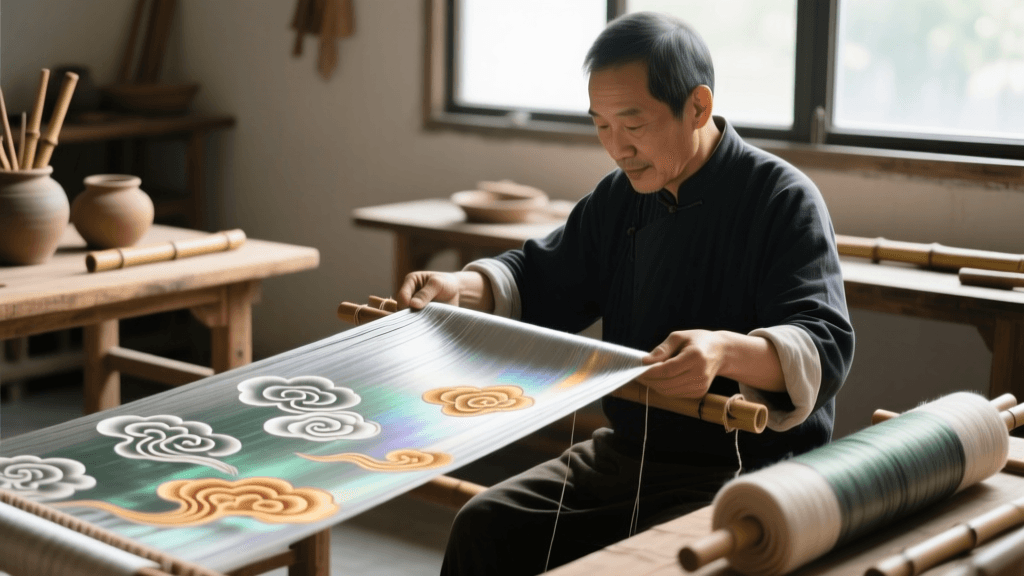
The foundation of Xiangyunsha is the Shuliang (薯莨) yam, a tuber rich in tannins and reddish-brown pigments. Artisans crush the tubers to extract a dark, astringent juice. Plain white silk gauze or satin is then immersed in this juice. However, a single dip is nowhere near sufficient. The silk must be dipped, wrung out by hand, and laid flat on grassy fields to dry in the blazing sun. This cycle of dipping and sun-drying is repeated up to 30 times over several days. The tannins gradually bond with the silk proteins, transforming the pristine white fabric into a deep, warm terracotta or rust color. The sun's UV rays act as a catalyst, fixing the botanical dye into the fibers.
Phase 2: The Mud Coating (The Alchemical Reaction)
This is the most critical and visually spectacular phase, unique to Xiangyunsha. Artisans harvest dark, silty mud from the bottom of the Pearl River Delta's unpolluted waterways. This specific mud is highly rich in iron ions. In the late afternoon, when the sun's intensity begins to wane, the mud is mixed with water to create a thick slurry. The tannin-dyed silk is laid out, and the mud is swept evenly across one side of the fabric using wide brushes or bare hands. Within minutes, a profound chemical reaction occurs: the iron in the mud reacts with the tannins in the silk to form a dark, lustrous, water-resistant compound. The side coated in mud turns a rich, metallic black-brown, while the underside remains the original rust-terracotta.
Phase 3: Washing, Resting, and Finishing
After the mud has reacted, the fabric is washed in the clean river water to remove the excess silt, leaving only the chemically bonded dark pigment. The silk is then dried one final time and stored in a dark, cool warehouse for at least six months. This resting period, known as 'sleeping,' allows the fabric's colors to mature, the fibers to soften, and the signature crackle pattern (龟裂纹, guilieming) to naturally develop on the dark surface.
Identifying Authentic Heritage Silk: A Buyer's Comparison
As the global demand for traditional Hanfu and luxury heritage garments has surged, the market has been flooded with chemical imitations of Xiangyunsha. These mass-produced alternatives use synthetic dyes and chemical coatings to mimic the two-toned appearance of genuine Gambiered Canton Gauze, but they lack the breathability, structural memory, and skin-nourishing properties of the authentic craft. When sourcing fabric for traditional garments, it is vital to know how to distinguish the heritage artisan product from factory-made replicas.
| Feature | Authentic Xiangyunsha | Chemical Imitation |
|---|---|---|
| Surface Texture | Smooth, supple, develops a natural 'crackle' pattern over time | Uniform, often stiff, coated feel with no natural aging |
| Color Profile | Deep brown/black top, rust/terracotta underside | Uniform color on both sides, or painted-on two-tone effect |
| Acoustics | Distinct rustling 'scroop' sound when walking or moving | Muffled, silent, or artificially crinkly |
| Scent | Faint earthy, herbal, or sweet potato aroma | Chemical, synthetic dye, or plastic odor |
| Water Resistance | Naturally repels water on the dark side due to mud-tannin bond | Absorbs water immediately or relies on synthetic sprays |
| Price (per meter) | $100 - $300+ USD | $15 - $40 USD |
Sourcing and Pricing: Navigating the Market
Acquiring authentic Xiangyunsha requires an understanding of its artisanal constraints and market pricing. Because the fabric is entirely dependent on the summer sun, production halts entirely during the winter months, creating a natural scarcity. When purchasing directly from heritage mills in Shunde or authorized high-end textile dealers, buyers should expect to pay between $100 and $300 USD per meter, with highly complex jacquard weaves or satin bases commanding prices at the upper end of this spectrum.
Standard bolts of Xiangyunsha are typically woven to a width of 114cm (45 inches) or 140cm (55 inches). When calculating yardage for a traditional garment, always account for the width. For a standard Ming Dynasty Mamianqun (horse-face skirt), you will need approximately 3 to 4 meters of 140cm wide fabric, depending on the desired pleat depth and the wearer's waist measurement. For a tailored Qipao or a Song Dynasty Beizi (long outer jacket), 2.5 to 3 meters is generally sufficient. Always request a 'heritage certification' tag from the seller, which many legitimate Shunde workshops now provide to combat counterfeiting.
Garment Applications: Hanfu and Qipao Tailoring
Xiangyunsha is prized by tailors of traditional Chinese clothing for its unique 'bone' or structural memory. Unlike standard mulberry silks that drape fluidly and cling to the body, Xiangyunsha has a crisp, architectural quality. This makes it the premier choice for garments that require structural integrity, such as the wide, standing collars of Ming Dynasty robes, the structured pleats of a Mamianqun, or the precise, geometric tailoring of a vintage-style Qipao. Furthermore, the fabric is naturally antibacterial, highly breathable, and exceptionally cooling, making it the ultimate luxury textile for humid summer climates.
Preservation and Care of Mud-Dyed Silk
Caring for Xiangyunsha requires a departure from standard silk maintenance. The mud-tannin coating is durable but sensitive to alkaline environments and extreme friction. To preserve the heritage integrity of your garment, follow these actionable care protocols:
- Washing: Hand wash exclusively in cool water (below 30°C or 86°F). Never use standard laundry detergents, which are highly alkaline and will strip the tannin coating. Use a neutral pH silk wash or a mild baby shampoo.
- Drying: Never wring or twist the fabric, as this will permanently damage the silk fibers and cause the dark coating to flake. Gently press the water out between two clean towels and hang to dry in a shaded, well-ventilated area. Direct sunlight during the drying phase of a finished garment will cause uneven fading.
- Ironing: Xiangyunsha rarely requires ironing if hung properly while damp. If necessary, use a low-heat steam setting and always place a cotton pressing cloth between the iron and the dark side of the fabric to prevent scorching the mud-dye.
- Storage: Store in a breathable cotton garment bag in a cool, dry place. Avoid plastic bags, which can trap moisture and cause the natural dyes to mildew.
Supporting the Artisans of Shunde
The survival of Xiangyunsha relies entirely on the continued patronage of conscious consumers and the dedication of the aging artisan population in Shunde. The physical toll of the mud-coating process is immense, and finding young apprentices willing to endure the grueling summer labor is an ongoing challenge for heritage workshops. By investing in authentic, ethically sourced Gambiered Canton Gauze, buyers do more than acquire a luxury textile; they actively fund the transmission of an irreplaceable intangible cultural heritage. Institutions like the Victoria and Albert Museum have long recognized the importance of preserving historical Chinese textiles, but it is the modern wearer who keeps the living tradition breathing, walking, and evolving in the contemporary world.