Traditional Chinese Wedding Attire: Qun Kua and Xiu He Fu Guide
The Renaissance of Traditional Chinese Wedding Attire
For decades, the quintessential image of a Chinese wedding involved a bride in a Western-style white gown and a groom in a tailored suit. However, a profound cultural renaissance has swept across China and its global diaspora, bringing traditional ceremonial attire back to the forefront of matrimonial celebrations. Modern couples are increasingly embracing garments like the Qun Kua (裙褂), Xiu He Fu (秀禾服), and historically accurate Hanfu to honor their heritage. According to the Metropolitan Museum of Art's Heilbrunn Timeline of Art History, traditional Chinese dress has always served as a profound visual language, communicating social status, cosmology, and ceremonial importance through color, silhouette, and motif.
This guide delves into the intricate world of Chinese ceremonial and wedding attire, offering actionable advice on sourcing, fitting, and budgeting for your own traditional celebration.
Decoding the Qun Kua and Xiu He Fu
While both garments are predominantly red and heavily embroidered, they originate from different regional traditions and possess distinct silhouettes, histories, and price points.
Qun Kua (裙褂): The Cantonese Masterpiece
The Qun Kua is a two-piece ensemble consisting of a tailored jacket (Kua) and a straight, pleated skirt (Qun). Originating in the Guangdong region, it is the gold standard for traditional Cantonese and Hokkien weddings. The defining feature of a Qun Kua is its embroidery, specifically Chao Xiu (Chaozhou embroidery), which utilizes metallic gold and silver threads couched onto red silk.
The value of a Qun Kua is determined by its embroidery density, known as Kua Huang (褂皇). A true Kua Huang features 100% embroidery density, meaning the base red silk is completely obscured by metallic threads, giving the garment a stiff, armor-like majesty. Other tiers include Kua Hou (90% density) and Xiao Wu Fu (50-70% density).
- Motifs: Dragons and phoenixes (Long Feng Cheng Xiang) represent the balance of yin and yang. Bats symbolize five blessings, while pomegranates denote fertility.
- Cost: Authentic, hand-embroidered Kua Huang garments range from $8,000 to over $20,000 USD. Lesser densities range from $3,000 to $6,000 USD.
- Timing: Handmade pieces require 6 to 12 months of lead time. Many families opt to rent heirloom-quality Kua Huang sets for $1,500 to $3,000 for the wedding day.
Xiu He Fu (秀禾服): The Modern Cinematic Favorite
Unlike the ancient lineage of the Qun Kua, the Xiu He Fu is a relatively modern invention. It was popularized by the 2001 television drama Orange Turned Red, worn by the character Xiu He. It features a looser, A-line silhouette with a flared skirt (often incorporating elements of the traditional horse-face skirt, or mamianqun) and wider, bell-shaped sleeves.
Because it is less restrictive and more forgiving on the figure, the Xiu He Fu has become the most popular choice for mainland Chinese weddings, particularly for the morning tea ceremony and bridal games.
- Motifs: While dragons and phoenixes are common, Xiu He Fu frequently features peonies (wealth and honor), lotuses (purity), and butterflies (romance).
- Cost: Mass-produced or machine-embroidered sets are highly accessible, ranging from $300 to $1,500 USD. High-end, hand-embroidered bespoke sets can reach $4,000 USD.
- Timing: Ready-to-wear options are available immediately; bespoke orders take 1 to 3 months.
Hanfu Wedding Ceremonies: The Zhou and Ming Dynasty Revivals
Driven by a massive youth-led cultural movement—widely covered by international outlets such as BBC Culture's coverage on the Hanfu movement—many couples are now opting for historically accurate Hanfu ceremonies, bypassing the Qing-dynasty-influenced Qun Kua entirely.
Ming Dynasty Elegance: Fengguan Xiapei
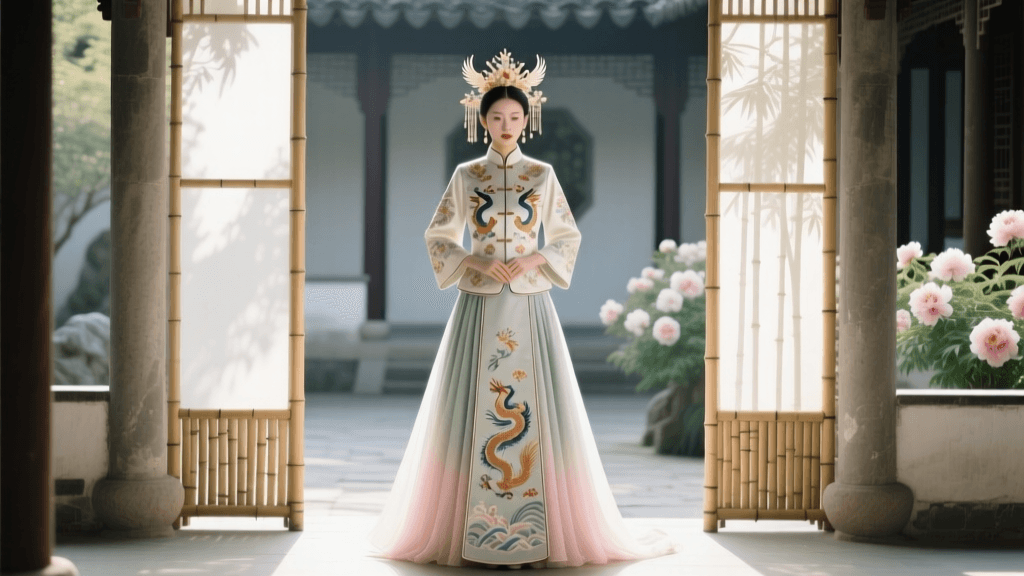
The Ming Dynasty bridal attire is the epitome of classical Chinese romanticism. The bride wears a Fengguan Xiapei (Phoenix Crown and Rosary). The crown is an elaborate metalwork headdress adorned with kingfisher feathers (or modern silk alternatives), pearls, and gold filigree. The garment itself is typically a deep crimson or navy blue cross-collared robe with woven gold cloud patterns.
Zhou Dynasty Solemnity: Juebian and Xuanxun
For couples seeking extreme historical antiquity, the Zhou Dynasty Xuanxun ceremony attire is profoundly solemn. Eschewing the vibrant reds of later eras, Zhou ceremonial wear features black and deep crimson, representing the heavens and the earth. The groom wears a Juebian cap, and the attire is characterized by flowing, unadorned silk lines that emphasize ritual purity over ostentatious display.
Practical Guide: Sourcing, Fitting, and Budgeting
Planning a traditional Chinese wedding wardrobe requires meticulous attention to detail. The preservation of these intricate textile arts is heavily documented by institutions like the Victoria and Albert Museum's Chinese collections, which highlights the unparalleled skill of regional embroidery guilds that historically supplied bridal courts. To honor this craftsmanship, modern buyers must approach the process with patience.
Essential Measurements
Unlike Western gowns that rely on corsetry, traditional Chinese jackets require precise flat-pattern measurements. When ordering bespoke, provide your tailor with:
- Shoulder Width: Measured from the edge of one shoulder bone to the other.
- Bust & Waist: Measured over the undergarments you intend to wear on the day.
- Sleeve Length: For Xiu He Fu, measure from the shoulder to the desired bell-sleeve drop (often past the wrists).
- Jacket & Skirt Length: The jacket should end precisely at the hip bone, while the skirt sits high on the natural waist.
Accessories and Styling
The garment is only half the equation. Budget an additional 15-20% of your attire cost for accessories:
- Footwear: Red silk embroidered flats or traditional wooden-soled platform shoes. Avoid Western heels, as they disrupt the drape of the pleated skirt.
- Hairpieces: Gold filigree hairpins, jade combs, and red velvet tassels. For Ming Hanfu, a rented replica Phoenix Crown costs around $200-$500.
- Props: A folding fan with calligraphy or a red silk handkerchief to hold during the tea ceremony.
Comparison Chart: Choosing Your Ceremonial Attire
Use the table below to determine which traditional garment best aligns with your wedding vision, budget, and timeline.
| Feature | Qun Kua (Cantonese) | Xiu He Fu (Modern/Cinematic) | Ming Dynasty Hanfu |
|---|---|---|---|
| Silhouette | Straight, tailored jacket; A-line pleated skirt | Looser jacket; wide flared bell sleeves; voluminous skirt | Cross-collared wide-sleeve robe; layered skirts |
| Embroidery | Dense metallic couching (Gold/Silver) | Mixed silk and metallic threads; varied motifs | Woven brocade (Zhuanghua) or subtle gold applique |
| Lead Time | 6 - 12 Months (Handmade) | 1 - 3 Months (Bespoke) or Immediate (Retail) | 3 - 6 Months (Specialist Hanfu Tailors) |
| Avg. Purchase Cost | $3,000 - $20,000+ | $300 - $4,000 | $400 - $2,500 |
| Best For | Formal Tea Ceremonies; Cantonese/Hokkien families | Pre-wedding photos; morning bridal games | Historical enthusiasts; outdoor temple ceremonies |
Conclusion
Choosing traditional Chinese wedding attire is an investment in cultural continuity. Whether you opt for the armor-like majesty of a Cantonese Qun Kua, the romantic flair of a Xiu He Fu, or the historical gravitas of Ming Dynasty Hanfu, these garments transform a wedding day into a living museum of Asian heritage. By understanding the distinct craftsmanship, budgeting accurately for bespoke embroidery, and allowing ample time for tailoring, modern couples can honor centuries of textile artistry while celebrating their unique love story.