Traditional Chinese Wedding Attire Guide And Costs
The Renaissance of Chinese Bridal Fashion
The modern Chinese wedding is a beautiful amalgamation of Eastern heritage and Western convenience. While the white Victorian-style gown remains a staple for the main ceremony, there has been a massive resurgence in traditional Chinese wedding attire for tea ceremonies, banquets, and morning gate-crashing games. Brides are increasingly looking to their roots, investing in garments that are not just clothing, but wearable heirlooms rich in cultural symbolism. According to cultural historians and institutions like the Metropolitan Museum of Art, the mastery of Chinese silk weaving and embroidery has been a cornerstone of societal status and ceremonial life for millennia. Today, that legacy continues in the intricate goldwork and vibrant red silks of modern bridal wear.
Navigating the world of Chinese bridal fashion can be overwhelming. Between the loose-fitting Xiuhefu, the heavily embroidered Qungua, the form-fitting Qipao, and the historically accurate Hanfu, how do you choose? This comprehensive guide breaks down the styles, costs, symbolism, and actionable planning timelines you need to curate your perfect ceremonial wardrobe.
Decoding the Garments: Xiuhefu, Qungua, Qipao, and Hanfu
1. Xiuhefu (秀禾服)
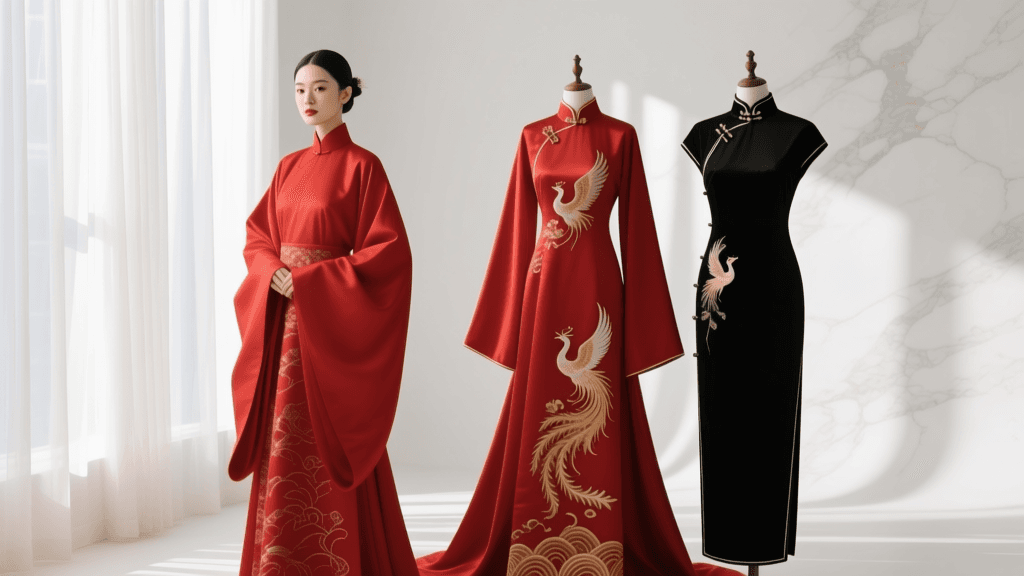
The Xiuhefu is currently the most popular choice for the traditional Chinese tea ceremony. Interestingly, it is not a direct historical artifact but rather a modern adaptation inspired by the costumes worn in the 2001 television drama Juzi Hong Le (Orange Turned Red). Characterized by a loose, A-line skirt (often a pleated mamianqun or horse-face skirt) and a wide-sleeved, relaxed-fit top, the Xiuhefu is incredibly forgiving and comfortable. Its voluminous skirt makes it easy to sit cross-legged on the bed during morning games or kneel during the tea ceremony. Embroidery is typically scattered across the red silk base, featuring gold and silver threads, and the garment is generally more affordable than a Qungua.
2. Qungua (裙褂)
Originating from the Guangdong and Fujian provinces, the Qungua (or Kwa) is the pinnacle of Cantonese bridal fashion. It consists of a fitted jacket and a straight, wrap-around skirt. Unlike the Xiuhefu, a true Qungua is defined by its dense, near-total coverage of metallic embroidery. In fact, the quality and price of a Qungua are classified by the density of its embroidery: from Xiao Wu Fu (30% embroidery) to the ultra-premium Gua Huang (95-100% embroidery, where the red silk base is barely visible). Because of the dense metallic threadwork, a high-quality Qungua can weigh between 5 to 8 kilograms (11 to 17 lbs), requiring the bride to maintain excellent posture. As noted by China Highlights, the Qungua is often treated as a family heirloom, passed down from mother to daughter, symbolizing the continuity of the family line.
3. Qipao / Cheongsam (旗袍)
The Qipao is a symbol of 1920s Shanghai glamour. Form-fitting, elegant, and featuring a high mandarin collar with intricate knotted buttons (pankou), the Qipao is less about ancient tradition and more about mid-century modern sophistication. Brides typically opt for a red, floor-length Qipao with a high slit for the wedding banquet or evening reception, as it allows for ease of movement while mingling with guests. Custom tailoring is an absolute must for a Qipao, as the silhouette leaves no room for error in the fit.
4. Hanfu (汉服)
With the rise of the Hanfu movement among Chinese youth, many brides are opting for historically accurate Ming Dynasty wedding attire, known as Fengguan Xiapei (Phoenix Crown and Cloud Scarf). This ensemble features a vibrant, multi-layered robe with wide, sweeping sleeves, a pleated skirt, and a heavily ornate jade-and-gold phoenix crown. As documented by Encyclopedia Britannica, the Hanfu revival is deeply tied to a modern reclamation of Han ethnic identity, making this a deeply meaningful choice for brides who prioritize historical authenticity over regional Cantonese customs.
Comparison Chart: Choosing Your Bridal Silhouette
| Garment Type | Silhouette & Fit | Embroidery Density | Weight | Best Ceremony Phase | Avg. Cost (USD) |
|---|---|---|---|---|---|
| Xiuhefu | Loose, A-line skirt, relaxed top | Low to Medium (10-50%) | Light (1-2 kg) | Morning games, Tea Ceremony | $200 - $1,500 |
| Qungua | Fitted jacket, straight wrap skirt | High to Total (50-100%) | Heavy (4-8 kg) | Tea Ceremony, Main Portraits | $1,500 - $10,000+ |
| Qipao | Form-fitting, high slit, high collar | Medium (Targeted motifs) | Very Light (0.5 kg) | Banquet, Evening Reception | $300 - $2,000 |
| Hanfu (Ming) | Layered, wide sleeves, sweeping | Medium (Woven/Brocade) | Medium (2-4 kg) | First Look, Cultural Portraits | $250 - $3,000 |
The Language of Threads: Embroidery Symbolism
When selecting your garment, you are not just choosing colors; you are choosing blessings. Traditional Chinese wedding garments rely heavily on the ancient art of silk embroidery to convey specific wishes for the couple's future. Understanding these motifs will help you select a garment that aligns with your personal hopes for your marriage.
- The Dragon and Phoenix (龙凤): The ultimate symbol of marital harmony. The dragon represents the groom (Yang), and the phoenix represents the bride (Yin). Together, they signify a balanced and prosperous union.
- Peonies (牡丹): Known as the 'King of Flowers,' peonies represent wealth, honor, and romance.
- Bats (蝙蝠): The Chinese word for bat (fu) sounds identical to the word for good fortune. Five bats embroidered together represent the 'Five Blessings': longevity, wealth, health, virtue, and a peaceful death.
- Pomegranates (石榴): Bursting with seeds, the pomegranate is a subtle but powerful wish for fertility and a large, thriving family.
- Lotus (莲花): Rising cleanly from muddy waters, the lotus represents purity, harmony, and a smooth transition into married life.
Actionable Planning: Timelines, Fittings, and Budgets
Sourcing traditional Chinese wedding attire requires a different timeline than buying a Western wedding dress. Hand-embroidered garments, particularly a bespoke Qungua from Chaozhou (the embroidery capital of China), can take master artisans anywhere from three to eight months to complete. Here is your actionable planning checklist to ensure a stress-free process.
6 to 8 Months Before the Wedding
- Decide on Renting vs. Buying: A bespoke, high-density Qungua can cost upwards of $5,000 to $10,000. If this exceeds your budget, look into high-end bridal rental boutiques in your local Chinatown or specialized online retailers. Xiuhefu and Hanfu are much more accessible for direct purchase ($200-$800) via platforms like Etsy or specialized Asian bridal sites.
- Order Bespoke Qipaos: If you are having a Qipao custom-made for the reception, finalize your design and fabric now. Handmade pankou (frog buttons) and precise tailoring require multiple fittings.
3 to 4 Months Before the Wedding
- First Fitting: For custom garments, attend your first fitting. Pro Tip: Always bring the exact undergarments and the specific heel height of the shoes you plan to wear. A Qipao's hemline and a Qungua's skirt length will look drastically different with a 2-inch heel versus a 4-inch heel.
- Sourcing Accessories: Begin sourcing your gold jewelry. In Cantonese tradition, brides wear heavy gold pig necklaces, dragon-and-phoenix bangles, and jade pendants. If these are family heirlooms, have them professionally cleaned and appraised now.
1 Month Before the Wedding
- Final Fitting & Weight Check: If you have ordered a heavy Qungua, practice walking and sitting in it. The weight of the metallic threads can cause the jacket to pull backward. Ensure your tailor has added internal structural supports or hidden loops to distribute the weight onto your shoulders rather than your neck.
- Garment Care Prep: Purchase specialized, wide-shouldered wooden hangers. Never hang a heavy, embroidered Qungua on a standard wire or velvet hanger, as the weight will tear the silk base fabric over time.
Hair, Makeup, and the Bridal Crown
Your traditional attire must be matched with appropriate styling. The Xiuhefu and Qungua are typically paired with an elaborate updo adorned with gold hairpins, pearl tassels, and red silk ribbons. If you opt for the Ming Dynasty Hanfu, you must budget time and money for a Fengguan (Phoenix Crown). These crowns are incredibly heavy, often weighing several kilograms, and require a highly skilled hairstylist who knows how to use structural padding and U-pins to secure the crown safely to your head without causing tension headaches during a 10-hour wedding day.
Makeup for traditional Chinese attire leans toward classic, high-contrast elegance. Think porcelain skin, sharp winged eyeliner, and a bold, classic red lip that matches the crimson silk of your dress. Avoid overly bronzed or contour-heavy makeup, which can clash with the flat, vibrant red and gold palette of the garments.
Preserving Your Heirloom
If you have invested in a bespoke Qungua or a high-end Xiuhefu, preservation is critical. The metallic threads used in Chinese embroidery are prone to oxidation and tarnishing if exposed to humidity and direct sunlight. After your wedding, have the garment professionally dry-cleaned by a specialist who understands delicate silks and metallic threads. Store it flat in an acid-free, archival-quality textile box, layered with unbleached muslin cloth. Never store it in a plastic garment bag, as trapped moisture will cause the silk to rot and the gold threads to turn black.
Conclusion
Choosing your traditional Chinese wedding attire is a profound journey into your heritage. Whether you select the historical grandeur of a Hanfu, the structured elegance of a Cantonese Qungua, the modern comfort of a Xiuhefu, or the sleek glamour of a Qipao, you are wrapping yourself in centuries of artistry, symbolism, and familial love. By understanding the distinct features, costs, and timelines associated with each garment, you can confidently curate a bridal wardrobe that honors the past while celebrating your future.