Preserving Chinese Silk Heritage: Yunjin and Xiangyunsha Crafts
The Living Heritage of Chinese Silk Artisans
When discussing the pinnacle of Asian traditional garments, few textiles command the reverence of China’s Intangible Cultural Heritage (ICH) silk crafts. For centuries, the creation of luxury fabrics for imperial courts and scholarly elites was guarded by master artisans whose techniques were passed down through strict familial lineages. Today, as the global Hanfu movement experiences a massive renaissance, modern consumers and collectors are increasingly seeking out authentic, historically accurate textiles. This demand has brought renewed attention—and vital economic support—to the aging artisans who preserve China's most complex weaving and dyeing traditions.
According to UNESCO's registry of China's Intangible Cultural Heritage, the preservation of these crafts is not merely about maintaining historical aesthetics; it is about safeguarding the unique regional chemistry, mechanical ingenuity, and cultural philosophies embedded in every thread. Among the dozens of recognized textile crafts, two stand out for their unparalleled complexity and their profound impact on high-end traditional garment making: Nanjing Yunjin (Cloud Brocade) and Xiangyunsha (Gambiered Canton Gauze). Understanding the nuances of these fabrics is essential for anyone looking to invest in authentic, museum-quality Hanfu or traditional Chinese attire.
Nanjing Yunjin: The Emperor’s Brocade
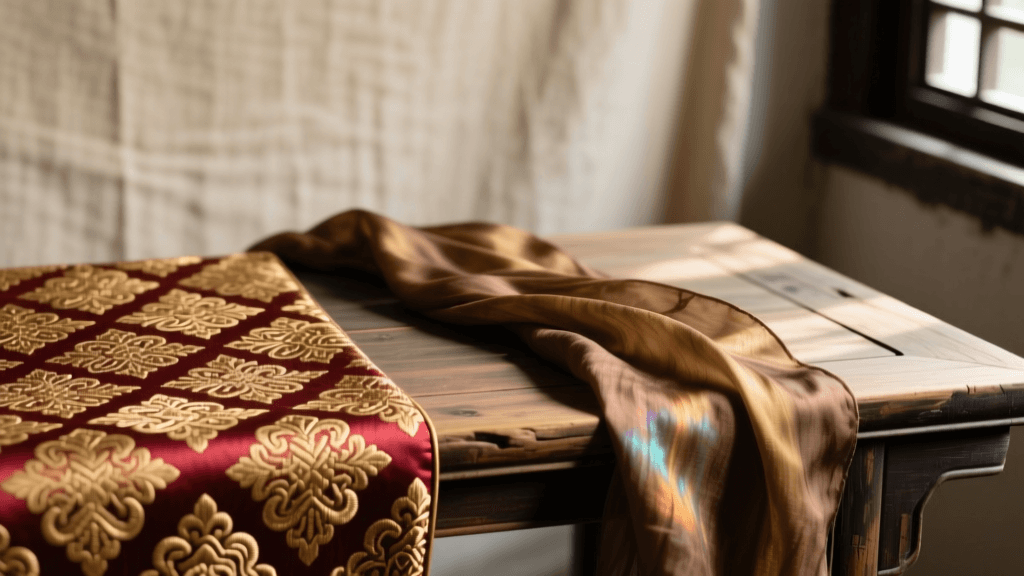
Nanjing Yunjin, literally translating to 'cloud brocade,' is renowned for its vibrant colors, intricate patterns, and the liberal use of precious metals and feathers. Historically reserved for the imperial family during the Ming and Qing dynasties, Yunjin represents the absolute zenith of Chinese jacquard weaving. The fabric is so named because its patterns are as magnificent and varied as the clouds in the sky.
The Mechanics of the Great Pattern Loom
The creation of authentic Yunjin cannot be replicated by modern power looms. It requires a massive wooden jacquard loom known as the 'Da Hua Lou,' which measures approximately 5 meters long and 4 meters high. Operating this loom is a strenuous, two-person endeavor. The 'puller' sits at the top of the loom, manually lifting the warp threads according to a complex, knot-based memory code, while the 'weaver' sits below, passing the shuttle and beating the weft threads into place.
The defining technique of Yunjin is 'Tong Jing Duan Wei' (continuous warp, broken weft). This allows the weaver to change the colored weft threads freely across the width of the fabric, enabling the creation of highly detailed, multicolored motifs without the limitations of standard repeating patterns. Artisans frequently incorporate genuine gold leaf wrapped around silk cores, silver threads, and even iridescent peacock feathers into the weft, giving the fabric a sculptural, three-dimensional texture.
Actionable Advice for Sourcing Yunjin
- Cost and Investment: Authentic, hand-woven Yunjin is exceptionally expensive due to the labor intensity. Expect to pay between $800 and $2,500 USD per meter, depending on the density of the gold thread and the complexity of the motif.
- Lead Times: Because a master weaving team can only produce about 5 to 6 centimeters of fabric per day, commissioning enough fabric for a full Ming dynasty-style Mamianqun (horse-face skirt) or round-collar robe typically requires a lead time of 6 to 12 months.
- Verification: Always request the artisan's ICH certification. Genuine Yunjin will come with a certificate of authenticity tied to a recognized provincial or national-level inheritor.
Xiangyunsha: The Alchemy of Mud and Sun
While Yunjin represents the structured majesty of the northern and central courts, Xiangyunsha (Gambiered Canton Gauze) embodies the organic, elemental alchemy of the southern Pearl River Delta. Recognized globally for its unique properties, the traditional practices of Sericulture and silk craftsmanship in China highlight how regional environments dictate textile production.
The 30-Step Mud-Dyeing Process
Xiangyunsha is the only silk fabric in the world dyed using natural plant juices and river mud. The process begins with plain white silk gauze, which is repeatedly dipped in the tannin-rich juice of the 'Shoulang' (Dioscorea cirrhosa) tuber. After dozens of soakings and sun-dryings, the fabric takes on a deep rust-brown color.
The magic occurs during the final, crucial step: the application of mud. Artisans smear the silk with iron-rich, unpolluted river mud specifically sourced from the Shunde district of Guangdong. The iron ions in the mud react chemically with the tannins in the plant juice, creating a dark, glossy, blackish-brown surface on one side, while the reverse remains a matte rust-brown. The fabric is then washed in the river to remove the excess mud and left to cure.
Actionable Advice for Sourcing Xiangyunsha
- The Curing Period: Freshly dyed Xiangyunsha is notoriously stiff and can feel almost like paper. It requires a minimum of 6 months of 'curing' in a temperature-controlled, dark environment to allow the chemical bonds to fully stabilize and the fibers to soften. When buying, always ask the vendor for the dyeing date.
- Cost and Investment: Authentic mud-dyed Xiangyunsha generally ranges from $150 to $400 USD per meter. Beware of cheap imitations that use chemical black dyes; genuine Xiangyunsha will have a distinct, slightly earthy scent and a subtle crackled texture on the black side.
- Best Applications: Due to its breathable, moisture-wicking, and naturally antibacterial properties, Xiangyunsha is ideal for summer Hanfu, particularly Song dynasty-style Beizi (open-front coats) and lightweight Ruqun sets.
Comparison Chart: Yunjin vs. Xiangyunsha
To help collectors and Hanfu enthusiasts make informed decisions, here is a structured comparison of these two heritage textiles:
| Feature | Nanjing Yunjin (Cloud Brocade) | Xiangyunsha (Gambiered Gauze) |
|---|---|---|
| Origin Region | Nanjing, Jiangsu Province | Shunde, Guangdong Province |
| Primary Technique | Hand-operated Jacquard weaving | Tannin-juice dipping and iron-mud dyeing |
| Visual Texture | Glossy, raised metallic motifs, vibrant | Crackled black surface, matte brown reverse |
| Average Cost (per meter) | $800 - $2,500+ USD | $150 - $400 USD |
| Production Lead Time | 6 to 12 months for custom orders | 2 months for dyeing + 6 months curing |
| Ideal Hanfu Styles | Ming Dynasty Mamianqun, formal outerwear | Song Dynasty summer coats, everyday wear |
| Durability & Care | Delicate; dry clean only, store flat | Highly durable; softens with gentle hand-washing |
Verifying Authentic Intangible Cultural Heritage
As the commercial value of heritage silk rises, so does the prevalence of factory-made counterfeits. Mass-produced 'Yunjin' is often woven on computerized power looms using synthetic metallic yarns, while fake 'Xiangyunsha' is simply printed with black and brown chemical dyes to mimic the crackled effect. Organizations like the World Crafts Council continually advocate for the protection and proper labeling of master artisans to prevent cultural dilution.
To ensure you are supporting true heritage crafts, look for the official Chinese government ICH labels. National-level inheritors (国家级非物质文化遗产代表性传承人) are required to stamp or sign their premium fabric bolts. Furthermore, authentic Xiangyunsha will always feature the selvedge markings indicating the specific dyeing workshop in Shunde. When engaging with custom Hanfu tailors, insist on seeing the raw fabric bolt and its accompanying provenance documentation before the cutting process begins.
Care and Maintenance for Heritage Silks
Owning a garment made from ICH-certified silk requires a departure from modern laundry habits. These fabrics are living materials that react to their environment.
Caring for Yunjin
Because Yunjin incorporates delicate metallic threads and complex raised weaves, it must never be submerged in water. The gold and silver threads can tarnish or snap if agitated. Always rely on specialized, eco-friendly dry cleaning. When storing Yunjin garments, never fold them sharply, as this will permanently crease the metallic threads. Instead, roll the garment around acid-free tissue paper and store it in a breathable cotton bag in a climate-controlled, dark closet.
Caring for Xiangyunsha
Conversely, Xiangyunsha thrives on gentle interaction. The mud-dyeing process makes the silk naturally resistant to mold and insects. To wash, use cool water and a pH-neutral silk detergent. Gently press the water through the fabric without wringing or twisting. The friction of wearing and gently washing Xiangyunsha actually breaks down the initial stiffness, resulting in a luxurious, drapey texture that molds to the wearer's body over time. Hang it to dry in a shaded, well-ventilated area; direct, harsh sunlight can cause the tannin dyes to fade unevenly.
The Future of the Artisan
The survival of Nanjing Yunjin and Xiangyunsha relies heavily on a new generation of consumers who value slow fashion and historical accuracy over fast, disposable trends. By understanding the immense labor, regional specificity, and chemical mastery required to produce these textiles, buyers can justify the premium costs and long wait times. Investing in these fabrics is not merely a sartorial choice; it is a direct contribution to the livelihoods of the artisans who serve as the living bridges to China's magnificent textile past.