Preserving Chinese Silk Heritage: Kesi and Su Embroidery Artisans
The Living Threads of China's Intangible Cultural Heritage
The modern Hanfu revival is not merely a fashion movement; it is a vital conduit for the preservation of China's intangible cultural heritage. As demand for historically accurate traditional garments grows, a dedicated network of master artisans is working tirelessly to keep ancient textile crafts alive. Among the most revered of these traditions are Kesi (silk tapestry) and Su Embroidery (Suzhou embroidery). These techniques require thousands of hours of meticulous handiwork, transforming raw silk into wearable art. According to UNESCO's Intangible Cultural Heritage list, sericulture and silk craftsmanship in China encompass a profound ecosystem of traditional knowledge, from mulberry cultivation to the complex weaving and embroidery techniques that define historical Asian fashion. Supporting these artisans ensures that the soul of traditional Chinese clothing survives in the modern era.
Kesi (Silk Tapestry): Carving Time in Silk
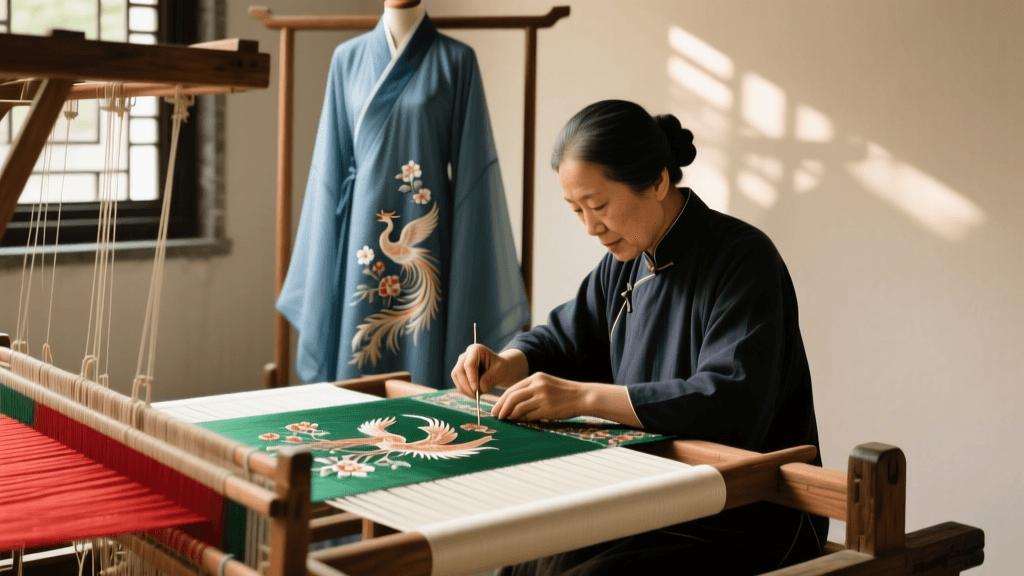
Kesi, which translates to 'cut silk', is one of the most labor-intensive and highly prized textile arts in Chinese history. Unlike standard embroidery where threads are stitched onto a pre-existing base fabric, Kesi is woven on a specialized loom. The artisan uses a base silk warp and weaves colored silk weft threads only in the areas where a specific color is needed, using small wooden bobbins. When the piece is held up to the light, the boundaries between different color blocks appear as tiny slits or 'cuts' in the fabric, giving the art form its name. The Metropolitan Museum of Art notes that Kesi weavers essentially 'carve' the design in silk, allowing for incredible detail that mimics brush paintings. Creating a single Kesi collar piece for a traditional Hanfu jacket can take an experienced artisan two to three weeks of continuous work. A full-length Kesi Mamianqun (horse-face skirt) or a formal Ming dynasty-style round-collar robe can require over a year of dedicated weaving, with prices ranging from $2,500 to over $15,000 USD depending on the complexity of the metallic threads and the reputation of the weaver.
Su Embroidery: The Pinnacle of Needlework
Originating from the Suzhou region, Su Embroidery is celebrated for its delicate, photorealistic quality and its unique thread-splitting technique. A master Su embroiderer will take a single strand of silk thread and split it into fractions—often 1/16, 1/32, or even 1/64 of its original thickness. This allows for imperceptible color gradations and incredibly fine details, such as the individual barbs on a peacock feather or the subtle shading of a lotus petal. The pinnacle of this craft is 'double-sided embroidery', where the artisan creates two entirely different, perfectly finished images on the front and back of a single piece of sheer silk organza, with all knots and thread ends hidden within the microscopic stitches. In the context of Hanfu, Su embroidery is frequently applied to the cuffs, collars, and hems of Song and Ming dynasty garments. A bespoke, hand-embroidered Su silk Dahu (sleeveless vest) typically costs between $800 and $3,000 USD, reflecting the hundreds of hours spent hunched over the embroidery frame.
Comparison Chart: Kesi vs. Su Embroidery
| Feature | Kesi (Silk Tapestry) | Su Embroidery |
|---|---|---|
| Core Technique | Woven on a loom; weft threads create the pattern. | Needlework stitched onto a pre-woven base fabric. |
| Visual Signature | Tiny 'cut' slits between color blocks; reversible. | Smooth, painted appearance; flat or raised textures. |
| Time per Sq. Inch | Approx. 2 to 4 hours of weaving. | Approx. 1 to 3 hours of stitching (depends on thread split). |
| Price Range (Garment) | $2,500 - $15,000+ USD | $800 - $4,000 USD |
| Best Hanfu Application | Formal Ming dynasty robes, Mamianqun panels. | Song dynasty Beizi (jackets), delicate collars and cuffs. |
Practical Guide: Commissioning Bespoke Artisan Hanfu
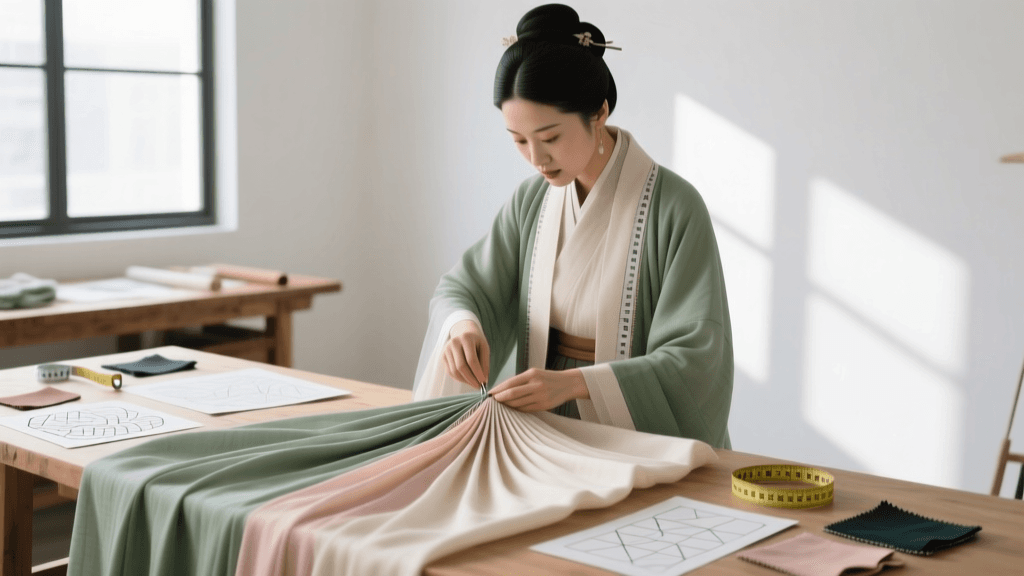
For enthusiasts and collectors looking to commission authentic, handcrafted Hanfu directly from intangible heritage artisans or their specialized studios, precise preparation is essential. Unlike mass-produced e-commerce Hanfu, bespoke pieces require exact measurements and significant lead times.
Essential Measurements
- Tongxiu (Total Sleeve Span): Measured from the left wrist, across the back of the neck, to the right wrist. Crucial for traditional wide-sleeved garments like the Daopao.
- Yichang (Garment Length): Measured from the base of the back neck to the desired hemline, usually the ankle or floor.
- Shoulder and Bust: While traditional Hanfu relies heavily on flat cutting and wrapping, modern bespoke tailors require these to ensure the Jiaoling (cross-collar) sits correctly without gaping.
Timelines and Costs
Expect a lead time of 3 to 8 months for authentic handcrafted pieces. Artisans often work on a seasonal basis, aligning their weaving and dyeing with natural humidity and temperature changes, which affect silk tension and natural dye absorption. A deposit of 30% to 50% is standard practice, with the remainder due upon completion and photographic proof of the finished textile.
Authentication: Spotting Handcrafted Masterpieces
As the Hanfu market expands, machine-made imitations of Kesi and Su embroidery have flooded the market. Knowing how to authenticate handcrafted intangible heritage textiles is a vital skill for collectors.
- Examine the Reverse Side: Authentic Kesi will look nearly identical on the back as on the front, with clean color transitions and no messy bobbin threads. Machine-woven imitations often have a messy back with long 'float' threads or a synthetic mesh backing.
- Check the Thread Luster: Hand-prepared traditional silk has a deep, multi-faceted luster that changes in different lighting. Machine embroidery often uses synthetic rayon or polyester blends, which have a harsh, plastic-like shine.
- Look for Human Imperfections: Master artisans are incredibly precise, but hand-split Su embroidery will have microscopic variations in tension and thread thickness that give the design a 'breathing', organic quality. Machine embroidery is mathematically uniform and rigid.
Caring for Heritage Textiles
Garments featuring genuine Kesi or Su embroidery are investment pieces that require specialized care to preserve their structural integrity and vibrancy. Never wash these garments in water, as the natural silk dyes can bleed and the tension of the woven tapestry can warp. Instead, rely on professional dry cleaners who specialize in historical textiles and understand the delicate nature of protein-based silk fibers. When storing, avoid wire hangers which will distort the warp threads of the Kesi. Fold the garment carefully with acid-free tissue paper to pad the folds and prevent hard creases, and store it in a breathable cotton garment bag in a climate-controlled environment, strictly away from direct UV light which will rapidly degrade the silk proteins and fade the natural dyes.
Supporting the Artisans: Ethical Consumption
The survival of these intangible cultural crafts depends on ethical consumerism. When purchasing artisan Hanfu, seek out studios that are transparent about their weavers and embroiderers, ensuring fair compensation for their grueling labor. Many heritage cooperatives in Suzhou, Nanjing, and Hangzhou now offer workshop tours, allowing buyers to meet the artisans, observe the wooden looms and embroidery frames in action, and directly fund the apprenticeship programs necessary to pass these ancient skills to the next generation.