Decoding Chinese Official Robes: Rank, Color Codes, and Buzi
The Visual Language of Imperial Power
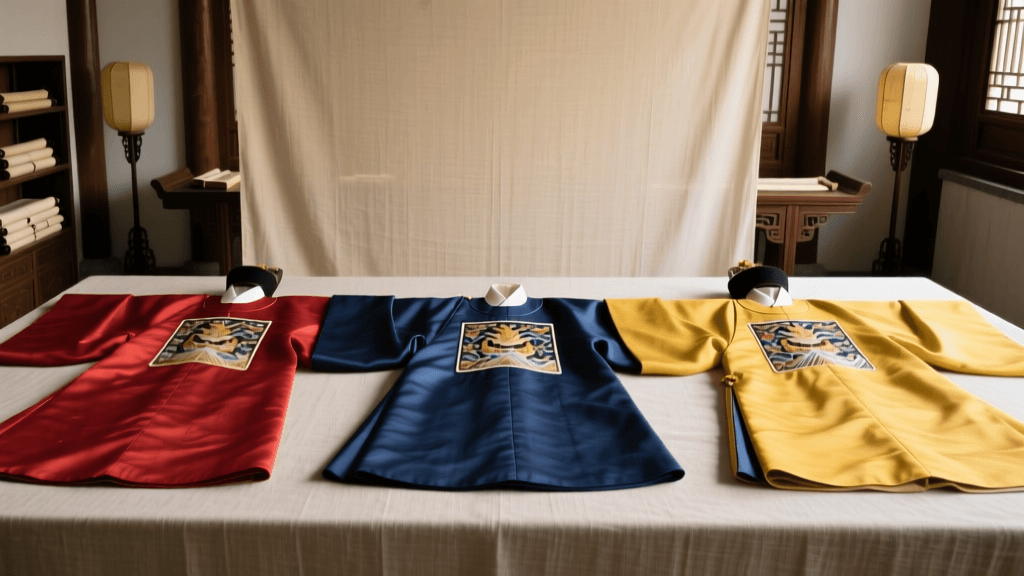
For over two millennia, clothing in China was far more than a matter of personal style or protection from the elements; it was a strictly regulated visual language that communicated a person's exact social standing, profession, and relationship to the divine. Nowhere is this more evident than in the official robes (bufu) of the Ming (1368–1644) and Qing (1644–1912) dynasties. Through a complex system of sumptuary laws, color codes, and embroidered rank badges known as Buzi (Mandarin squares), the imperial court maintained a rigid social hierarchy. Today, understanding these codes is essential for historians, Hanfu revivalists, and antique textile collectors alike.
The Imperial Palette: Color Codes and Sumptuary Laws
In traditional Chinese cosmology, colors were deeply tied to the Five Elements (Wu Xing) theory. The imperial government strictly controlled who could wear specific hues, with violations sometimes punishable by severe penalties.
Yellow: The Emperor's Prerogative
Bright yellow (minghuang) was exclusively reserved for the Emperor, the Empress, and the Empress Dowager. It symbolized the earth element and the center of the universe. Close imperial relatives and high-ranking princes were permitted to wear apricot yellow or golden yellow, but the vivid, saffron-like bright yellow was a fiercely protected monopoly. For modern Hanfu enthusiasts, wearing bright yellow with five-clawed dragon motifs is historically inaccurate for anyone outside the imperial family, though modern fashion has largely relaxed these ancient taboos.
Red, Blue, and the Bureaucracy
Red, symbolizing fire and joy, was heavily utilized in court robes for high-ranking officials and during joyous state ceremonies. The vibrant reds were historically achieved using safflower (Carthamus tinctorius) dyes, which were incredibly labor-intensive to produce, further elevating the color's status. Blue and black, derived from ubiquitous indigo fermentation vats, were the standard colors for lower-ranking officials, scholars, and commoners. According to the Metropolitan Museum of Art's Heilbrunn Timeline, the Qing dynasty later introduced the iconic dark blue-black surcoats (gua) worn over the dragon or rank robes, standardizing the outer layer of official dress regardless of the inner robe's color.
Decoding the Buzi: The Ultimate Rank Identifier
While color indicated broad social categories, the Buzi (Mandarin square) pinpointed an official's exact rank within the sprawling imperial bureaucracy. Worn on the chest and back of the outer surcoat, these intricately embroidered squares featured specific birds for civil officials and mythical or real beasts for military officers.
A key distinction for collectors and historians is the construction of the badge. Ming dynasty Buzi were typically woven or embroidered as a single, continuous square (up to 35 cm). In contrast, Qing dynasty Buzi were split vertically down the middle (approx. 28 cm x 28 cm) because the Qing surcoat buttoned down the center front, requiring the badge to be parted.
Rank Insignia Table: Qing Dynasty Civil and Military Officials
| Rank | Civil Official (Birds) | Military Official (Beasts) |
|---|---|---|
| 1st Rank | Crane (Xianhe) | Qilin (Mythical Chimera) |
| 2nd Rank | Golden Pheasant (Jinji) | Lion (Shizi) |
| 3rd Rank | Peacock (Kongque) | Leopard (Bao) |
| 4th Rank | Wild Goose (Yan) | Tiger (Hu) |
| 5th Rank | Silver Pheasant (Baijian) | Bear (Xiong) |
| 6th Rank | White Egret (Bailu) | Panther (Biao) |
| 7th Rank | Mandarin Duck (Xichi) | Tiger (Hu - alternate) |
| 8th Rank | Quail (Anchun) | Bear (Xiong - alternate) |
| 9th Rank | Paradise Flycatcher (Lianshou) | Sea Horse (Haima) |
Practical Guide: Collecting and Evaluating Antique Buzi
The market for antique Chinese textiles is robust, with Mandarin squares being highly sought after by collectors due to their manageable size and dense iconography. Whether you are acquiring pieces for a private collection, museum donation, or historical reproduction research, understanding the material realities of these garments is crucial.
Authentication and Material Analysis
- Thread Composition: Authentic 18th and 19th-century Buzi utilized 'couching' techniques where strips of real gold leaf applied to animal hide or paper were wrapped around a silk core. If the gold thread is overly shiny, uniform, or shows signs of modern synthetic metallic film, it is likely a 20th-century tourist-trade reproduction.
- Dye Dating: The introduction of synthetic aniline dyes from Europe in the late 19th century (circa 1880s) revolutionized textile coloring. If a purported 18th-century badge features neon pinks, vivid purples, or unnaturally bright greens, it is either a later piece or has been re-embroidered. The Victoria and Albert Museum's textile conservation archives note that natural dyes (indigo, madder, pagoda tree buds) possess a softer, more complex patina that synthetic dyes cannot replicate.
- The Backing Test: Turn the badge over. Authentic hand-embroidered pieces will show a chaotic but deliberate web of carrying threads and knots. Machine-embroidered fakes will have a uniform, locked-stitch backing.
Measurements, Costs, and Market Realities
When shopping at auction houses or specialized antique textile dealers, expect the following market realities:
- Standard Dimensions: A genuine Qing dynasty Buzi will typically measure between 27 cm and 30 cm square (approx. 11 x 11 inches). Ming examples are rarer and larger, often exceeding 35 cm.
- Pricing Tiers: A heavily worn, 19th-century 8th or 9th rank badge with minor silk shattering can be acquired for $200 to $400. Mid-tier pieces (4th to 6th rank, good color retention, intact gold couching) range from $800 to $2,500. Museum-quality 18th-century Kesi (cut silk tapestry) badges featuring 1st rank Cranes or Qilins routinely fetch $5,000 to $15,000+ at major auction houses.
- Condition Reports: Silk is a protein fiber highly susceptible to 'silk shattering' caused by historical mordants (like iron) used to weight the fabric. Always inspect the black or dark blue background threads, as these are usually the first to disintegrate.
Conservation and Care for the Modern Collector
If you acquire an antique Mandarin square, proper storage is non-negotiable to preserve the delicate silk and metallic threads. Never hang a Buzi by its edges; the weight will distort the ancient fibers. Instead, practice flat storage:
- Line an archival-quality, acid-free box with unbuffered acid-free tissue paper.
- Place the Buzi face-up. Do not fold it. If the box is too small, gently roll the badge around an acid-free tube with the embroidered face outward to prevent creasing the metallic threads.
- Store in a climate-controlled environment (ideally 65°F with 50% relative humidity) away from direct UV light, which will rapidly fade the natural safflower and indigo dyes.
Modern Revival: Wearing Rank Symbols Today
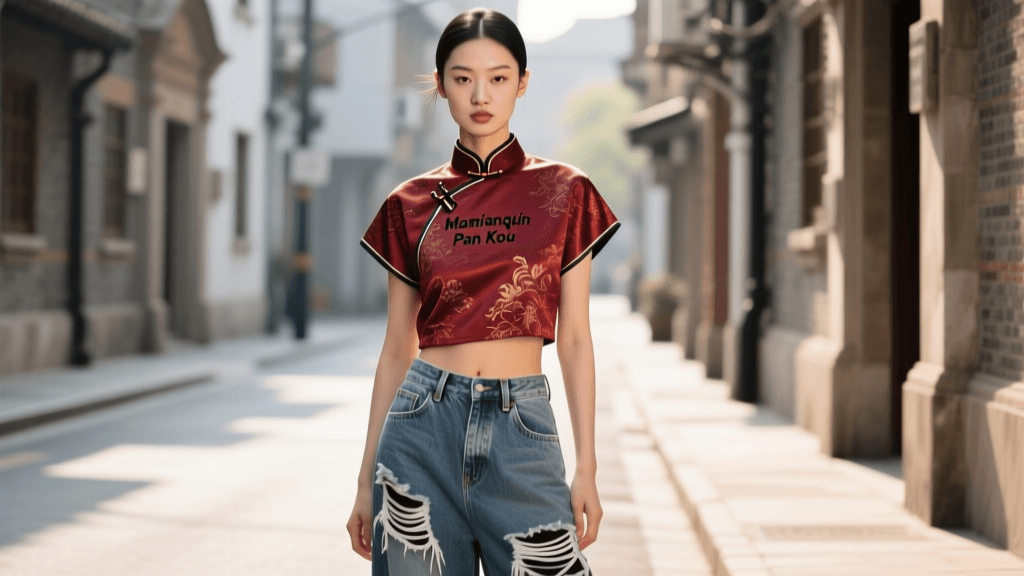
The contemporary Hanfu movement and modern bespoke Qipao tailoring have seen a massive resurgence in traditional motifs. While modern wearers are no longer bound by imperial sumptuary laws, wearing a 1st-rank Crane or Qilin motif carries a cultural weight of supreme authority and longevity. Designers today often adapt these historical rank codes into subtle jacquard weaves or tonal embroidery on modern outerwear, allowing enthusiasts to honor the profound symbolism of the Buzi without wearing a literal historical costume. By understanding the deep-rooted color codes and rank hierarchies of the past, modern consumers can appreciate these garments not just as beautiful textiles, but as the surviving legal and social documents of imperial China.