Chinese Natural Dye Plants: Eco-Friendly Dyeing 2026
The Renaissance of Traditional Chinese Natural Dyes in 2026
As the global fashion industry faces mounting pressure to decarbonize and eliminate toxic effluent, 2026 has marked a definitive turning point toward regenerative textile practices. At the forefront of this movement is the revival of traditional Chinese natural dye plants. For millennia, artisans crafting silk, hemp, and ramie for traditional Chinese garments relied on a sophisticated botanical palette. Today, these ancient methods are being integrated with modern eco-friendly dyeing technologies to create zero-waste, sustainable supply chains.
Unlike synthetic azo dyes, which account for nearly 20% of global industrial wastewater pollution, plant-based dyes offer a biodegradable alternative that actually nourishes the soil during cultivation. According to the UNEP Alliance for Sustainable Fashion, shifting toward bio-based and natural dyeing systems is one of the most critical steps in reducing the apparel sector's chemical footprint. For designers, artisans, and cultural preservationists crafting modern Hanfu and sustainable couture, mastering Chinese natural dye plants is no longer just a historical pursuit—it is a vital sustainability skill for 2026.
Top Chinese Natural Dye Plants for Sustainable Textiles
The traditional Chinese dyeing canon, historically documented in texts like the Tiangong Kaiwu (The Exploitation of the Works of Nature), relies on specific indigenous flora. Here are the premier plants driving the eco-dyeing revival today.
Liao Lan (Polygonum tinctorium) - Chinese Indigo
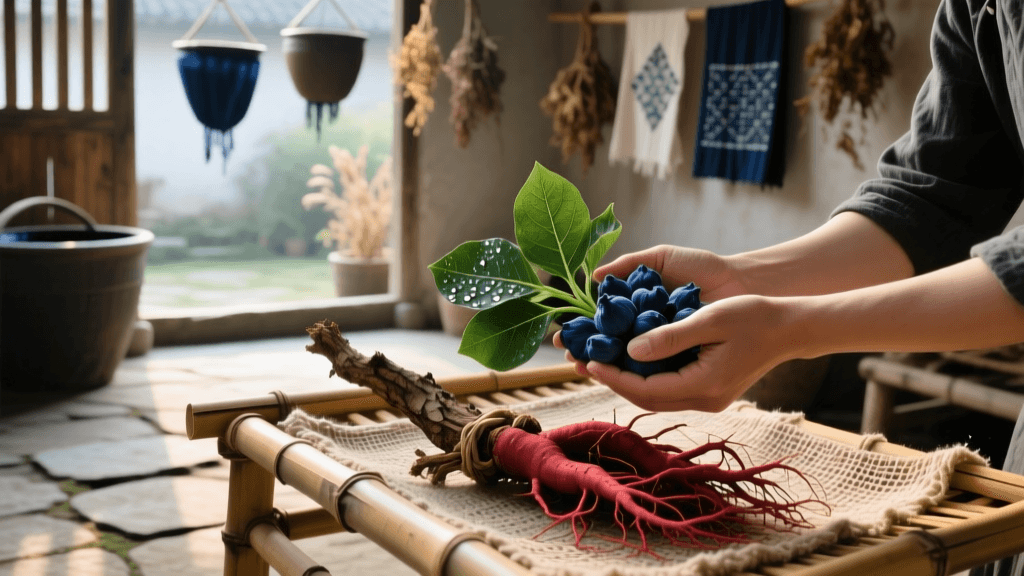
While tropical indigo (Indigofera tinctoria) is common globally, China's native indigo, Liao Lan, thrives in temperate climates and has been the cornerstone of Chinese blue textiles for centuries. In 2026, regenerative farms in Zhejiang and Guizhou are cultivating Liao Lan using companion planting to fix nitrogen in the soil. The leaves are fermented into a paste (dian lan) and reduced in an alkaline vat. The resulting deep, living blues possess natural antibacterial properties, making them highly sought after for sustainable intimates, summer linens, and meditation wear.
Qian Cao (Rubia cordifolia) - Chinese Madder
Qian Cao yields a spectrum of reds, from soft terracotta to deep crimson, depending on the mordant and water pH. The roots contain alizarin and purpurin. Modern eco-dyers in 2026 utilize ultrasonic-assisted extraction (UAE) to pull the color compounds from the roots using 40% less water and lower temperatures than traditional boiling methods, preserving the plant's integrity and reducing energy consumption.
Zhi Zi (Gardenia jasminoides) - Gardenia Yellow
The fruit of the gardenia shrub provides a brilliant, vibrant yellow without the need for a metallic mordant, as it acts as a direct dye. Rich in crocin, Zhi Zi is historically used for high-status ceremonial robes. While its lightfastness is moderate, it remains a staple for eco-friendly inner linings, meditation cushions, and garments intended for indoor or evening wear.
Huai Hua (Sophora japonica) - Pagoda Tree
The unopened flower buds of the pagoda tree yield a striking yellow-green hue, historically reserved for imperial garments. The buds are rich in rutin and can be harvested without killing the tree, making it a highly sustainable, perennial dye source. Artisans in 2026 often prune the trees for dye while the mature wood is used for sustainable carpentry, exemplifying a circular bio-economy.
Botanical Dye Comparison & Mordant Guide
To achieve optimal colorfastness and environmental safety, selecting the right bio-mordant is crucial. Heavy metal mordants like chrome and tin are obsolete in 2026 eco-dyeing. Instead, we use alum (potassium aluminum sulfate) in strict, closed-loop concentrations, or entirely plant-based tannins.
| Botanical Name | Traditional Name | Target Color | Recommended Eco-Mordant | Lightfastness (1-8) |
|---|---|---|---|---|
| Polygonum tinctorium | Liao Lan | Deep Blue | None (Vat Dye) | 6 |
| Rubia cordifolia | Qian Cao | Crimson / Brick Red | Alum + Cream of Tartar | 5 |
| Gardenia jasminoides | Zhi Zi | Vibrant Yellow | None (Direct Dye) | 3 |
| Sophora japonica | Huai Hua | Yellow-Green | Symplocos (Bio-Mordant) | 4 |
| Phellodendron amurense | Huang Bo | Neon / Imperial Yellow | None (Direct Dye) | 2 |
The 2026 Eco-Friendly Dyeing Process: Step-by-Step
Transitioning from synthetic to natural dyes requires a paradigm shift in water and energy management. Here is the modernized, eco-friendly protocol for dyeing silk and organic cotton with Chinese plants.
Step 1: Bio-Scouring
Traditional scouring uses harsh sodium hydroxide. In 2026, eco-dyers use bio-enzymes derived from fermented soy milk or pineapple leaf enzymes to strip natural waxes and pectins from cellulose and protein fibers. This reduces water toxicity and prepares the fiber to accept the dye evenly. Soak your fabric in a 5% soy milk solution for 12 hours, then rinse in cool water.
Step 2: Sustainable Mordanting
For mordant dyes like Qian Cao (Madder), use Symplocos tinctoria—a plant native to Asia that naturally accumulates aluminum from the soil. By boiling Symplocos leaves, you create a bio-mordant bath that eliminates the need for mined alum entirely. Use 15 grams of Symplocos leaf powder per 100 grams of fiber. Simmer the fabric in the bath at 80°C for one hour, then let it cool in the bath to maximize fiber uptake.
Step 3: Low-Energy Extraction and Dyeing
Instead of boiling dye materials for hours, utilize the 'slow steep' method. Place your plant material (e.g., dried Huai Hua buds) in a mesh bag and steep in 60°C water overnight. The next day, gently heat the bath to 70°C, add your mordanted fabric, and maintain this temperature for 45 minutes. This low-energy extraction preserves delicate color compounds and drastically cuts electricity or gas usage.
Step 4: Effluent Treatment and Composting
The hallmark of true sustainability is end-of-life management. The spent dye baths from Chinese plants are entirely biodegradable. According to data from the Textile Exchange, natural dye effluent can be safely routed into greywater systems to irrigate non-edible landscaping or directly composted with carbon-rich materials like dried leaves. Never pour synthetic dye waste into the soil, but plant-based waste actively feeds the microbiome.
Essential 2026 Eco-Dyeing Equipment
To execute these traditional techniques with modern precision, artisans should equip their studios with the following tools:
- Digital pH Meter: Crucial for maintaining the 10.5-11.0 pH required for Liao Lan indigo vats, ensuring proper reduction without wasting alkaline ash.
- Stainless Steel Vats: Replaces reactive copper or iron pots that can alter botanical colors unpredictably and leach heavy metals into the dye bath.
- Ultrasonic Extractor: For small-batch studios looking to reduce water usage by 40% during madder root processing while increasing color yield.
- Botanical Mesh Bags: Made from unbleached organic hemp, these keep plant matter separate from the fabric, eliminating the need for post-dye filtering and reducing water usage during cleanup.
Sourcing and Cultivating Dye Plants Sustainably
For artisans looking to vertically integrate their supply chain in 2026, cultivating your own dye garden is highly recommended. Liao Lan (Chinese Indigo) can be grown from seed in temperate zones, requiring only moderate water and naturally deterring pests due to its high indican content, eliminating the need for chemical pesticides. Qian Cao (Madder) is a perennial vine that takes two to three years to develop mature roots, making it an excellent long-term crop for permaculture textile farms.
When sourcing commercially, look for suppliers certified in regenerative agriculture. The demand for traceable, ethically harvested Chinese dye plants has surged, leading to cooperative farming models in provinces like Yunnan and Fujian, where indigenous farming techniques are preserved alongside modern ecological standards.
Conclusion
The integration of Chinese natural dye plants into contemporary eco-friendly dyeing is a testament to the timeless wisdom of Asian textile traditions. By embracing Liao Lan, Qian Cao, Zhi Zi, and Huai Hua, modern designers and artisans are not only preserving a rich cultural heritage but also actively engineering a cleaner, more sustainable fashion ecosystem for 2026 and beyond. Through mindful sourcing, bio-mordanting, and zero-waste water practices, the colors of nature continue to clothe the future.