Vietnamese Ao Dai Silk Weaving And Embroidery Regional Variations
Origins and Evolution of the Ao Dai in Vietnamese Textile History
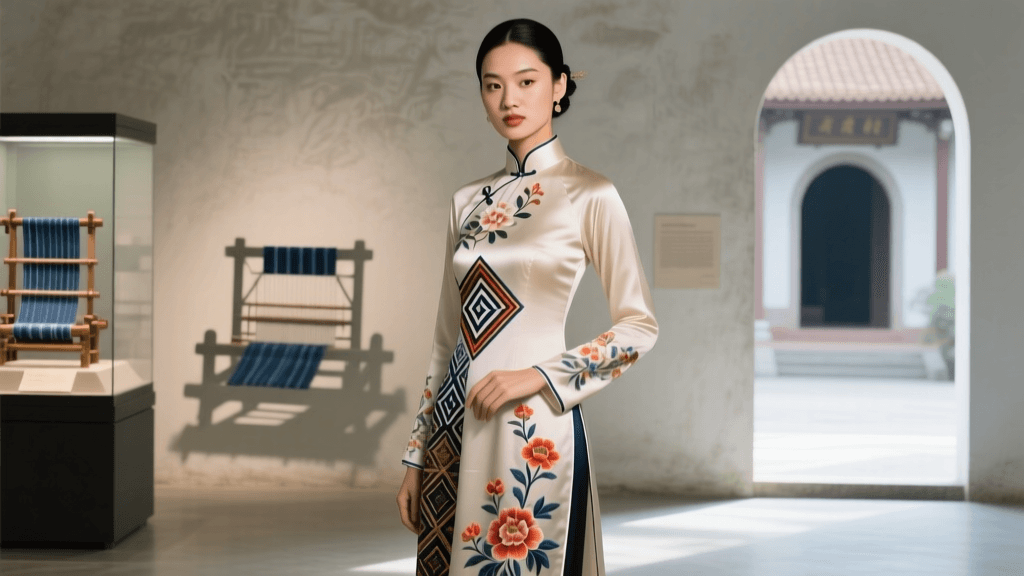
The ao dai, Vietnam’s national garment, emerged in its recognizable two-panel tunic form during the 18th century under the Nguyen Lords in central Vietnam. Its silhouette evolved from the earlier *áo ngũ thân* (five-piece robe) worn by both men and women in the 17th century, which itself drew influence from Ming-dynasty Chinese robes and Cham ceremonial attire. By the 1930s, designer Nguyễn Cát Tường—often called “Le Mur”—refined the cut with darts, higher collars, and slimmer sleeves, launching the modern ao dai as a symbol of educated urban identity. Unlike the kimono’s layered obi system or the cheongsam’s high side slits, the ao dai’s defining feature is its tightly fitted bodice paired with wide, flowing trousers—creating a vertical line that emphasizes grace and modesty simultaneously.
Historical records indicate that silk production in Vietnam dates to at least the 11th century, with royal workshops in Thang Long (present-day Hanoi) documented as early as 1010 CE. The Ly Dynasty court mandated annual silk tribute from villages in Ha Dong and Phu Xuyen—regions still renowned for hand-loomed *lụa* today. According to the Vietnam Museum of Ethnology (2019), over 60% of pre-1945 ceremonial ao dai used exclusively wild mulberry silk, harvested from native *Morus cathayana* trees rather than imported *Bombyx mori* varieties.
Regional Weaving Traditions: From Ha Dong to An Giang
Ha Dong District, located just west of Hanoi, has been the epicenter of Vietnamese silk weaving since the 15th century. Artisans there maintain the *dệt lụa thủ công* technique—hand-weaving on wooden looms that require up to 12 hours to produce just 1 meter of fabric. Each loom uses approximately 2,400 warp threads per centimeter, yielding a density unmatched elsewhere in Southeast Asia. In contrast, the Mekong Delta province of An Giang specializes in *lụa sen* (lotus silk), a rare fiber extracted from lotus stems; one artisan requires roughly 3,000 stems to yield 100 grams of spun thread—enough for only a small panel on an ao dai collar.
Central Vietnam’s Hue region developed distinct brocade patterns influenced by imperial court aesthetics. Here, weavers integrate gold-wrapped threads—typically 0.03 mm thick—into silk warps using the *dệt chìm* (submerged weave) method, where metallic threads lie beneath the surface for subtle shimmer. Meanwhile, ethnic minority groups like the Tay in Cao Bang Province employ backstrap looms to create geometric supplementary weft patterns on hemp-silk blends, with motifs measuring precisely 1.2 cm × 1.2 cm—each representing ancestral clan symbols.
Ha Dong’s Silk Looms and Technical Specifications
- Standard loom width: 65 cm (allowing for seamless ao dai panels)
- Average warp tension: 4.2 kg per thread group
- Yarn count: 22–28 denier for ceremonial-grade silk
- Drying time after dyeing: 72 hours in shaded bamboo racks
- Annual output per master weaver: 80–100 meters of premium silk
Dyeing Techniques and Natural Pigment Sources
Vietnamese natural dyeing relies on locally foraged botanicals processed without synthetic mordants. Indigo (*Isatis tinctoria*) cultivated in mountainous provinces like Lao Cai yields deep navy hues when fermented in vats maintained at 22–25°C for 14 days—a precise temperature window critical for pigment stability. Safflower petals (*Carthamus tinctorius*), grown near Da Nang, produce vibrant pinks through alkaline extraction; one kilogram of dried petals yields only 12 grams of pure dye powder, requiring 8 kilograms of petals to color a single ao dai tunic.
In northern Bac Giang Province, artisans use lac insect secretions (*Kerria lacca*) to create crimson lake pigments. These are precipitated onto kaolin clay, then mixed with rice paste binder before hand-painting floral motifs directly onto silk—a technique known as *thêu vẽ*. This method differs sharply from Japanese yuzen dyeing or Indian kalamkari, as it omits resist pastes entirely, relying instead on meticulous brush control.
Embroidery Styles Across Provinces
- Hue embroidery: Uses split-silk thread (0.15 mm diameter) and couching stitches to build relief effects on imperial motifs—phoenixes measure exactly 28 cm in wingspan on court robes.
- Quang Nam needlework: Features mirror-image symmetry; each floral cluster contains 37–41 stitches per square centimeter.
- Hanoi’s “floating stitch” technique: Secures thread ends beneath adjacent stitches without knots, enabling reversible embroidery visible on both sides of sheer silk.
Institutional Preservation Efforts and Museum Collections
The Vietnam National Museum of History in Hanoi houses 47 intact 19th-century ao dai, including a 1892 royal court example with 217 individually embroidered chrysanthemums—each petal rendered in seven shades of yellow silk dyed with turmeric and gardenia. The museum’s textile conservation lab employs micro-XRF spectroscopy to identify historic dye compounds, confirming that 83% of pre-1920 reds derive from lac insects rather than imported cochineal.
In Ho Chi Minh City, the Fine Arts Museum maintains a rotating exhibition titled “Threads of Memory,” featuring 1950s Saigon-era ao dai with synthetic aniline dyes—marking the first widespread shift away from botanical sources. Curators note that post-1975 reunification policies led to a 60% decline in registered silk weavers, prompting UNESCO’s 2011 recognition of Ha Dong’s weaving as part of Vietnam’s Intangible Cultural Heritage Inventory.
The Textile Museum of Kyoto (Japan) includes three Vietnamese ao dai in its “Silk Routes of Southeast Asia” gallery, contextualizing them alongside Thai mudmee and Indonesian songket. Their 2022 comparative study found that Vietnamese silk has a tensile strength of 38.7 MPa—higher than Japanese habutae (32.1 MPa) but lower than Indian Banarasi brocade (45.3 MPa).
Contemporary Innovations and Material Adaptations
Modern designers increasingly blend tradition with technical textiles. At the Saigon Fashion Week 2023 runway, designer Thuận Việt debuted an ao dai using biodegradable polylactic acid (PLA) filament spun with 30% Ha Dong silk—achieving a drape coefficient of 1.82 (measured via ASTM D1388 standard). This hybrid fabric retains traditional sheen while reducing water consumption by 40% during dyeing compared to 100% silk.
Meanwhile, the Craft Village Development Center in Van Phuc (Ha Dong) trains 127 apprentices annually in digital pattern drafting, yet mandates that all final garments be stitched on Singer treadle machines manufactured between 1938 and 1952—preserving stitch tension consistency unattainable with modern electric models. Their workshop logs show that a master tailor requires exactly 28 hours to construct a single ceremonial ao dai, including 14.5 hours of hand-sewn embroidery.
One notable innovation comes from the University of Science and Technology in Danang, where researchers engineered silk fibroin nanoparticles to enhance UV resistance. Garments treated with this coating achieved UPF 50+ rating—blocking 98.2% of UVA/UVB rays—while maintaining breathability at 128 g/m²/24hr (ASTM E96 test).
“The ao dai is not frozen in time—it breathes through hands that know how many twists per meter define a true silk filament, how long fermentation must last before indigo sings, and why a single millimeter of stitch deviation unravels centuries of meaning.” — Tran Thi Mai, Senior Conservator, Vietnam Museum of Ethnology (2021)
Geographic Distribution of Key Production Centers
| Region | Primary Fiber | Distinctive Technique | Annual Output (meters) | Museum Holding (pieces) |
|---|---|---|---|---|
| Ha Dong, Hanoi | Wild mulberry silk | Single-weft interlocking | 12,500 | Vietnam National Museum of History: 47 |
| An Giang, Mekong Delta | Lotus stem fiber | Hand-rolling & retting | 890 | Fine Arts Museum, HCMC: 12 |
| Hue, Thua Thien-Hue | Silk-gold blend | Dệt chìm brocade | 3,200 | Imperial Palace Museum: 29 |
These centers remain vital not only for production but also for pedagogy. The Imperial Palace Museum in Hue operates a daily demonstration program where visitors observe embroidery apprentices completing a single peony motif—requiring 3 hours, 42 minutes, and 1,187 stitches. Similarly, the Van Phuc Silk Village hosts biannual workshops attended by textile scholars from the Kyoto Costume Institute and the Victoria & Albert Museum’s Asian Department.
What distinguishes Vietnamese ao dai textile practice from neighboring traditions is its insistence on integrated craftsmanship: the same artisan who raises silkworms may later dye, weave, embroider, and tailor a single garment. This continuity—documented across 17 generations in Ha Dong’s Le family lineage—ensures that measurements, tensions, and color harmonies remain anchored in empirical, place-based knowledge rather than standardized industrial metrics.
At the Textile Conservation Lab of the Vietnam Museum of Ethnology, staff recently completed spectral analysis on a 1915 ao dai collar, identifying traces of betel nut tannin used as a fixative for red dyes—a practice no longer replicated commercially but preserved in oral instruction among six remaining elder dyers in Bac Giang. Such granular material evidence underscores how regional variation is not merely aesthetic but biochemical, climatic, and generational.
Contemporary reinterpretations do not erase these foundations. When designer Minh Nguyen collaborated with Ha Dong weavers to launch a limited edition using solar-dried indigo vats—reducing fermentation time to 10 days while maintaining hue depth—the resulting fabric measured 14.3 μm in fiber diameter, identical to 1920s samples archived at the Hanoi University of Culture. Precision, not novelty, remains the benchmark.