Mastering Chinese Drawloom Weaving Techniques & Looms in 2026
The Resurgence of the Hualou Drawloom in 2026
In the landscape of Asian traditional garments, few textile achievements rival the complexity and breathtaking beauty of Chinese brocades. As the Xin Zhongshi (new Chinese style) fashion movement continues to dominate global runways and streetwear in 2026, there has been an unprecedented surge in demand for authentic, hand-woven heritage textiles. At the heart of this renaissance is the Hualou drawloom, an ancient, multi-story wooden marvel that predates the European Jacquard loom by centuries. Understanding the mechanics, history, and modern preservation of Chinese traditional looms is essential for collectors, fashion historians, and textile enthusiasts navigating the 2026 market.
According to UNESCO's Intangible Cultural Heritage registry, the sericulture and silk craftsmanship of China represent a continuous lineage of knowledge spanning millennia. Yet, the specific mechanics of the Hualou drawloom remain one of the most closely guarded and physically demanding artisanal practices in the world. Today, we explore the intricate anatomy of these ancient weaving techniques, the "Big Three" brocades they produce, and how you can engage with this craft in 2026.
The Anatomy of the Hualou Drawloom
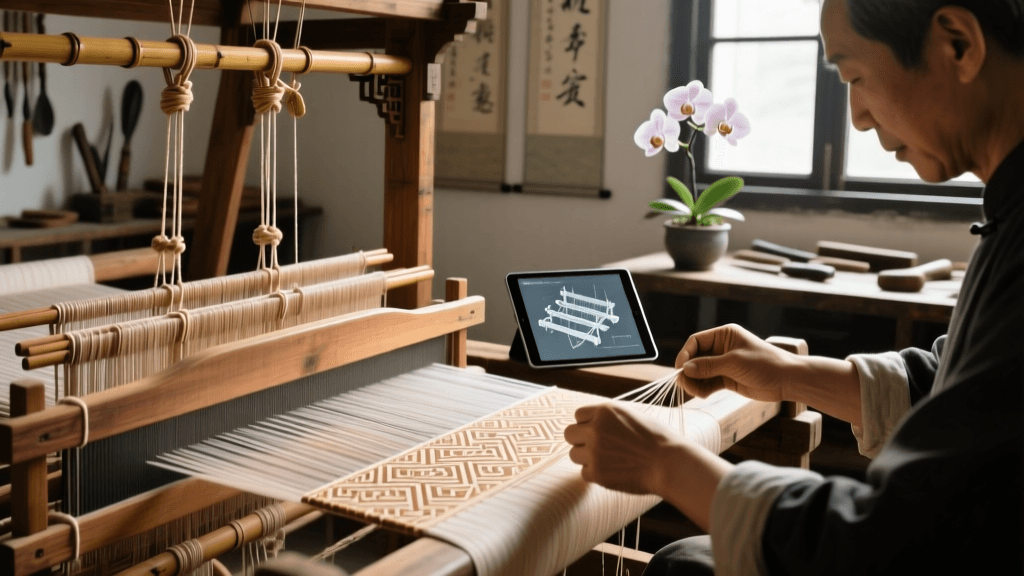
The Hualou (literally "flower loom") is a massive, two-story wooden drawloom that requires the synchronized effort of two highly trained artisans: the weaver, who sits at the lower level managing the shuttle and ground warp, and the "drawboy" (or drawgirl), who sits atop the loom's wooden tower manipulating the pattern harnesses. Unlike modern power looms that rely on electronic punch cards or digital Jacquard heads, the Hualou operates on a physical, mnemonic system of knotted cords known as the huaben (pattern book).
The Harness System: Yaxi and Daxi
The true genius of the Hualou lies in its dual-harness system. The daxi (ground harness) controls the foundational weave structure, typically a warp-faced or weft-faced twill. The yaxi (pattern harness) is connected to the tower above. Each cord in the yaxi corresponds to a specific warp thread. When the drawboy pulls a specific sequence of cords based on the weaver's vocal cues, individual warp threads are lifted, creating the "shed" through which the weaver passes the shuttle laden with supplementary weft threads—often spun gold, silver, or peacock feather filaments.
A single complex Yunjin brocade pattern can require over 12,000 individual pattern cords. The physical toll on the drawboy is immense, and the mental synchronization required between the two weavers is often compared to a choreographed dance. In 2026, ergonomic modifications and specialized shock-absorbing seating have been introduced in preservation workshops to protect the joints of master artisans, though the fundamental mechanics remain entirely unchanged from the Ming Dynasty.
The Brocade Trinity: Shu, Song, and Yunjin
Chinese brocade weaving is traditionally categorized into three major regional styles, each utilizing variations of the drawloom technique. As of 2026, the market valuation and application of these textiles in high-end Xin Zhongshi garments vary significantly based on their weave structure and material composition. The Metropolitan Museum of Art's Heilbrunn Timeline of Art History notes that these regional variations developed distinct aesthetic vocabularies based on local trade routes and imperial patronage.
| Brocade Type | Origin Region | Loom Variation | Defining Characteristic | 2026 Avg. Price (Per Meter) |
|---|---|---|---|---|
| Shu Brocade | Chengdu, Sichuan | Multi-harness Drawloom | Vibrant, warp-faced patterns; highly durable; utilizes local plant dyes. | ¥18,000 - ¥25,000 RMB |
| Song Brocade | Suzhou, Jiangsu | Standard Hualou | Flat, matte finish; intricate geometric and floral motifs; heavily used in scroll mounting. | ¥22,000 - ¥35,000 RMB |
| Yunjin | Nanjing, Jiangsu | Large-scale Hualou | "Cloud-like" weft-faced patterns; incorporates real gold leaf and peacock feathers. | ¥80,000 - ¥150,000+ RMB |
2026 Preservation: AI and the Huaben Pattern Books
One of the most critical challenges facing traditional Chinese weaving in 2026 is the deterioration of antique huaben (pattern manuals). These physical "programs" made of knotted cords dictate the exact sequence of the drawboy's pulls. When a master artisan passes away without an apprentice to inherit the physical huaben, the pattern is effectively lost.
To combat this, the China National Silk Museum in Hangzhou, alongside several university textile labs, has deployed advanced 3D scanning and AI-driven topological mapping to digitize surviving huaben. By translating the physical knots into digital Jacquard punch-card equivalents, institutions are creating open-source archives for academic study. However, purists and master weavers maintain that the soul of the textile lies in the micro-tensions of the hand-drawn cord—a nuance that AI can map, but cannot replicate on a power loom. This distinction is what separates a genuine Hualou-woven garment from a mass-produced Jacquard replica, a crucial factor for collectors investing in heritage fashion pieces this year.
Practical Guide: Studying and Sourcing in 2026
For textile enthusiasts, fashion designers, and historians looking to engage with Chinese traditional looms in 2026, there are several actionable pathways to experience, study, and source authentic pieces.
1. Immersive Masterclasses and Workshops
Several heritage institutes now offer structured programs for international and domestic students. The Nanjing Yunjin Institute and the Chengdu Shu Brocade Museum both host intensive 14-day masterclasses. In 2026, tuition for these programs averages around ¥12,500 RMB (approximately $1,750 USD), which includes materials, loom time, and translation services. Participants learn the fundamentals of warp threading, shuttle throwing, and the vocal communication required to operate the Hualou. Note that mastering the drawboy's cord-pulling technique takes years of physical conditioning, so these courses focus on foundational theory and basic pattern execution.
2. Sourcing Authentic Hualou Brocades
With the explosion of the Xin Zhongshi aesthetic, the market is flooded with power-loom imitations. To ensure you are purchasing authentic hand-drawn brocade, look for the following indicators:
- The Reverse Side: Authentic Hualou brocades, particularly Yunjin, feature a remarkably clean reverse side where supplementary weft threads are tightly bound. Machine-made Jacquard imitations often show long, loose "floats" on the back.
- Gold Thread Composition: Traditional Yunjin uses pianjin—gold leaf applied to a paper or animal membrane backing, then sliced into microscopic strips and wrapped around a silk core. Modern fakes use synthetic metallic yarns (Lurex), which reflect light uniformly and lack the organic, multi-faceted shimmer of real gold leaf.
- Selvedge Marks: Master weavers often incorporate a distinct, tightly woven selvedge that bears the seal of the specific workshop or the artisan's signature thread, a practice heavily regulated by provincial heritage boards in 2026.
3. Acquiring Miniature and Study Looms
Full-scale Hualou drawlooms are massive structures, often measuring over 4 meters long and 3 meters high, making them impossible for most private collectors to house. However, in 2026, several specialized woodworking ateliers in Suzhou produce 1:4 scale functional miniature drawlooms. Priced between ¥25,000 and ¥40,000 RMB, these miniatures are fully operational and are used by textile universities and serious hobbyists to study the mechanics of the yaxi and daxi harnesses without requiring a two-story ceiling. When commissioning a miniature loom, ensure the artisan uses traditional mortise-and-tenon joinery without metal nails, preserving the acoustic and structural integrity of the original Ming-era designs.
The Future of Ancient Weaving
The survival of the Chinese Hualou drawloom is a testament to the enduring value of human touch in an increasingly automated world. As 2026 sees a deeper integration of heritage textiles into contemporary global fashion, the artisans perched atop these towering wooden looms remain the vital bridge between ancient imperial aesthetics and modern sartorial innovation. Whether you are a collector verifying the authenticity of a Song brocade jacket, a designer seeking inspiration from digital huaben archives, or a student preparing for a masterclass in Chengdu, understanding the profound mechanics of these ancient looms enriches our appreciation for one of Asia's most spectacular textile traditions.