Decoding Chinese Garment Color Codes: Rank, Symbolism & Guide
The Cosmology of Color: Wuxing and the Five Elements
When exploring the rich tapestry of Asian traditions, few elements are as meticulously regulated and deeply symbolic as traditional Chinese clothing. From the flowing sleeves of the Hanfu to the structured elegance of the Qipao and the formal dignity of the Tangzhuang, every thread tells a story. However, beyond mere aesthetics, historical Chinese garments were governed by strict color codes, cosmological beliefs, and sumptuary laws that dictated who could wear what, and when. Understanding these color codes and rank symbols is not just an academic exercise; it is essential for modern enthusiasts, collectors, and brides seeking authentic traditional attire. This guide decodes the historical symbolism of Chinese garment colors and provides actionable, practical advice for sourcing, measuring, and commissioning bespoke traditional clothing today.
The foundation of Chinese color symbolism is rooted in the Wuxing, or the Five Elements theory, which intertwines with the philosophy of Yin and Yang. According to this ancient cosmological framework, the universe is composed of five fundamental elements: Wood, Fire, Earth, Metal, and Water. Each element corresponds to a specific cardinal direction, season, and, most importantly for textile artisans, a primary color. Wood is associated with green and the east; Fire with red and the south; Earth with yellow and the center; Metal with white and the west; and Water with black and the north. As noted in the Metropolitan Museum of Art's Heilbrunn Timeline of Art History, the mastery of silk dyeing in ancient China allowed artisans to translate these profound philosophical concepts into vibrant, wearable art. These colors were not merely decorative; they were believed to harmonize the wearer with the cosmos, bringing auspicious energy and warding off malevolent forces.
Sumptuary Laws and Imperial Rank
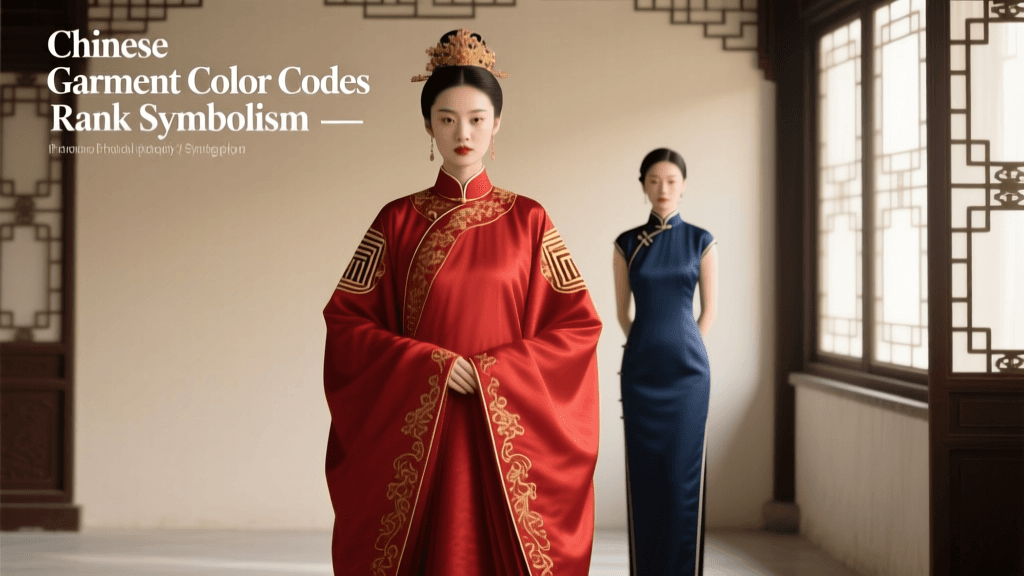
As dynasties evolved, particularly during the Ming (1368–1644) and Qing (1644–1912) eras, these cosmological colors were codified into rigid sumptuary laws. The color yellow, representing the Earth and the center of the universe, became the exclusive prerogative of the Emperor. The wearing of bright yellow by anyone else was considered an act of treason. Meanwhile, red, symbolizing fire, joy, and good fortune, became the ubiquitous color for weddings, festivals, and high-ranking civil officials. Black and blue were often reserved for scholars, lower-ranking officials, and the working class, though deep indigo and black held their own dignified symbolism, representing water, wisdom, and steadfastness. As detailed in Encyclopedia Britannica's comprehensive overview of Chinese dress, these sumptuary laws ensured that a person's social rank, profession, and even their moral standing could be read instantly from a distance.
Decoding the Buzi: Mandarin Squares and Civil/Military Rank
Beyond solid colors, rank was vividly displayed through the Buzi, or Mandarin squares. These intricately embroidered badges were affixed to the chest and back of official robes. Civil officials wore squares featuring birds, representing elegance and literary refinement, while military officials wore squares depicting beasts, symbolizing courage and martial prowess. For example, the first-rank civil official wore the crane, the pinnacle of avian elegance, while the ninth-rank wore the quail. On the military side, the first-rank commander bore the qilin (a mythical chimerical beast), and the ninth-rank wore the rhinoceros. The Metropolitan Museum of Art's overview of the Qing Dynasty highlights how these badges were not merely decorative but served as a strict bureaucratic uniform, ensuring immediate recognition of authority in the sprawling imperial court.
Table: Traditional Chinese Color Codes, Elements, and Rank Associations
| Color | Wuxing Element | Cosmological Meaning | Historical Rank & Usage |
|---|---|---|---|
| Yellow | Earth | Center, Stability, Imperial Power | Exclusive to the Emperor and immediate royal family. |
| Red | Fire | South, Joy, Prosperity, Vitality | High-ranking officials, brides, grooms, and festive occasions. |
| Green | Wood | East, Spring, Growth, Virtue | Lower-ranking officials, scholars, and Tang dynasty brides. |
| White | Metal | West, Autumn, Purity, Mourning | Traditionally associated with mourning and funerals; avoided in weddings. |
| Black | Water | North, Winter, Wisdom, Depth | Scholars, philosophers, and commoners; Qin dynasty imperial color. |
Practical Guide: Buying and Tailoring Traditional Attire Today
1. Sourcing Authentic Fabrics and Understanding Costs
Transitioning from history to the modern wardrobe, how does one apply this knowledge when purchasing or commissioning traditional garments today? Whether you are buying a Qipao (Cheongsam) for a formal event or a Hanfu for a traditional wedding, understanding fabrics, measurements, and costs is crucial. For a bespoke Qipao, the silhouette demands absolute precision. A master tailor will require a minimum of 12 to 16 distinct measurements. Beyond the standard bust, waist, and hips, you must provide the hollow-to-hem length, shoulder slope, armhole depth, bicep circumference, and neck base circumference. The timing for a bespoke, hand-stitched Qipao is typically 6 to 8 weeks. If you are sourcing authentic Xiangyunsha (gambiered Canton gauze) silk—a highly prized, mud-dyed silk known for its cooling properties and distinct crackling sound—expect to pay between $80 and $150 per yard for the fabric alone, with bespoke tailoring fees in Shanghai or Hong Kong ranging from $400 to $1,200 depending on the complexity of the embroidery and the use of traditional Pankou (knotted buttons).
2. Navigating Historical Accuracy in Hanfu Weddings
For those exploring Hanfu, particularly for weddings, historical accuracy offers fascinating color alternatives to the modern default of bright red. While Ming dynasty wedding attire heavily favored red and gold to symbolize fire and prosperity, Tang dynasty brides often wore green. In Tang cosmology, a green bridal gown symbolized the Wood element, representing vitality, the sanctity of the groom's family, and the bride's enduring virtue. If you are commissioning a Ming-style Da Shan (large collar shirt) and Mang Ao (python jacket), opt for authentic Song Brocade or Yun Brocade. Real Yun Brocade, woven with peacock feather threads and real gold foil, is exceptionally rare and can cost upwards of $300 per yard. A more accessible but historically accurate alternative is high-quality mulberry silk jacquard, which costs around $35 to $60 per yard. When ordering Hanfu online or from a tailor, always measure your 'Tong Xiu' (total sleeve length from center back to wrist) and 'Yao Wei' (waist circumference), as traditional garments rely heavily on flat-pattern cutting rather than the darted, three-dimensional tailoring of Western or Qipao garments.
Conclusion
Ultimately, the colors and ranks woven into Asian traditional garments are a testament to a civilization that viewed clothing as a microcosm of the universe. By respecting these historical color codes and understanding the practical realities of modern bespoke tailoring, you do more than wear a beautiful garment; you become a custodian of a profound cultural legacy. Whether draped in the auspicious red of a Ming bride or the scholarly indigo of a Tang poet, your attire will resonate with centuries of philosophical depth and artisanal mastery.