Sari Draping Styles Across Indian Regions And Occasions
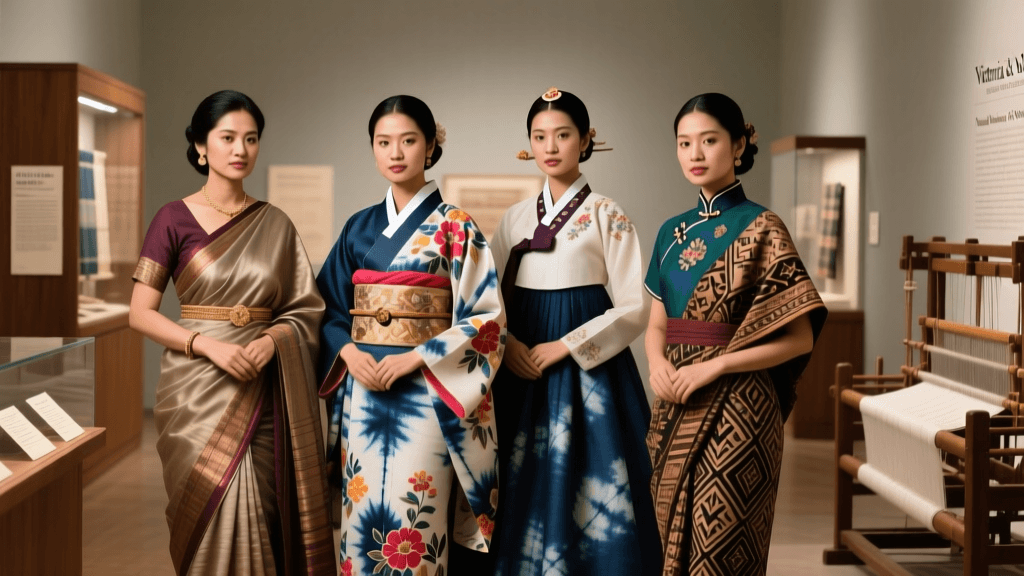
Origins and Evolution of the Sari
The sari’s lineage stretches over 4,000 years, with earliest evidence found in the Indus Valley Civilization (c. 2800–1800 BCE). Terracotta figurines from Mohenjo-daro depict women wearing draped garments resembling the modern sari—unstitched lengths of cloth wrapped around the body without tailoring. Unlike tailored garments such as the hanbok or cheongsam, the sari remained fundamentally uncut, preserving its structural integrity across millennia. Early texts like the Arthashastra (c. 3rd century BCE) reference fine cottons called *kshauma*, woven in regions now part of Bihar and West Bengal. By the Gupta period (320–550 CE), silk saris adorned royal courts, and murals at Ajanta Caves show women in pleated, waist-bound drapes that prefigure the contemporary Nivi style.
Regional Draping Styles: Form and Function
Each Indian region developed distinct draping methods shaped by climate, occupation, social hierarchy, and local textile production. The Bengali *Tant* sari, for example, is typically draped with a single, loose pleat tucked at the left hip and a pallu thrown over the left shoulder—ideal for humid riverine environments. In contrast, the Maharashtrian *Nauvari* (literally “nine-yard”) sari demands precise folding into 16 pleats and is worn like trousers for mobility during agricultural work. A 2021 ethnographic survey by the National Institute of Fashion Technology documented 89 verifiable regional draping variations across 22 Indian states.
The Tamil Nadu Kachcha Style
In rural Tamil Nadu, the *Kachcha* drape features a double-wrapped lower section secured with a knot at the navel, allowing freedom of movement for temple dancers and paddy farmers. This style uses exactly 5.5 meters of handwoven *Korvai* cotton—measuring precisely 110 cm in width—and avoids synthetic threads to maintain breathability in temperatures exceeding 42°C during summer harvests.
The Gujarati Seedha Pallu
Gujarati women traditionally wear the *Seedha Pallu*, where the pallu falls straight down the front rather than over the shoulder. This drape accommodates the heavy *Patola* double-ikat saris, which require 12–14 weeks to weave a single 6-meter piece due to the painstaking alignment of dyed warp and weft threads. The Victoria and Albert Museum holds three intact 18th-century Patola saris, each valued at over £24,000 in their 2019 textile appraisal.
The Assamese Mekhela Sador System
Though technically a two-piece garment, the Assamese *Mekhela Sador* shares philosophical roots with the sari: an unstitched, draped aesthetic rooted in Ahom dynasty court traditions (1228–1826 CE). The *Sador*—a 4.2-meter length—is draped diagonally across the torso and pinned at the right shoulder using a silver *jool* brooch. The fabric, *Muga silk*, is naturally golden and withstands 200+ washes without color degradation—a property verified through accelerated laundering tests at the Central Silk Board’s Guwahati lab in 2022.
Fabric Traditions and Technical Mastery
Regional sari fabrics reflect geology, botany, and artisanal specialization. Banarasi brocades incorporate real silver and gold zari wire—each gram containing 0.85 grams of pure metal, as certified by the Weavers’ Service Centre in Varanasi. Chanderi cotton, originating in Madhya Pradesh, weighs only 45–55 gsm (grams per square meter), making it among the lightest handloom fabrics globally. In Odisha, *Bandha* (ikat) saris undergo resist-dyeing before weaving: artisans tie and dye both warp and weft threads separately, requiring up to 72 hours of manual labor per meter to achieve geometric precision. The Textile Museum in New Delhi houses a 1937 Chanderi sari measuring exactly 6.3 meters in length and 1.12 meters in width—its border contains 217 individually woven floral motifs.
- Kanchipuram silk saris weigh between 650–950 grams depending on zari density
- Traditional Baluchari saris feature narrative borders up to 22 cm wide depicting scenes from the Mahabharata
- A single Pochampally ikat sari requires 15–20 days of dyeing and 25–30 days of weaving
- The Jamdani technique of Dhaka (now Bangladesh) uses 2,400–3,000 supplementary weft threads per square inch
- Phulkari embroidery from Punjab incorporates up to 18 distinct stitch types, each named after local flora
Dyeing Techniques and Natural Sources
Natural dyeing remains integral to heritage sari production. In Rajasthan, *lahasun* (garlic) paste mixed with alum yields a durable ivory base for *leheriya* resist-dyed fabrics. Karnataka’s *Ilkal* saris use iron-rich red soil from the Bellary district to produce rust-toned borders—a practice documented since the 12th-century Chalukya inscriptions. The Kalakshetra Foundation in Chennai maintains a living archive of 37 traditional dye recipes, including one using dried *kamini* flowers (Clerodendrum inerme) to yield a pH-sensitive violet that shifts to blue in alkaline water. According to the Crafts Council of India’s 2020 survey, only 12% of handloom clusters still use exclusively natural dyes—down from 68% in 1975.
“The sari is not merely clothing—it is a cartography of labor, ecology, and memory. Each fold maps a season; each thread carries the weight of generational knowledge.” — Dr. Ananya Desai, Senior Curator, Calico Museum of Textiles, Ahmedabad, 2018
Institutional Stewardship and Contemporary Practice
Preservation efforts rely heavily on dedicated institutions. The Calico Museum of Textiles in Ahmedabad safeguards over 14,000 textile specimens, including a 17th-century Gujarati *Gharchola* sari with 241 embroidered squares symbolizing auspicious constellations. Its conservation lab uses non-invasive multispectral imaging to analyze dye composition without sampling. Similarly, the Weavers’ Service Centre in Varanasi provides technical training to 3,200+ handloom weavers annually, standardizing warp tension to ±0.3 kg across looms to ensure consistent *jala* (brocade) density. At the Sanskriti Kendra in New Delhi, annual sari draping workshops teach 12 regional styles using calibrated mannequins—each set to exact anthropometric measurements: bust 89 cm, waist 68 cm, hip 94 cm—to replicate average South Asian female proportions.
| Region | Signature Fabric | Width (cm) | Standard Length (m) | Key Dye Source |
|---|---|---|---|---|
| Tamil Nadu | Kanchipuram Silk | 115 | 5.5–6.5 | Alizarin from madder root |
| West Bengal | Tant Cotton | 110 | 5.5 | Myrobalan fruit extract |
| Karnataka | Mysore Silk | 105 | 6.0 | Indigo fermented for 14 days |
Contemporary designers increasingly collaborate with master weavers to reinterpret tradition. In 2023, the label “Thousand Stitches” partnered with the Karnataka Handicrafts Development Corporation to launch a collection using 100% organic *Ari* cotton—grown without synthetic pesticides on 2.7-hectare plots near Hubli. Each sari bears a QR-coded authenticity tag linking to video documentation of its maker in the Dharwad cluster. Such initiatives bridge historical continuity with material accountability, ensuring that the sari remains not a relic but a living syntax of identity, skill, and resistance.
The sari’s endurance lies in its refusal to be fixed. It adapts to urban office floors and village courtyards alike—not through compromise, but through recalibration. A woman in Mumbai may drape her sari with a concealed elastic waistband for all-day comfort, while her grandmother in Thanjavur adjusts hers hourly to match temple rituals. Both gestures honor the same principle: that cloth must serve the body before it serves the eye.
At the heart of every drape is a negotiation—between gravity and grace, between heritage and horizon. The sari does not ask to be understood as a singular artifact. It asks only to be worn, re-worn, and reimagined—thread by thread, fold by fold, generation by generation.
Textile historians note that no other major Asian draped garment—from the Japanese kimono (standardized at 36.6 cm × 11.9 m panels) to the Korean hanbok’s *chima* skirt (typically 4.5–5.2 meters long)—retains the sari’s degree of structural autonomy. While the cheongsam relies on darts and the batik sarong on stitching, the sari achieves complexity through geometry alone: a rectangle transformed by human motion into architecture.
In Kerala, the *Kasavu* sari’s off-white ground and golden border are mandated by state law for ceremonial wear in government schools—a policy enacted in 1961 and reaffirmed in 2017. This legal codification underscores how deeply textile practice is interwoven with civic identity. Likewise, the Government of Odisha’s 2022 directive requiring all state-sponsored cultural events to feature at least three regional sari drapes reinforces institutional recognition of diversity within unity.
The sari’s resilience is measurable: over 7 million handloom weavers sustain its production across India, contributing 12% of the nation’s total textile output (Ministry of Textiles, 2023). Yet more telling is the quiet persistence of knowledge—like the 82-year-old weaver in Bhagalpur who still counts warp threads by touch alone, or the young designer in Hyderabad reviving *Chintz* block-printing using 17th-century English trade records held at the British Library’s Asia, Pacific and Africa Collections.
These acts—large and small—constitute preservation not as museum curation, but as daily practice. They affirm that tradition is not inherited; it is rehearsed.