2026 Chinese Fashion History Research: 3D Drape Analysis
The Digital Renaissance of Chinese Fashion History in 2026
The academic study of Chinese fashion history has entered an unprecedented era of technological integration in 2026. No longer confined to the careful examination of fragile, decomposing silk fragments in climate-controlled vaults, researchers and university students are now leveraging advanced digital humanities to resurrect ancient garments. The intersection of traditional textile analysis and 3D fabric drape simulation has revolutionized how we understand the movement, structure, and cultural significance of historical Chinese clothing, from the flowing Shenyi of the Han Dynasty to the elaborate Ruqun of the Tang era.
For students, educators, and independent researchers, mastering these digital tools is no longer optional; it is a fundamental requirement for publishing in top-tier fashion history journals and securing academic grants. This comprehensive guide explores the methodologies, software, hardware, and academic programs defining Chinese fashion history research in 2026.
The Shift from Physical Archives to Digital Twins
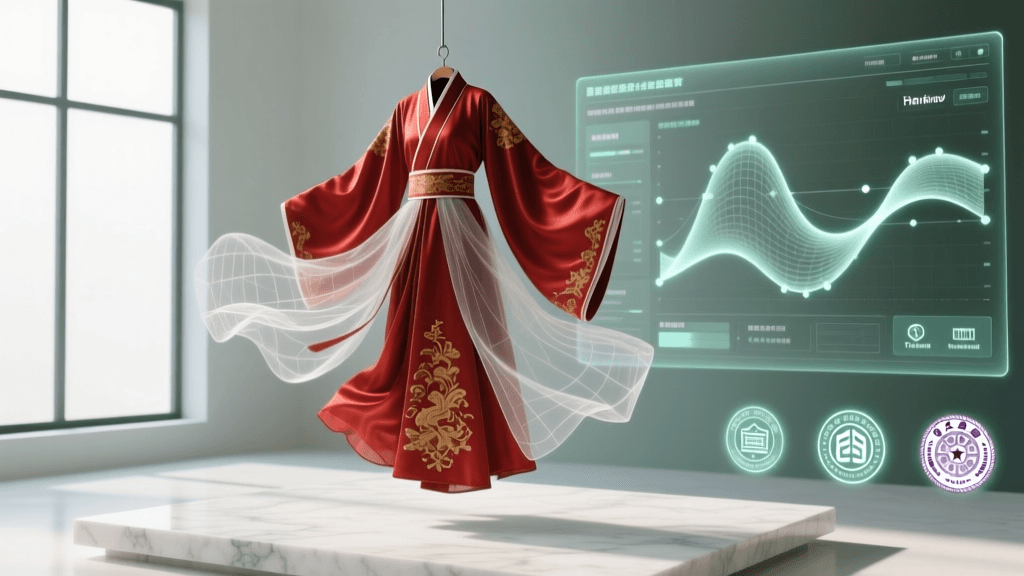
Historically, the primary challenge in Chinese fashion education was the inability to observe garments in motion. Ancient paintings and terracotta statues provide static glimpses of how fabrics draped, but they cannot convey the kinetic energy of a silk luo (gauze) robe catching the wind, or the heavy, structured fold of a Ming Dynasty zhuanghua (brocade) jacket. In 2026, the creation of 'digital twins'—physics-accurate 3D replicas of historical garments—allows researchers to run kinetic simulations. By inputting precise physical data of modern, historically accurate silk reproductions into virtual environments, academics can test hypotheses regarding ancient tailoring techniques, layering methods, and the socio-economic implications of fabric consumption.
Mastering 3D Fabric Drape Analysis for Hanfu Studies
The core of modern academic research in this field relies on bridging the gap between physical material science and virtual rendering. To achieve a historically accurate simulation of a Han Dynasty curved-hem robe, researchers must follow a rigorous, multi-step data collection process.
Step 1: Physical Fabric Testing via KES-FB
Before a digital simulation can occur, the physical properties of the textile must be quantified. Researchers utilize the Kawabata Evaluation System for Fabrics (KES-FB) to measure the exact mechanical properties of historically replicated silks. In 2026, university labs measure five critical parameters:
- Tensile Properties: How much the silk warp and weft stretch under the weight of heavy embroidery.
- Bending Rigidity: Crucial for simulating the stiff drape of heavily sized historical hemp versus the fluid collapse of degummed silk.
- Shear Properties: Determines how the fabric biases and drapes when cut on the diagonal, a common technique in ancient Chinese tailoring to conserve fabric width.
- Compression: How the fabric layers compress against the body when bound by sashes or zuo-ren (left-over-right) closures.
- Surface Friction: Affects how inner layers of Zhongyi (undergarments) glide against outer robes.
Step 2: Translating Data into Virtual Environments
Once the KES-FB data is compiled, it is imported into industry-standard simulation software. Leading academic institutions primarily utilize CLO3D for its robust physics engine and ability to handle complex, multi-layered garment construction. By mapping the physical Kawabata data to the software's material editor, researchers can simulate the exact drape of a 2026 museum-grade reproduction of Mawangdui silk gauze. This allows academics to digitally 'try on' garments on historically accurate 3D body scans, revealing how ancient tailoring accommodated different postures and movements.
Top Academic Programs for Chinese Textile Research in 2026
For prospective graduate students and post-doctoral researchers, selecting the right institution is critical. The following table outlines the leading universities driving Chinese fashion history and digital textile research in 2026.
| Institution | Key Research Lab | 2026 Academic Focus | Est. Annual Grant Funding |
|---|---|---|---|
| Donghua University (Shanghai) | Key Laboratory of Textile Science & Technology | AI-assisted pattern reconstruction of fragmented Silk Road textiles. | $450,000 USD |
| Tsinghua University (Beijing) | Academy of Arts & Design Heritage Lab | Digital archiving of minority ethnic weaving techniques and 3D preservation. | $380,000 USD |
| China Academy of Art (Hangzhou) | Silk and Fashion Innovation Center | Integration of ancient dye chemistry with virtual reality museum exhibitions. | $310,000 USD |
| Beijing Institute of Fashion Technology | Center for Chinese Dress and Ornaments | Kinetic analysis of Ming Dynasty court robes and structural tailoring. | $275,000 USD |
Essential Hardware for a 2026 Digital Garment Lab
Setting up a university-grade or independent digital fashion lab requires significant computational power, particularly when rendering high-polygon simulations of complex embroidery and multi-layered Hanfu. The standard hardware requirements for academic labs in 2026 include:
- Processing & Rendering: Workstations equipped with NVIDIA RTX 5090 or equivalent enterprise GPUs are standard to handle real-time cloth collision and ray-traced rendering of silk luster.
- 3D Scanning Rigs: Photogrammetry arrays utilizing 100+ megapixel synchronized sensors to capture the micro-textures of ancient textile fragments without physical contact.
- Haptic Feedback Gloves: Used in VR environments to allow researchers to 'feel' the simulated resistance and weight of digital brocades, aiding in the understanding of ancient garment manipulation.
- Automated KES-FB Testing Units: The latest 2026 models feature AI-driven optical sensors that reduce fabric testing time by 40% while increasing shear and bend measurement accuracy.
Archiving the Silk Road: Global Collaborations
The study of Chinese fashion history is inherently linked to the vast trade networks of antiquity. Academic research in 2026 heavily emphasizes cross-cultural textile exchanges. The UNESCO Silk Roads Programme has been instrumental in funding international collaborations that trace the migration of weaving techniques, such as the introduction of Persian weft-faced compound twill (jin) into Chinese looms during the Tang Dynasty. Modern researchers use 3D drape analysis to study how these foreign structural influences altered the silhouette of Chinese garments, providing empirical data to support historical trade theories.
Bridging Academia and the Xin Zhongshi Market
Academic research does not exist in a vacuum; it directly fuels the booming Xin Zhongshi (New Chinese Style) fashion movement. In 2026, the global fashion market has seen a massive surge in demand for garments that blend traditional Chinese aesthetics with modern wearability. University research labs frequently partner with international design weeks and commercial brands to ensure that Xin Zhongshi collections are historically grounded. By providing open-source digital libraries of historically accurate patterns and fabric physics data, academics help contemporary designers avoid cultural appropriation and historical inaccuracies, elevating the entire industry.
Global Museum Partnerships and Open-Source Data
The democratization of fashion history research is a hallmark of 2026. Major global institutions are opening their archives to digital researchers. Institutions like the Victoria and Albert Museum have released high-resolution, open-access 3D scans of their Qing Dynasty court textile collections. This allows a student in South America or Africa to download the exact digital topology of a 19th-century dragon robe, apply 2026 fabric simulation physics, and study its construction without needing to travel to London. This global collaboration is dismantling geographical barriers and fostering a new generation of diverse scholars dedicated to Asian textile traditions.
Conclusion: The Future of the Thread
As we navigate through 2026, the fusion of ancient Chinese tailoring wisdom and cutting-edge 3D fabric drape analysis has permanently altered the landscape of fashion history education. By treating historical garments not merely as static artifacts, but as dynamic, kinetic structures, researchers are uncovering lost narratives about the daily lives, movements, and technological prowess of ancient civilizations. For students and academics willing to master the intersection of material science and digital simulation, the future of Chinese fashion history research is boundless, weaving the threads of the past directly into the digital fabric of the future.