Ming Dynasty Court Fashion: Decoding Mang and Feiyu Robes
The Zenith of Chinese Court Dress: The Ming Dynasty
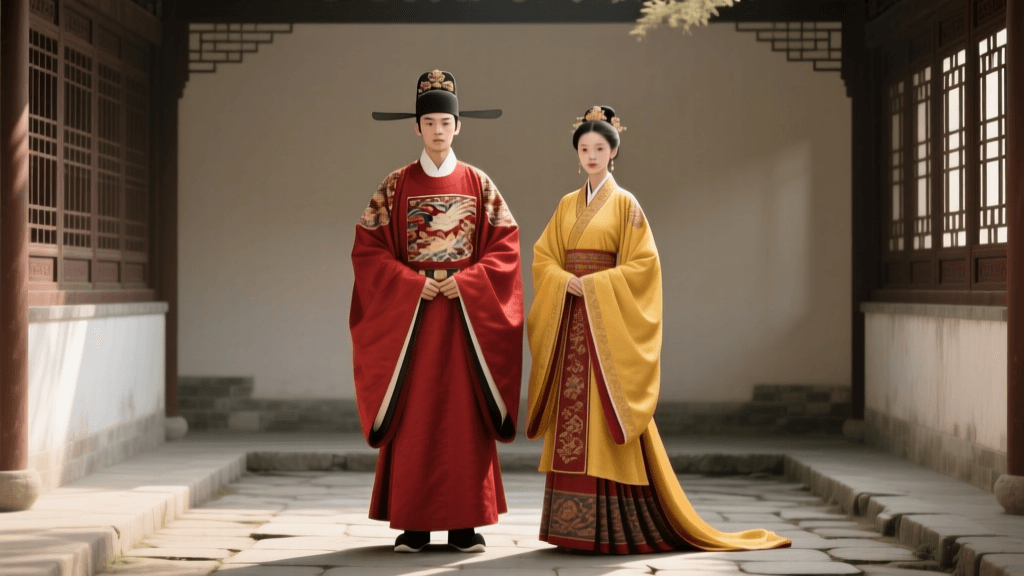
The Ming Dynasty (1368–1644) represents a pinnacle in the evolution of Chinese court fashion, characterized by strict sumptuary laws, intricate weaving techniques, and a profound emphasis on hierarchical symbolism. Following the collapse of the Mongol-led Yuan Dynasty, the Ming emperors sought to restore native Han Chinese cultural identity. This restoration was vividly materialized in the court's sartorial codes, which dictated everything from the color of a garment to the specific mythical beasts woven into its silk threads. According to the Metropolitan Museum of Art's Heilbrunn Timeline, the Ming era saw a conscious, state-sponsored revival of native traditions, resulting in a highly structured and visually magnificent court wardrobe that continues to captivate historians and modern Hanfu enthusiasts alike.
Decoding the Hierarchy: Mang, Feiyu, and Douniu
At the heart of Ming court fashion were the賜服 (cifu), or 'bestowed robes,' granted by the Emperor to high-ranking officials, military generals, and favored courtiers. These robes were not merely clothing; they were wearable manifestations of imperial favor and political power. The most coveted among these were the Mang (Python), Feiyu (Flying Fish), and Douniu (Bullfight) robes. While the five-clawed dragon (long) was strictly reserved for the Emperor, these secondary mythical beasts featured four claws or distinct anatomical variations that denoted elite, yet subordinate, status.
The Feiyu robe, famously worn by the Jinyiwei (the Emperor's elite secret police and ceremonial guards), featured a creature with a dragon-like head, fish-like tail, and the wings of a bat or bird. The Mang robe depicted a four-clawed serpent-like beast, while the Douniu featured a hornless, bull-like dragon. Mistaking these motifs or wearing a robe above one's rank was considered an act of treason, punishable by severe penalties.
| Robe Type | Motif Description | Court Rank / Permission | Modern Replica Cost (USD) |
|---|---|---|---|
| Long (Dragon) | Five-clawed imperial dragon | Emperor and Crown Prince only | $800 - $2,500+ |
| Mang (Python) | Four-clawed dragon-like serpent | High-ranking civil/military officials | $300 - $1,200 |
| Feiyu (Flying Fish) | Dragon head, fish tail, wings | Jinyiwei guards, mid-level elites | $250 - $900 |
| Douniu (Bullfight) | Hornless, bull-like dragon | Lower-ranking bestowed officials | $200 - $750 |
| Qilin | Chimerical hooved beast | Military officers, nobility | $200 - $800 |
Dynasty Evolution: From Tang Fluidity to Ming Structure
To understand Ming court fashion, one must view it through the lens of dynasty evolution. The preceding Tang Dynasty favored fluid, wide-sleeved round-collared robes heavily influenced by Persian and Central Asian trade, utilizing vibrant, contrasting colors and lightweight silks. The Song Dynasty that followed shifted toward a more restrained, scholarly aesthetic with subdued colors and stiff, straight collars. The Ming Dynasty synthesized these eras, rejecting the tight-fitting, narrow-sleeved equestrian garments of the Yuan Dynasty in favor of voluminous, wide-sleeved robes that required the wearer to move with deliberate, dignified grace.
However, the Ming did not entirely discard Mongol influences. The yesa robe—a pleated, side-slit garment originally designed for horseback riding—was adapted into the Ming court as a formal military and guard uniform. As detailed in the Heilbrunn Timeline of Art History on Chinese Textiles, Ming weavers elevated these structural forms by utilizing advanced draw-loom technologies to weave intricate gold and silver metallic threads directly into the silk brocade, creating garments that were structurally imposing and visually blinding in the imperial court's sunlight.
Practical Guide: Commissioning Authentic Ming Replicas
As noted in cultural analyses of the modern revival by Sixth Tone, modern Hanfu enthusiasts demand rigorous historical accuracy, moving away from early 2000s theatrical costumes toward museum-grade replicas. If you are looking to acquire or commission an authentic Ming Dynasty Mang or Feiyu robe today, you must navigate specific tailoring, fabric, and timing requirements.
Measurements and Fit
Ming court robes are characterized by their specific proportions, which differ vastly from modern Western tailoring. When submitting measurements to a bespoke tailor or specialized Hanfu studio, provide the following:
- Center Back to Hem (CB): Measure from the C7 vertebra (the prominent bone at the base of the neck) down to the ankle bone. Ming robes should graze the top of the foot, typically requiring a length of 125cm to 140cm depending on your height.
- Sleeve Length: Measured from the center-back nape, across the shoulder, and down to the wrist. Ming sleeves are designed to extend past the hands when the arms are clasped in front of the body. Expect a total sleeve span of 150cm to 170cm.
- Sleeve Width (Cuff): Formal court robes feature 'pipa' (lute-shaped) or wide straight sleeves. The cuff circumference should be a minimum of 45cm to 60cm to allow for the elegant draping of silk.
- Cross Collar Width: Ensure the tailor uses the traditional 'jiaoling youren' (right-over-left) closure, with a collar width of 8cm to 12cm to frame the face properly without choking the neck.
Fabric Selection and Costs
The material dictates both the historical accuracy and the price of your garment. Avoid cheap, shiny polyester satins, which melt under stage lights and lack historical precedent.
- Entry-Level (Jacquard & Cotton Blends): Off-the-rack polyester jacquard Feiyu robes on platforms like Taobao range from $60 to $120 USD. These are suitable for casual cosplay or beginner enthusiasts but lack the structural weight of real court dress.
- Mid-Tier (Mulberry Silk & Tussah): Woven silk brocades with metallic yarn substitutes (Lurex) cost between $250 and $500 USD. These offer excellent drape and breathability.
- Museum-Grade (Zhuanghua & Song Brocade): Authentic Zhuanghua (woven with real peacock feather threads and gilt silver) or heavy Song brocade replicas from heritage studios like Ming Hua Tang or Shi San Yu cost between $800 and $2,500+ USD. These fabrics are stiff, heavy, and perfectly mimic the architectural silhouette of Ming court wear.
Timing and Care
Bespoke silk weaving and tailoring require significant lead time. Expect a wait of 45 to 90 days for custom-woven brocade robes. Always order at least three months before major cultural festivals, historical reenactment events, or traditional weddings. Due to the metallic threads and delicate silk structures, these robes must never be machine washed or submerged in water. Dry clean only, and store them flat or loosely rolled in acid-free tissue paper to prevent the metallic threads from cracking or tarnishing.
Essential Court Accessories
A Ming court robe is incomplete without its accompanying regalia. To achieve a fully accurate silhouette, you must invest in the following accessories:
- Wusha Mao (Black Gauze Cap): The iconic winged hat worn by Ming officials. Authentic replicas use bamboo frames covered in stiffened black silk gauze. Cost: $40 - $150 USD.
- Court Boots: Black leather or thick cotton boots with thick white soles (chaodi). The elevated sole forces the wearer to take slow, measured steps, preventing the heavy silk robes from dragging in the dirt. Cost: $60 - $120 USD.
- Rank Belts: Depending on the robe, a jade, horn, or gold-inlaid leather belt is worn around the waist to secure the heavy pleats of a yesa or round-collared robe. Cost: $80 - $300 USD.
Conclusion
The Mang and Feiyu robes of the Ming Dynasty are far more than historical artifacts; they are masterclasses in textile engineering, political symbolism, and sartorial hierarchy. By understanding the evolutionary context of these garments and adhering to strict tailoring and material guidelines, modern collectors and enthusiasts can accurately resurrect the majesty of the Chinese imperial court, ensuring these magnificent traditions continue to be worn, studied, and revered in the modern era.