Mastering the Chinese Drawloom: 2026 Zhuanghua Weaving Guide
The Resurgence of Nanjing Cloud Brocade in 2026
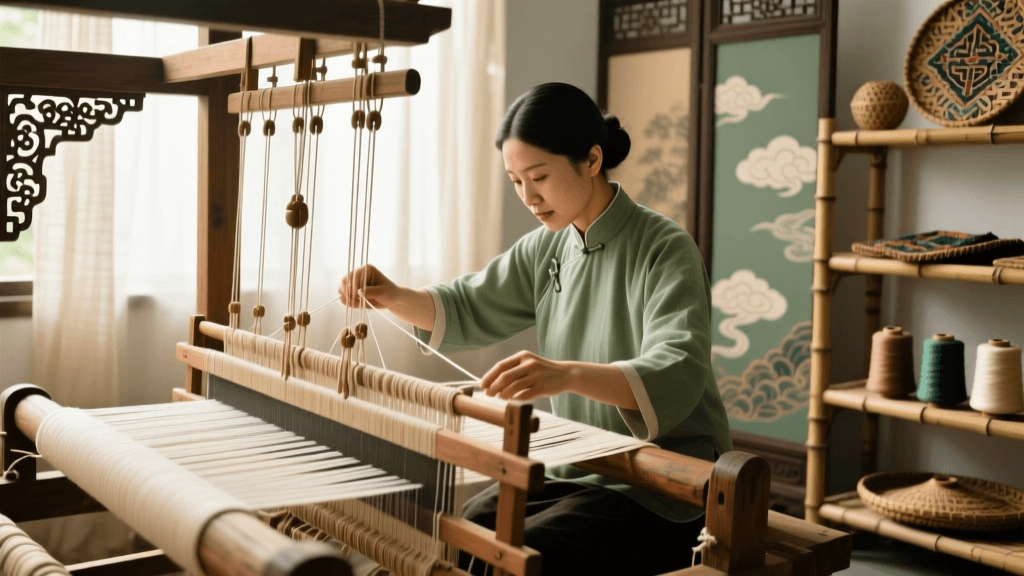
The Hua Lou (花楼), or traditional Chinese drawloom, represents one of the most complex and historically significant weaving apparatuses in human history. Used primarily for creating Zhuanghua (Nanjing Cloud Brocade), this ancient technology has experienced a massive renaissance among textile artisans and heritage preservationists in 2026. Unlike the automated Jacquard looms that eventually replaced them in the industrial era, traditional drawlooms require a profound, tactile connection between the weaver, the drawboy (pattern puller), and the silk itself. Today, mastering the Zhuanghua technique is not just an act of historical preservation; it is a highly sought-after skill in the luxury textile and haute couture markets.
Zhuanghua is famous for its intricate, multi-colored patterns and the integration of precious materials like gold foil and peacock feather yarns. According to the China National Silk Museum, the meticulous process of creating cloud brocade remains one of the few textile arts that still resists full automation, preserving the intangible cultural heritage of ancient Chinese weaving. For modern artisans in 2026, setting up a studio dedicated to the Hua Lou requires a deep understanding of traditional mechanics, precise environmental controls, and access to specialized silk threads.
Anatomy of the Hua Lou: Understanding the Drawloom
The traditional Hua Lou is a masterpiece of wooden engineering, typically constructed from aged elm or beech to withstand the immense tension of silk warps. The loom is operated by two individuals: the weaver, who sits at the front managing the ground harness and shuttle, and the drawboy, who sits atop the elevated wooden frame (the 'flower tower') pulling the figure harness cords to create the intricate pattern sheds.
In 2026, while purists still utilize full-scale antique restorations, many independent studios have adopted hybrid drawlooms. These modernized versions maintain the traditional wooden figure harness but integrate automated draw-assist motors and laser-guided shed alignment, allowing solo artisans to weave complex brocades without a second person. Below is a comparison of the primary loom setups available to weavers this year.
| Loom Type (2026 Models) | Footprint | Harness Capacity | Avg. Cost (USD) | Best For |
|---|---|---|---|---|
| Traditional Elm Hua Lou | 4.0m x 2.5m | 12,000+ heddles | $14,500 - $18,000 | Heritage studios, master weavers |
| 2026 Hybrid Studio Drawloom | 2.5m x 1.5m | 6,000 heddles | $6,200 - $8,500 | Solo artisans, boutique fashion |
| Desktop Jacquard-Adapter | 1.2m x 0.8m | 1,200 heddles | $1,800 - $2,400 | Students, sampling, hobbyists |
Sourcing Authentic Materials for Zhuanghua Weaving
The soul of Zhuanghua lies in its materials. Sourcing the correct silk and metallic threads in 2026 requires a nuanced understanding of denier counts and traditional metallurgy. Unlike standard tabby weaving, cloud brocade relies on a combination of foundational warp threads and supplementary, heavily decorated weft threads.
1. Mulberry Silk (Sang蚕丝)
For the ground warp, you must source high-grade, degummed mulberry silk. In 2026, the industry standard for Zhuanghua warp is a 20/22 denier thread, twisted to provide maximum tensile strength. The weft typically utilizes a slightly thicker 27/29 denier thread to give the brocade its characteristic plush, three-dimensional relief. Expect to pay approximately $140 to $180 per kilogram for premium, ethically sourced, continuous-filament mulberry silk from established cooperatives in Zhejiang and Jiangsu provinces.
2. Gold and Silver Foil Threads
Authentic Zhuanghua incorporates 'Yinxi' (silver) and 'Jinxi' (gold) threads. Historically, these were made by slicing ultra-thin gold leaf adhered to paper or animal intestine into microscopic strips, which were then spiral-wrapped around a silk core. While traditional paper-backed gold threads are still produced for museum-grade restorations, most 2026 commercial studios use advanced Lurex alternatives or modern mylar-backed gold foils that resist tarnishing and humidity degradation. However, if you are weaving for the luxury heritage market, authentic paper-backed gold thread remains mandatory, costing upwards of $45 per meter.
3. Peacock Feather Yarn
One of the most stunning elements of high-end cloud brocade is the incorporation of peacock feather filament. Artisans in 2026 can purchase pre-spun peacock silk blends, where the iridescent barbs of the feather are twisted with a fine silk binder. This creates a weft thread that shifts color dynamically in the light, a hallmark of imperial-era Zhuanghua.
Step-by-Step: Setting Up Your Pattern Harness
The most daunting aspect of the Hua Lou is the 'Jie Ben' (knotting the pattern cords). This is the physical programming of the loom, where the design is translated into a network of cords that the drawboy will pull. Here is the actionable setup process for a standard 2026 hybrid drawloom:
- Drafting the Pattern Grid: Begin by translating your digital or hand-drawn motif into a point-paper grid. Each square represents one warp end and one weft pick. In 2026, many weavers use specialized CAD textile software to generate the tie-up schematics, which are then printed on large-format plotters for reference.
- Threading the Heddles: Thread the ground warp through the front harness heddles and the reed. Ensure your tension is uniformly set to approximately 450 grams per thread, utilizing a digital tension meter to prevent silk breakage during the beat-up phase.
- Tying the Figure Cords: Working from the back of the loom upward, tie the figure harness cords to the specific warp threads dictated by your pattern grid. Use a traditional 'slip-knot' method that allows for quick correction. A standard 10cm x 10cm motif repeat can require over 4,000 individual knots.
- Testing the Shed: Before introducing the precious gold or peacock wefts, weave a 5cm sample using cheap cotton yarn. Check for 'floats' (missed tie-ups) and ensure the shed opens cleanly to at least 4 centimeters, allowing the thick brocade shuttles to pass without snagging.
Integrating 2026 Technology with Ancient Methods
While the core mechanics of the Hua Lou remain unchanged for centuries, 2026 has introduced remarkable technological aids for the solo artisan. Augmented Reality (AR) weaving glasses are now being utilized by advanced studios. By wearing these lightweight headsets, the weaver can see a digital overlay of the next weft color and the exact shed alignment projected directly onto the warp. This drastically reduces errors when working with complex, multi-colored 'Zhuang' (make-up) wefts.
Furthermore, the historical context of these techniques is more accessible than ever. As noted in the Metropolitan Museum of Art's Heilbrunn Timeline, the evolution of silk weaving along the Silk Road fundamentally shaped global textile history. Today's weavers can study high-resolution, 3D-scanned artifacts from imperial collections online, allowing them to reverse-engineer ancient tie-up sequences that were once lost to time. For those seeking foundational knowledge on the structure of these textiles, Britannica's comprehensive guide to brocade textiles provides an excellent overview of the supplementary weft techniques that define the Zhuanghua style.
Environmental Control and Loom Maintenance
Silk is a highly hygroscopic protein fiber. If the air in your studio is too dry, the warp threads will become brittle and snap under the tension of the reed. If it is too humid, the silk will absorb moisture, expand, and cause the shed to stick, ruining the tension.
- Optimal Humidity: Maintain your studio at exactly 60% to 65% Relative Humidity (RH). In 2026, smart ultrasonic humidifiers integrated with IoT hygrometers can automatically adjust the moisture levels in real-time, ensuring the silk remains pliable.
- Temperature: Keep the ambient temperature steady at 21°C to 23°C (70°F to 73°F). Fluctuations in temperature cause the wooden frame of the Hua Lou to expand and contract, which alters the warp tension.
- Wood Maintenance: The wooden pulleys and guides of the drawloom must be treated annually with natural tung oil or beeswax. Avoid synthetic lubricants, as they can off-gas and degrade the delicate gold foil threads resting near the harness.
The Economics of Handwoven Cloud Brocade Today
Mastering the Chinese drawloom is an investment of both time and capital. Zhuanghua is famously slow to produce; a highly skilled weaver and drawboy team can only produce about 5 to 6 centimeters of authentic cloud brocade per day. In the 2026 luxury market, handwoven Nanjing Cloud Brocade commands staggering prices, often ranging from $800 to over $2,500 per meter, depending on the density of the gold thread and the complexity of the motif.
For independent artisans, the key to profitability lies in bespoke, small-batch commissions for haute couture houses, heritage restoration projects, and high-end interior design. By combining the ancient, meditative discipline of the Hua Lou with modern 2026 studio efficiencies and premium material sourcing, today's weavers are not just preserving a relic of the past—they are actively shaping the future of luxury Asian textile arts.
'To weave the clouds of Nanjing is to capture the breath of the dragon in silk and gold. The loom does not merely make cloth; it weaves time itself.' — Traditional Weaver's Proverb