Chinese Couture: Traditional Silk and Embroidery on Global Runways
The Global Ascent of Chinese Couture Aesthetics
The intersection of traditional Chinese garments and international haute couture represents one of the most dynamic cross-cultural exchanges in modern fashion history. From the sweeping silk trains of Paris runways to the intricate beadwork seen in Milan, Chinese aesthetics have transcended mere orientalism to become foundational elements of global luxury design. The Metropolitan Museum of Art's landmark exhibition, China: Through the Looking Glass, highlighted how deeply Chinese art, film, and historical garments have permeated Western fashion consciousness, moving beyond pastiche into genuine structural and textile innovation. For contemporary designers, stylists, and atelier directors, understanding the technical specifications, sourcing realities, and historical context of these traditional elements is crucial for creating authentic, high-end couture that respects its origins while pushing the boundaries of modern luxury.
Key Traditional Elements in Modern Haute Couture
Suzhou Embroidery (Su Xiu)
Suzhou embroidery, or Su Xiu, is renowned for its delicate, almost photorealistic stitching and the meticulous splitting of silk threads. Master artisans can split a single silk thread into 16, 32, or even 48 finer strands to achieve imperceptible color gradients and microscopic detail. In the context of international couture, Su Xiu is frequently utilized for bodices, jacket panels, and sweeping train appliqués. Unlike standard machine embroidery, authentic hand-embroidered Su Xiu requires a profound investment of time and capital. The cost of authentic, hand-embroidered Su Xiu panels can range from $1,500 to over $5,000 per square meter, depending on the density of the stitching and the mastery level of the artisan. Lead times for custom couture panels typically span three to six months, necessitating early integration into the couture design calendar.
Silk Brocade and Sericulture
The foundation of Chinese luxury fashion is its silk. As recognized by UNESCO's Intangible Cultural Heritage list, the sericulture and silk craftsmanship of China represent millennia of refined textile engineering. In modern couture, heavy silk brocades such as Shu brocade from Sichuan and Yun brocade from Nanjing are favored for their structural integrity and opulent metallic threading. These fabrics feature complex jacquard weaves that incorporate gold and silver foil threads, providing a natural stiffness that is ideal for sculptural corsetry, architectural collars, and voluminous A-line skirts without the need for excessive synthetic interfacing.
Silhouette Adaptations: The Mamianqun
The Mamianqun, or horse-face skirt, has seen a massive resurgence, transitioning from historical Hanfu revivals to high-fashion runways. The skirt consists of two overlapping panels with flat fronts and heavily pleated sides. In couture, adapting the mamianqun requires precise mathematical calculations for the pleat depth. Designers often utilize high-twist crepe silk or heavy brocade to maintain the structural integrity of the knife pleats without excessive bulk at the waistband. A standard couture mamianqun might feature 12 to 16 knife pleats per side, with each pleat measuring exactly 2.5 centimeters in depth, secured by internal silk organza tapes to ensure the pleats flare perfectly during movement.
Sourcing Guide and Material Comparison
For atelier directors and independent couturiers looking to integrate authentic Chinese textiles into their collections, establishing direct relationships with regional workshops in Jiangsu, Zhejiang, and Sichuan provinces is essential. Below is a comparative guide to help designers budget and plan their couture productions.
| Textile / Technique | Origin Region | Estimated Cost (USD/sqm) | Couture Application | Lead Time |
|---|---|---|---|---|
| Su Xiu (Suzhou Embroidery) | Jiangsu | $1,500 - $5,000+ | Bodices, Jackets, Train Appliqués | 3 - 6 Months |
| Shu Brocade (Sichuan) | Sichuan | $200 - $600 | Structured Corsets, A-Line Skirts | 4 - 8 Weeks |
| Yun Brocade (Nanjing) | Jiangsu | $400 - $1,200 | Evening Gowns, Outerwear | 6 - 10 Weeks |
| Xiang Embroidery (Hunan) | Hunan | $800 - $3,000 | Textured Overlay, Menswear | 2 - 5 Months |
Practical Draping and Construction Techniques
Traditional Chinese garments rely heavily on flat-pattern cutting (pingmian jiancai), contrasting sharply with the Western tradition of bias-cutting and darting to contour the body. In modern couture, designers often hybridize these approaches to achieve a contemporary fit while honoring historical aesthetics. For instance, a traditional cross-collar (jiaoling youren) top might be constructed with a flat back panel but feature Western bust darts and side-seam shaping to accommodate modern undergarments and red-carpet styling requirements.
When working with heavy silk brocades, it is essential to use a flat-lining technique. Couturiers should pair the delicate outer brocade with a sturdy silk organza or cotton sateen underlining. This not only supports the weight of the fabric and prevents seam distortion but also provides a stable base for internal boning if the garment requires corsetry. Furthermore, finishing the raw edges of brocade requires meticulous hand-binding with silk bias tape, as the metallic threads in Yun and Shu brocades can easily fray and degrade if exposed to friction.
Integrating Motifs and Runway Styling
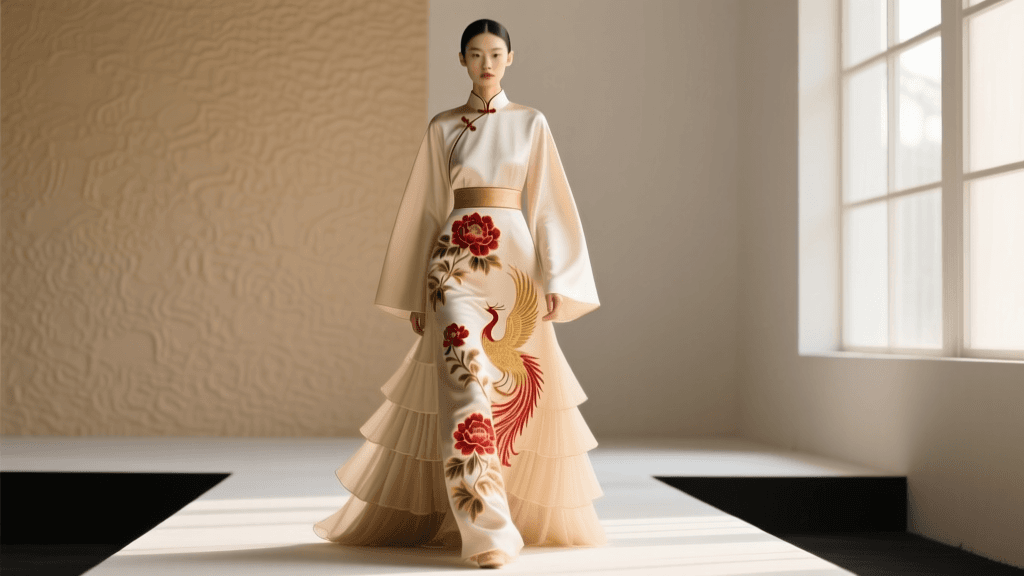
Traditional Chinese motifs—such as the dragon, phoenix, peony, and lotus—carry profound symbolic weight, representing imperial power, rebirth, wealth, and purity, respectively. In international couture, the most successful designers avoid literal, costume-like translations of these motifs. Instead, they employ tonal embroidery, micro-beading that mimics the seed stitch of traditional embroidery, or jacquard weaving to create subtle, textured patterns that reveal themselves only under the harsh lights of the runway.
Runway styling also plays a critical role in contextualizing these garments. Pairing a heavily embroidered, traditional-style couture jacket with minimalist, bias-cut silk crepe trousers creates a striking juxtaposition that grounds the historical piece in modernity. Accessories should be curated with equal care; adapting traditional jade and gold hairpins (buyao) for modern updos, or utilizing silk-embroidered clutch boxes inspired by Qing dynasty court accessories, can elevate the overall styling without overwhelming the silhouette.
Navigating Cultural Appreciation in Couture
As Chinese fashion elements become increasingly prevalent on global runways, the line between cultural appreciation and appropriation requires careful navigation. Understanding the deep historical context is vital. The Metropolitan Museum of Art's Heilbrunn Timeline of Art History details the profound economic, diplomatic, and cultural roots of Chinese silk, emphasizing that these textiles were not merely decorative, but served as currency, diplomatic gifts, and markers of social hierarchy.
To practice genuine cultural appreciation, international designers should prioritize collaboration over extraction. This means hiring Chinese master artisans as consultants, crediting regional workshops in show notes, and ensuring fair compensation for the intensive labor required for techniques like Su Xiu. By treating traditional Chinese textiles and silhouettes as living, evolving art forms rather than static historical artifacts, the global couture industry can foster a respectful and innovative cross-cultural dialogue.
Conclusion
The integration of Chinese traditional garments, textiles, and embroidery into international haute couture is a testament to the enduring power and versatility of these ancient crafts. From the mathematical precision of the mamianqun pleats to the breathtaking artistry of split-thread Suzhou embroidery, these elements offer unparalleled opportunities for luxury design. By approaching these traditions with technical rigor, historical respect, and a commitment to ethical sourcing, contemporary couturiers can create breathtaking runway moments that honor the past while defining the future of global fashion.