Children's Hanfu Guide: Sizing, Styles, and Styling for Kids
The Renaissance of Children's Traditional Chinese Clothing
The global revival of traditional Chinese clothing, often referred to as the Guochao (national trend) movement, has transcended adult fashion to deeply influence children's wardrobes. Today, parents across Asia and the global diaspora are increasingly dressing their children in authentic traditional garments for cultural festivals, Lunar New Year celebrations, and milestone photography. According to industry reports covered by China Daily, the Hanfu market has seen exponential growth, with a significant demographic shift toward family-oriented and children's traditional apparel. This trend is not merely about aesthetics; it is a profound way to pass down cultural heritage, instill a sense of identity, and celebrate Asian traditions in a modern context.
Dressing children in traditional attire, however, comes with unique challenges. Unlike adults, children require garments that accommodate rapid growth, active play, and sensitive skin. This comprehensive guide will walk you through the most popular styles of children's traditional Chinese clothing, provide an actionable sizing chart, recommend the best fabrics for little ones, and offer practical budgeting advice for parents.
Top Traditional Styles for Kids
When shopping for children's traditional Chinese clothing, you will generally encounter four main categories. Each serves a different cultural and practical purpose.
1. Hanfu (Han Ethnic Clothing)
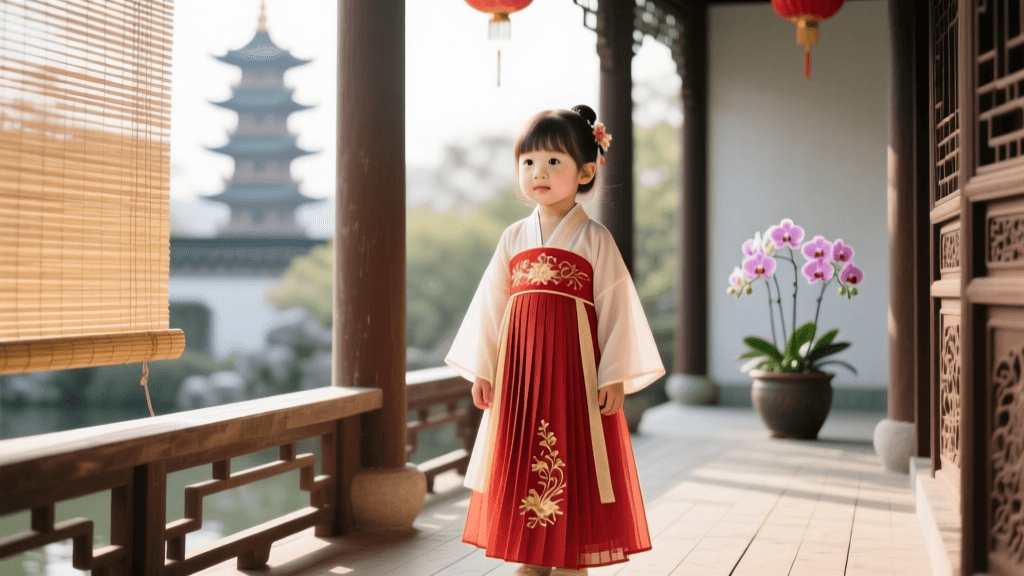
Hanfu represents the historical dress of the Han Chinese. For children, the most popular and practical styles are the Ruqun (a cross-collar top paired with a high-waisted skirt) for girls, and the Yuanlingpao (round-collar robe) or Shenyi (deep robe) for boys. Modern children's Hanfu often features simplified tying mechanisms—such as hidden snaps or elastic waistbands— disguised beneath traditional-looking sashes to help kids dress themselves and prevent tripping hazards. As noted in cultural analyses by the South China Morning Post, the youth and children's Hanfu movement is heavily driven by social media and a desire for historical connection.
2. Tangzhuang (Tang Suit)
The Tangzhuang is the quintessential Lunar New Year garment. Characterized by its mandarin collar and pankou (hand-knotted frog buttons), this jacket is typically worn over a simple cotton shirt and trousers. It is highly favored for toddlers and young boys because it does not restrict leg movement, making it ideal for running, playing, and participating in festive dragon dances.
3. Modern Qipao (Cheongsam)
While the traditional form-fitting Qipao is unsuitable for growing children, modern children's adaptations feature A-line or flared skirts, cotton linings, and back-zipper closures. These dresses are incredibly popular for Mid-Autumn Festival gatherings and formal family portraits, offering the elegant silhouette of the Qipao with the twirl-friendly comfort of a standard play dress.
4. Tiger Head Shoes and Hats (Hutouxie and Hutomao)
For infants and toddlers (ages 6 months to 3 years), traditional accessories are just as important as the clothing. Handcrafted Tiger Head shoes and hats are deeply rooted in Chinese folklore. The tiger is considered a guardian spirit that wards off evil and protects children from illness. These vibrant, heavily embroidered pieces make exceptional first-birthday gifts and cultural keepsakes.
The Ultimate Sizing and Measurement Guide
One of the most common mistakes parents make when buying traditional Chinese clothing online is relying on age-based sizing. Chinese children's apparel, particularly Hanfu and Tangzhuang, predominantly uses height-based sizing (measured in centimeters). Because traditional garments like robes and high-waisted skirts have different fit points than Western clothing, accurate measurements are crucial.
Use a soft measuring tape to measure your child's height, chest circumference, and sleeve length. When in doubt, always size up; traditional garments are designed with a relaxed, flowing drape, and extra length can be hemmed temporarily or rolled at the cuffs.
| Standard CN Size | Child's Height (cm) | Approx. Age | Chest Circumference (cm) | Recommended Garment Length |
|---|---|---|---|---|
| 80 | 75 - 85 cm | 1 - 2 Years | 50 - 54 cm | 40 - 45 cm |
| 90 | 85 - 95 cm | 2 - 3 Years | 54 - 58 cm | 45 - 50 cm |
| 100 | 95 - 105 cm | 3 - 4 Years | 58 - 62 cm | 50 - 55 cm |
| 110 | 105 - 115 cm | 4 - 5 Years | 62 - 66 cm | 55 - 62 cm |
| 120 | 115 - 125 cm | 6 - 7 Years | 66 - 70 cm | 62 - 68 cm |
| 130 | 125 - 135 cm | 8 - 9 Years | 70 - 74 cm | 68 - 75 cm |
Fabric Selection: Balancing Aesthetics and Playtime
Historically, traditional Chinese garments were crafted from luxurious silks, intricate brocades, and delicate gauzes, as documented by the Metropolitan Museum of Art's Heilbrunn Timeline of Art History. However, pure silk is notoriously difficult to clean, prone to water spotting, and fragile against the rough-and-tumble nature of childhood. When selecting fabrics for children, prioritize durability, breathability, and ease of care.
- Cotton-Linen Blends: The gold standard for everyday Hanfu and Tangzhuang. These blends offer the textured, historical look of raw linen but with the softness and washability of cotton. They are highly breathable, making them perfect for late spring and summer festivals.
- Bamboo Viscose: Often used for the inner layers (zhongyi) of Hanfu. Bamboo viscose is hypoallergenic, incredibly soft against sensitive skin, and possesses natural moisture-wicking properties.
- Washable Jacquard and Poly-Brocade: For winter festivals and Lunar New Year, thick brocades are essential for warmth and visual impact. Modern poly-blend jacquards mimic the look of traditional silk brocade but can withstand gentle machine washing and resist staining from festive foods.
- Avoid: Pure mulberry silk, heavily beaded garments (choking hazards for toddlers), and stiff, cheap polyester that traps heat and causes skin irritation.
Occasion-Based Budgeting and Styling
The cost of children's traditional Chinese clothing varies wildly based on the level of embroidery, fabric quality, and brand. Here is a practical breakdown to help you budget for different occasions.
1. Casual Cultural Events and Play (Budget: $15 - $35 USD)
For local community gatherings, school cultural days, or casual wear, opt for cotton Tangzhuang sets or simplified, unembroidered Hanfu. These are widely available on global e-commerce platforms. Look for sets that include the top, pants/skirt, and basic hair accessories.
2. Major Festivals and Family Portraits (Budget: $45 - $90 USD)
Lunar New Year, Mid-Autumn Festival, and professional studio photography call for mid-tier garments. In this price range, you will find beautiful cotton-linen Hanfu with machine-embroidered motifs (like koi fish, plum blossoms, or swallows), layered skirts, and matching capes (dou篷) for winter warmth.
3. Heirloom and Bespoke Pieces (Budget: $120 - $300+ USD)
For first birthdays, traditional coming-of-age ceremonies, or families seeking museum-quality craftsmanship, bespoke tailors offer hand-embroidered silk garments, real gold-thread work, and custom-fitted tiger shoes. These are treated as family heirlooms, passed down between siblings and cousins.
Timing Your Purchase
Crucial Tip: If you are ordering from Asian-based retailers for the Lunar New Year, you must place your orders at least 6 to 8 weeks in advance. The weeks leading up to the Spring Festival see massive logistical bottlenecks, and popular sizes (especially 100 and 110) frequently sell out by early December.
Renting vs. Buying for Photography
A massive trend in Asian traditional fashion is the Hanfu photography studio experience. If you only need an elaborate, heavily embroidered traditional outfit for a single photoshoot, renting is highly cost-effective. Many specialized boutiques and online services offer rental packages for $30 to $50, which include the garment, professional styling, and traditional hairpieces. This is an excellent way to let children experience the weight and grandeur of formal historical court dress without the financial commitment or storage hassle.
Garment Care for Little Ones
Proper care ensures that these beautiful garments can be passed down to younger siblings. Always check the care label, but follow these general rules for traditional children's wear:
- Washing: Turn garments inside out and place them in a mesh laundry bag. Wash on a gentle cycle with cold water using a mild, pH-neutral detergent. Never use bleach, as it will instantly ruin metallic embroidery threads.
- Drying: Air dry flat or hang in the shade. Direct sunlight can fade the vibrant reds and golds typical of festival wear. Never tumble dry brocade or lined garments, as the different fabrics may shrink at different rates, warping the seams.
- Ironing: Use a low-heat steam iron. For garments with raised embroidery or 3D frog buttons, place a clean cotton towel over the garment before ironing to prevent crushing the intricate details.
"Dressing a child in traditional clothing is more than just putting on a costume; it is an act of cultural storytelling. When a child wears a Tang suit or a Hanfu robe, they are physically stepping into the history of their ancestors, fostering a tactile connection to their heritage that books alone cannot provide."
Conclusion
Navigating the world of children's traditional Chinese clothing is a rewarding journey that blends historical appreciation with modern parenting practicality. By understanding height-based sizing, selecting child-friendly fabrics like cotton-linen blends, and planning your purchases well ahead of major festivals, you can ensure your child looks authentic, feels comfortable, and participates fully in the joyous celebrations of Asian culture. Whether it is a simple cotton Tangzhuang for a school parade or an embroidered Hanfu for a family portrait, these garments serve as beautiful, wearable bridges between the past and the future.