2026 Fashion Media: Styling Cheongsam & Hanbok for Editorials
The 2026 Shift: From Exoticism to Authentic Heritage Couture
The intersection of Asian traditional garments and global fashion media has reached a pivotal maturation point in 2026. Gone are the days when publications relied on superficial orientalist tropes or relegated the cheongsam and hanbok to mere costume styling. Today, top-tier editorial platforms, including Vogue, Harper's Bazaar, and i-D, are embracing what industry insiders call the "Heritage Couture" movement. This approach treats traditional Asian garments with the same rigorous sartorial respect as Parisian haute couture, focusing on construction, historical context, and modern styling relevance. For fashion stylists, photographers, and creative directors working in the 2026 media landscape, understanding the nuanced styling, lighting, and cultural consultation required for these garments is no longer optional—it is a professional necessity.
Styling the Cheongsam (Qipao) for Modern Editorials
The cheongsam, or qipao, has undergone a radical editorial renaissance this year. While its mid-century silhouette remains iconic, 2026 high-fashion editorials are favoring a deconstructed and sustainable approach to the garment. According to The Metropolitan Museum of Art's Heilbrunn Timeline of Art History, the qipao has always been a garment of evolution, adapting to the social shifts of the wearer. In contemporary 2026 shoots, stylists are moving away from stiff, synthetic brocades and instead sourcing deadstock silk jacquards and innovative cuprammonium rayons from heritage ateliers in Shanghai and Hong Kong.
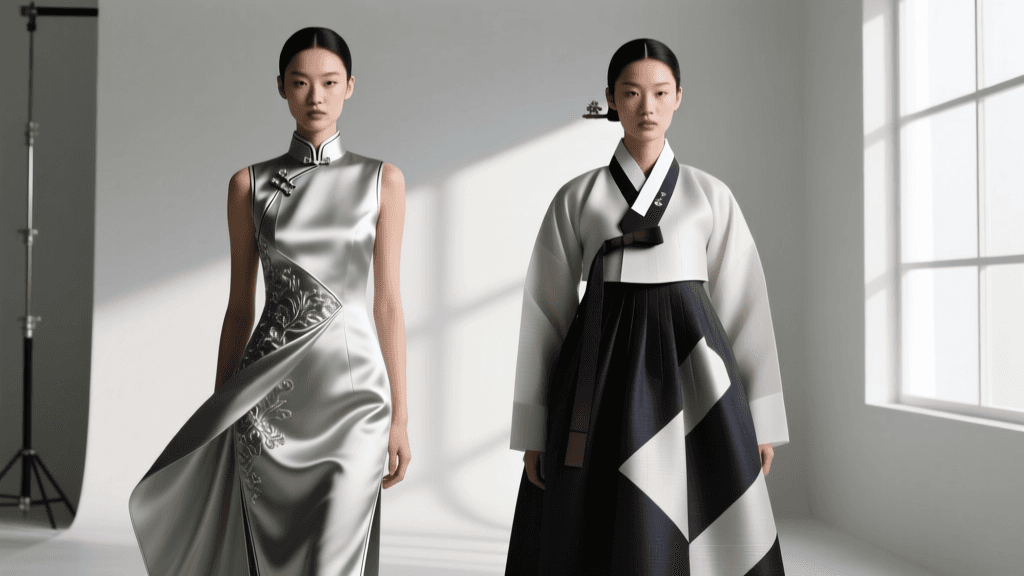
When styling the cheongsam for the camera, the focus must be on the garment's architectural elements: the mandarin collar (yuanbao ling) and the intricate pankou (frog) closures. Photographers are increasingly utilizing directional Rembrandt lighting to cast dramatic shadows that highlight the tailored columnar silhouette and the subtle side slits. Posing should be restrained and deliberate, allowing the fabric's drape and the precise tailoring at the bust and hip to command the frame. The modern editorial narrative favors quiet luxury, letting the meticulous hand-stitching and textile quality speak for themselves rather than relying on overly stylized, theatrical props.
Capturing the Hanbok: Volume, Movement, and Color
Conversely, styling the Korean hanbok for 2026 global fashion spreads requires an entirely different technical approach, centered on volume, movement, and color theory. The hanbok's structural brilliance lies in the contrast between the fitted jeogori (jacket) and the expansive chima (skirt). This year, editorial directors are juxtaposing traditional silk organza hanboks against brutalist architecture or stark, minimalist studio backdrops to create striking visual tension. Designers like Danha and Tchai Kim have dominated the 2026 media cycle by introducing contemporary proportions while maintaining historical integrity.
To capture the hanbok authentically, photographers must employ soft, diffused wrapping light that illuminates the vibrant obangsaek (traditional five-color) palette without blowing out the delicate silk highlights. Movement is critical; the chima is designed to bloom outward when the wearer walks or turns. Stylists must ensure the use of proper undergarments, such as the sokchima and modern structural petticoats, to maintain the iconic bell shape during dynamic, wind-assisted outdoor shoots. The Victoria and Albert Museum's Asian Collections provides extensive archival evidence of how these volumetric silhouettes have historically commanded space, a principle that modern editorial photographers are now actively replicating to convey power and grace.
Editorial Comparison: Cheongsam vs. Hanbok
To assist creative teams in planning their 2026 editorial calendars, we have compiled a technical comparison chart detailing the distinct requirements for shooting these two iconic garments.
| Feature | Cheongsam (Qipao) | Hanbok |
|---|---|---|
| Silhouette | Columnar, form-fitting, tailored | Voluminous, structural, bell-shaped |
| Lighting Needs | Directional, Rembrandt, high-contrast | Diffused, soft, wrapping light |
| Movement | Restrained, subtle fabric shifts | Expansive, requires wind or motion |
| Ideal Backdrop | Moody interiors, brutalist concrete | Minimalist studios, sweeping landscapes |
| Key Styling Focus | Pankou closures, collar fit, hem slit | Chima volume, jeogori proportions |
The Role of Cultural Consultation in 2026 Media
A defining characteristic of the 2026 fashion media landscape is the institutionalization of cultural consultation. Major publishing houses now mandate the presence of heritage consultants on set when styling traditional Asian garments. This practice ensures that the styling avoids the "costume" trap and respects the ceremonial and historical weight of the clothing. For instance, the placement of a norigae (traditional Korean ornamental pendant) on a hanbok, or the specific knotting of a pankou on a bridal cheongsam, carries deep cultural significance. Misstyling these elements can lead to immediate public backlash and accusations of cultural appropriation.
As noted by The Business of Fashion's Culture Hub, brands and media outlets that invest in cultural consultants are seeing higher engagement rates and deeper audience trust, proving that authenticity is a measurable metric in modern fashion journalism. Consultants also assist in proper terminology, ensuring that editorial copy accurately reflects the garment's origins, regional variations, and contemporary revivals, thereby educating the global readership.
Actionable Sourcing and Fitting Guide for Stylists
For stylists looking to source authentic pieces for upcoming 2026 shoots, the market has shifted heavily toward archival rentals and direct-from-atelier commissions. Mass-produced, fast-fashion interpretations are strictly embargoed by top-tier editorial guidelines. Expect to pay between $300 and $800 per day for archival rental fees for museum-quality silk cheongsams, while contemporary hanbok commissions from Seoul-based ateliers typically start at $1,500 with a six-week lead time.
- Cheongsam Fitting: Ensure the tailor allows exactly one inch of ease at the bust and hips. A common mistake in Western styling is over-tightening the garment, which distorts the silk grain, causes horizontal pulling at the closures, and restricts the model's breathing. The collar should sit flush against the neck without choking the model.
- Hanbok Fitting: The jeogori must sit precisely above the bust line, with the goreum (ribbon) tied in a traditional horizontal bow, not a vertical Western knot. The sleeves (baerae) should feature a gentle, sweeping curve that creates an elegant line when the model raises her arms.
- Accessory Pairing: In 2026, editorial stylists are pairing these heritage garments with contemporary, avant-garde footwear and minimalist fine jewelry, deliberately avoiding traditional hair sticks or fans unless specifically directed by a heritage consultant for a historically accurate narrative.
Conclusion
Ultimately, the integration of the cheongsam and hanbok into 2026 global fashion media represents a triumph of cultural appreciation over superficial trend-chasing. By prioritizing historical accuracy, investing in proper lighting techniques, and collaborating with heritage experts, creative professionals can produce editorial imagery that is not only visually breathtaking but culturally resonant. As the fashion industry continues to globalize, the respectful elevation of Asian traditional garments will remain a cornerstone of sophisticated, forward-thinking fashion media, setting a benchmark for how heritage textiles are celebrated on the world stage.