Buying Authentic Banarasi Silk Sarees Online: 2026 Guide
The Evolution of Banarasi Silk E-Commerce in 2026
The landscape of purchasing traditional South Asian garments has undergone a massive digital transformation. As of 2026, buying an authentic Banarasi silk saree online is no longer a gamble fraught with the risk of receiving mass-produced powerloom imitations. Thanks to stringent Geographical Indication (GI) enforcement, blockchain-backed artisan verification, and the rise of specialized direct-to-consumer (D2C) heritage platforms, global buyers can now source museum-quality textiles directly from the weavers of Varanasi. According to the National Handloom Development Programme, digital integration in the handloom sector has surged, allowing master weavers to bypass exploitative middlemen and offer transparent pricing to international clientele.
However, the proliferation of online marketplaces also means buyers must be highly educated about weave types, zari (metallic thread) purity, and platform credibility. This comprehensive 2026 guide breaks down the most trusted online marketplaces for Banarasi silk sarees, decodes the complex weaving terminology, and provides actionable steps to verify the authenticity of your purchase before it even arrives at your doorstep.
Top Trusted Online Marketplaces for Authentic Banarasi Sarees
Tilfi: The Direct-to-Consumer Artisan Pioneer
Tilfi has cemented its position in 2026 as the premier D2C platform for purists seeking unadulterated handloom Banarasi textiles. By partnering directly with multi-generational weaving families in the Saraiya and Peeli Kothi regions of Varanasi, Tilfi offers an inventory that is entirely devoid of powerloom stock. Their platform is particularly renowned for its pure Katan silk sarees featuring intricate Kadhua (handwoven extra weft) work. Prices on Tilfi for a pure handloom Katan silk saree with real silver zari typically start around ₹22,500 ($270 USD) and can reach upwards of ₹1,50,000 ($1,800 USD) for bridal Jangla patterns. Every purchase comes with a digitally verifiable GI certificate and a detailed dossier on the specific artisan who wove the garment.
Karigari Marketplace: Curated Weaver Cooperatives
For buyers looking for a wider variety of regional interpretations and experimental contemporary motifs, Karigari Marketplace is an exceptional aggregator. Operating as a curated hub for registered weaver cooperatives, Karigari ensures that the profits are distributed equitably among the artisan communities. In 2026, Karigari introduced an AI-assisted visual search tool that allows buyers to upload photos of vintage sarees and find matching handloom weaves from their cooperative partners. They excel in offering lightweight Banarasi organza (Kora) and Tussar silk blends, making them a favorite for modern, everyday styling. Their price point is highly accessible, with genuine handloom pieces starting at ₹12,000 ($145 USD).
Nalli Silks: The Heritage Retail Giant
Nalli Silks remains a titan in the traditional garment retail space, and their robust 2026 e-commerce infrastructure reflects their century-old legacy. While Nalli stocks a massive variety of textiles from across India, their Banarasi silk collection is unparalleled for bridal trousseaus. Nalli provides absolute certainty regarding authenticity, as they source directly from master weaver guilds and maintain rigorous in-house quality control. Their online portal offers high-definition 360-degree video views of the sarees, allowing buyers to inspect the drape and the reverse side of the weave—a crucial step in identifying true handloom Kadhua work. Expect to pay a premium for the Nalli brand assurance, with bridal Katan silk sarees averaging ₹45,000 ($540 USD).
Decoding the Weave: Kadhua, Phekwa, and Tanchoi
To shop intelligently online, you must understand the technical jargon used in product descriptions. The value of a Banarasi saree is intrinsically tied to its weaving technique.
- Kadhua (Handloom Extra Weft): The most labor-intensive and expensive technique. Each motif is woven individually by hand, and the extra weft threads are interlocked at the edge of the motif. This leaves a clean reverse side with no loose threads. A pure Kadhua saree takes 3 to 6 months to weave.
- Phekwa (Cutwork): A faster technique where the extra weft thread runs across the entire width of the fabric. The floating threads on the reverse side are later cut by hand. While still a handloom technique, it is less durable and significantly cheaper than Kadhua.
- Tanchoi: A complex weaving technique using one or two warps and multiple colored wefts to create intricate, self-design patterns without the use of heavy zari. It is highly prized for its subtle, understated elegance and lightweight drape.
- Jangla: Characterized by wild, scrolling floral and vegetal motifs that cover the entire body of the saree, often intertwined with heavy gold and silver zari. This is the quintessential Banarasi bridal weave.
How to Verify Authenticity: GI Tags and Zari Testing
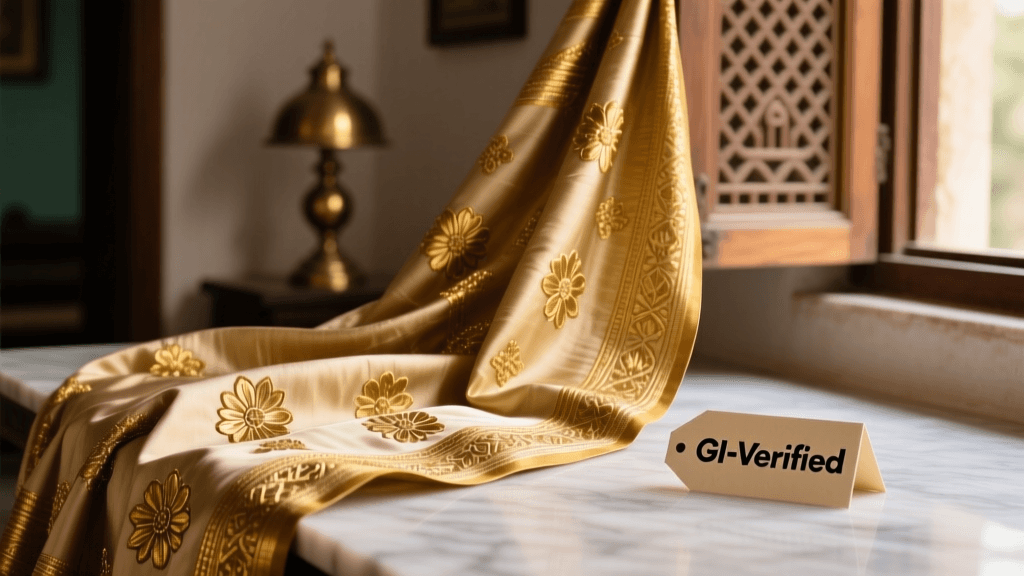
The Geographical Indications Registry of India strictly protects the 'Banaras Brocades and Sarees' tag. In 2026, the GI tag system has been upgraded with secure QR codes that link to a centralized government database. When buying online, ensure the product listing explicitly mentions a 9-digit GI unique ID. Upon delivery, scan the QR code on the holographic label; it should display the weaver's name, the loom registration number, and the exact date of weaving.
Equally important is verifying the Zari. Traditional Banarasi sarees use 'Real Zari', which consists of a silk core wrapped in flattened silver wire and electroplated with pure gold. Mass-produced fakes use synthetic polyester cores wrapped in metallic-colored plastic. While you cannot perform a chemical test on an online purchase, you can perform a safe burn test on the loose threads provided in the saree's fall or blouse piece. When burned, real zari leaves behind a fine, powdery ash of silver and smells like burnt hair (due to the silk core). Synthetic zari will melt into a hard plastic bead and emit a chemical odor. The Crafts Council of India frequently publishes updated visual guides on identifying genuine metallic threads versus modern synthetic substitutes.
2026 Price and Marketplace Comparison Guide
Understanding the current market rates is essential to avoid being scammed by listings that claim to be handloom but are priced suspiciously low. A genuine handloom Banarasi silk saree requires approximately 5.5 to 6 meters of fabric and 0.8 meters of blouse material. The table below outlines the expected pricing and best platforms for different weave types in 2026.
| Weave Type | Technique | Estimated 2026 Price (INR) | Estimated 2026 Price (USD) | Recommended Marketplace |
|---|---|---|---|---|
| Pure Katan with Jangla | Kadhua (Handloom) | ₹65,000 - ₹1,50,000+ | $780 - $1,800+ | Nalli Silks, Tilfi |
| Kora Silk with Butidar | Phekwa (Handloom) | ₹15,000 - ₹28,000 | $180 - $335 | Karigari Marketplace |
| Tanchoi Silk | Multi-weft (Handloom) | ₹25,000 - ₹45,000 | $300 - $540 | Tilfi, Nalli Silks |
| Art Silk / Imitation | Powerloom (Machine) | ₹2,500 - ₹6,000 | $30 - $72 | Myntra, Ajio (Not Authentic) |
Buyer Beware: If an online listing advertises a 'Pure Handloom Katan Silk Kadhua Saree' for under ₹10,000 ($120 USD) in 2026, it is almost certainly a powerloom imitation. The cost of raw silk and real silver zari alone makes such pricing economically impossible for authentic handloom garments.
Sizing, Draping, and Care Instructions for Online Buyers
When ordering online, pay close attention to the exact measurements. Standard Banarasi sarees are 5.5 meters long, but taller individuals or those who prefer the elaborate Gujarati or Maharashtrian draping styles should look for the 6-meter 'Saree with Extra Fall' option offered by premium marketplaces like Tilfi. Additionally, ensure the listing includes an 'Unstitched Blouse Piece' (usually 0.8 meters), as some modern contemporary listings sell the saree as a standalone drape.
Once your authentic Banarasi silk saree arrives, proper care is vital to preserve the metallic zari and the silk fibers. Never machine wash or use harsh chemical detergents. For the first three years, dry cleaning is highly recommended. Afterward, you may gently hand wash the saree in cold water using a mild, pH-neutral cleanser or traditional reetha (soapnut) extract. When storing, never use plastic covers, as they trap moisture and cause the zari to oxidize and turn black. Instead, wrap the saree in unbleached muslin cloth and store it in a dark, cool wooden chest. Placing dried neem leaves or silica gel packets in the folds will protect the silk from silverfish and humidity, ensuring your heritage garment remains a pristine family heirloom for generations to come.