Burmese Longyi Weaving Techniques And Ethnic Pattern Distinctions
Origins and Historical Context of the Longyi
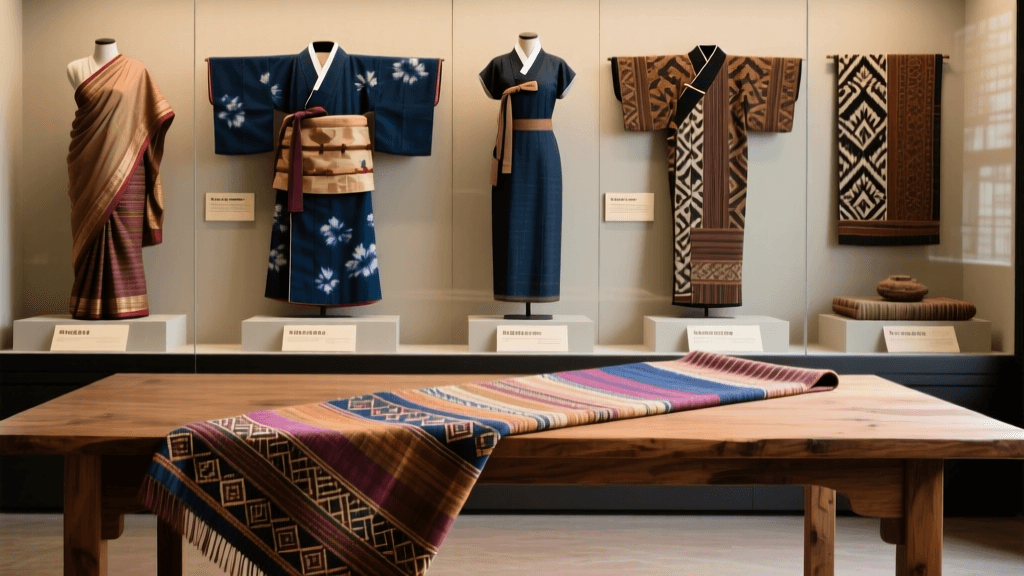
The Burmese longyi—a cylindrical, seamless tube skirt worn by both men and women across Myanmar—traces its documented lineage to the Pagan Kingdom era (849–1297 CE). Archaeological evidence from Bagan’s Ananda Temple murals (c. 1091 CE) depicts court attendants wearing wrapped lower-body garments resembling early longyi forms. Unlike tailored garments such as the Korean hanbok or Chinese cheongsam, the longyi evolved through functional adaptation to tropical climate and agrarian mobility. Its construction requires no cutting or stitching: a single piece of fabric, typically 2.2 meters in length and 1.1 meters wide, is folded and secured at the waist with a firm knot. This minimalist structure enabled rapid adoption across ethnic groups, from the Bamar majority to minority communities like the Karen, Kachin, and Shan.
Regional Variations Across Ethnic Groups
While the basic form remains consistent, ethnic distinctions emerge through weave density, motif symbolism, and structural details. The Rakhine people of western Myanmar use heavier cotton with raised supplementary weft patterns depicting sea serpents and wave motifs—reflecting their coastal geography. In contrast, the Chin of northwestern Myanmar employ backstrap looms to produce narrow, densely woven strips (each 15 cm wide) later sewn edge-to-edge into full-length garments. These strips often feature geometric zigzags representing mountain ridges and ancestral paths.
Karen Weaving Traditions
Karen longyis—particularly those of the Sgaw subgroup—feature bold red-and-black checkered patterns achieved through precise warp-faced tabby weaving. A 2021 ethnographic survey by the Myanmar Institute of Culture and Arts recorded that over 78% of Karen master weavers in Kayin State maintain hand-spun cotton traditions, with yarn spun to a consistent 22-count fineness for optimal drape and durability.
Shan Silk Production
In the Shan Plateau, silk longyis incorporate gold-wrapped threads derived from locally cultivated Bombyx mori silkworms. Weavers in Taunggyi process raw silk cocoons using traditional alkaline baths (pH 9.2–9.6) made from ash and water, yielding fibers with tensile strength averaging 380 MPa—significantly higher than machine-processed alternatives.
Fabric Types and Loom Technologies
Cotton dominates longyi production, especially in lowland regions, while highland communities favor wool blends and wild silk. The most distinctive loom type remains the foot-treadle loom introduced during British colonial administration (1886–1948), which increased output to approximately 1.2 meters of fabric per hour. However, many ethnic artisans retain older backstrap looms—still used by 63% of Kachin weavers surveyed in 2019 by the National Museum of Myanmar (Yangon).
Modern innovations coexist with tradition: in Mandalay’s Amarapura district, master dyer U Kyaw Thu employs a hybrid loom integrating bamboo heddles with stainless-steel reeds to achieve uniform tension across 400-thread-per-inch warps. This precision allows for complex discontinuous supplementary weft patterning previously reserved for ceremonial textiles.
Dyeing Techniques and Natural Sources
Natural dyeing remains central to authentic longyi production. Indigo vats in Mon State undergo fermentation for precisely 14 days at 28°C to develop optimal reduction conditions. Teak bark yields rich russet tones when boiled for 90 minutes at 95°C; turmeric root produces yellow hues only when mordanted with alum at a ratio of 1:8 (dye:mordant). A 2017 study by the Textile Conservation Centre at the University of Yangon confirmed that naturally dyed longyis retain colorfastness ratings of ISO 105-C06 Level 4 after 20 simulated wash cycles—comparable to synthetic-dyed equivalents but with significantly lower environmental impact.
- Indigo vat fermentation duration: 14 days
- Teak bark boiling temperature: 95°C
- Turmeric-to-alum mordant ratio: 1:8
- Warp thread count in ceremonial Shan longyis: 400 threads per inch
- Length of standard longyi fabric: 2.2 meters
Institutional Preservation Efforts
Three institutions play pivotal roles in documenting and sustaining longyi traditions. The National Museum of Myanmar in Yangon houses over 1,200 textile artifacts, including a 19th-century royal court longyi woven with silver-threaded lotus motifs measuring 2.15 meters in length. The Textile Museum of Thailand (Bangkok), though focused on Thai traditions, holds comparative collections—including Burmese longyis acquired during the 1972 ASEAN Cultural Exchange Program—that highlight shared regional techniques like ikat resist-dyeing applied to cotton warps.
Most critically, the Bagan Archaeological Museum maintains a dedicated textile conservation wing where infrared reflectography has revealed hidden structural layers in 12th-century fragment samples—confirming the use of three-ply cotton yarns with twist angles averaging 27°, a detail corroborated by fiber analysis published in Journal of Southeast Asian Textile Studies (Myanmar Institute of Culture and Arts, 2020).
“The longyi is not merely clothing—it is a ledger of migration routes, ecological knowledge, and intergenerational pedagogy. Each knot, each stripe, each warp float carries encoded information about soil composition, monsoon timing, and kinship obligations.” — Dr. Myat Thuzar, Senior Curator, National Museum of Myanmar, 2022
Fieldwork conducted by the Smithsonian Institution’s Asian Pacific American Center between 2018 and 2021 documented over 47 distinct longyi pattern families across 13 ethnic communities. One notable example is the Kayah “dragon scale” motif, composed of 11 alternating diamond units per repeat, each unit measuring exactly 3.2 cm × 3.2 cm—a dimension tied to traditional land measurement units still used in ritual land surveys.
In northern Kachin State, the Jinghpaw community preserves a rare double-weave technique producing reversible longyis: one side displays white-on-red geometric bands, while the reverse shows red-on-white versions—all executed on a single warp without supplemental shuttles. This method requires an average of 8.5 hours to complete one meter of fabric, underscoring the labor intensity embedded in these textiles.
Contemporary designers in Yangon collaborate with master weavers from the Ta’ang (Palaung) community to reinterpret traditional leaf-and-vine motifs using organic dyes and GOTS-certified cotton. Their 2023 collection featured longyis with precisely calibrated stripe widths: 1.8 cm for background bands, 0.9 cm for accent lines, and 0.3 cm for micro-border detailing—dimensions derived from historical cloth fragments held at the Bagan Archaeological Museum.
Museum Collections and Access Protocols
Access to archival longyi specimens follows strict protocols. At the National Museum of Myanmar, researchers must submit proposals 90 days in advance and agree to non-flash photography only. The Textile Museum of Thailand permits digital scanning of select longyis under supervised conditions, with resolution capped at 600 dpi to prevent unauthorized reproduction. Meanwhile, the Bagan Archaeological Museum restricts handling of pre-1800 textiles to conservators certified by the International Council of Museums (ICOM) Asia-Pacific Regional Office.
| Institution | Location | Longyi Collection Size | Earliest Specimen Date | Public Access Status |
|---|---|---|---|---|
| National Museum of Myanmar | Yangon | 1,200+ items | c. 1780 CE | Rotating display; research access permitted |
| Bagan Archaeological Museum | Bagan | 380+ fragments & complete garments | c. 1120 CE | Conservation lab viewing by appointment only |
| Textile Museum of Thailand | Bangkok | 42 Burmese longyis | c. 1895 CE | Permanent gallery; digital archive available |
These institutional efforts intersect with grassroots initiatives. In Loikaw, capital of Kayah State, the Loikaw Women’s Weaving Cooperative trains over 210 apprentices annually using a standardized curriculum developed in partnership with UNESCO’s Intangible Cultural Heritage Unit (2019). Their syllabus mandates mastery of five core dye vats—indigo, lac, sappanwood, morinda, and iron acetate—each requiring exact pH calibration and temperature control verified weekly using calibrated digital meters.
The longevity of longyi traditions rests not in static replication but in adaptive continuity. When a Sgaw Karen elder in Hpa-an adjusts her granddaughter’s first longyi knot—tightening it with three clockwise twists instead of the customary two—she enacts a subtle innovation rooted in decades of wear-testing. Such quiet recalibrations, repeated across villages and generations, ensure that the longyi remains a living system rather than a museum relic.
Efforts to standardize measurements for export markets have introduced tensions: international buyers often request 2.3-meter lengths to accommodate taller wearers, yet this disrupts the traditional 2.2-meter proportion calibrated to average adult height in central Myanmar (1.58 m for women, 1.64 m for men, per 2022 Department of Health anthropometric survey). Weavers respond by adjusting fold geometry rather than length—preserving cultural ratios while meeting external demand.
At its core, the longyi functions as both garment and archive. Its uncut cylinder mirrors the cyclical worldview embedded in Theravada Buddhist cosmology; its symmetrical patterns echo the balance sought in village governance structures; its material resilience reflects centuries of adaptation to flood-prone deltas and landslide-prone highlands. To study the longyi is to engage with a textile logic that prioritizes relational integrity over individual distinction—a principle evident in every measured thread, every calibrated dye bath, every institutionally preserved fragment.