Crafting the 15th-Century Burgundian Gown: A 2026 Maker's Guide
Introduction to the Burgundian Silhouette
As we navigate the historical costuming landscape in 2026, the demand for archaeological accuracy and traditional craftsmanship has never been higher. Among the most iconic and highly sought-after garments in European folk and court dress history is the 15th-century Burgundian gown. Originating from the opulent court of Burgundy, this style dominated Northern European fashion from the late 1300s through the late 1400s. Characterized by its deep V-neckline, high empire waist, voluminous skirts, and dramatic trumpet sleeves, the Burgundian gown represents a pinnacle of medieval tailoring.
For modern makers, historical reenactors, and textile artists, recreating this garment requires moving beyond commercial costume patterns and embracing historical construction methods. According to the Metropolitan Museum of Art's Heilbrunn Timeline of Art History, the Burgundian court's immense wealth allowed for unprecedented textile consumption, setting trends that rippled across the continent. This guide will walk you through the precise methods for sourcing, drafting, and hand-stitching an authentic Burgundian V-neck gown using techniques and materials available to dedicated artisans in 2026.
The Anatomy of the Burgundian Gown
Before cutting into your carefully sourced yardage, it is crucial to understand the structural elements that define the 15th-century silhouette. The gown is typically worn over a supportive kirtle and a linen chemise. The outer gown features:
- The Deep V-Neck: Plunging down to the mid-ribcage, often bordered by a wide, contrasting collar made of fur (such as miniver or ermine) or dark velvet.
- The High Waistline: Sitting just beneath the bust, creating a long, flowing drape that elongates the lower body.
- Trumpet Sleeves: Fitted closely at the upper arm and flaring dramatically at the wrist, sometimes trailing to the floor or featuring a contrasting lining that is pulled through slashes.
- Voluminous Skirts: Achieved not through modern gathering, but through the insertion of wide triangular gores that provide a heavy, sweeping hemline.
Sourcing Historically Accurate Textiles in 2026
The modern textile market has seen a massive revival in heritage weaving and natural dyeing. In 2026, serious costumers avoid synthetic blends, polyester satins, and chemically dyed cottons, which fail to drape or behave like medieval textiles. The Victoria and Albert Museum emphasizes that medieval garments relied heavily on the structural integrity of wool and the crispness of linen to achieve their distinct silhouettes.
Below is a comprehensive sourcing and yardage guide for your project:
| Fabric Type | Historical Equivalent | 2026 Sourcing Strategy | Est. Yardage |
|---|---|---|---|
| Outer Gown | Wool Broadcloth / Silk Damask | Specialty heritage weavers; look for natural madder or woad dyes | 6-8 yards |
| Gown Lining | Linen or Lightweight Fur | Baltic linen imports; high-quality ethical faux fur for modern builds | 5-7 yards |
| Kirtle | Medium-weight Wool | Wensleydale or Shetland wool blends with a tight, fulled weave | 4-5 yards |
| Chemise | Fine Bleached Linen | Handkerchief-weight linen (3.5 oz to 4.5 oz per yard) | 3-4 yards |
| Collar Trim | Fur or Velvet | Upcycled vintage fur coats or silk-cotton velvet blends | 1-2 yards |
Pattern Drafting: Geometry Over Curves
One of the most common mistakes modern sewists make is applying 20th-century tailoring concepts to 15th-century garments. Medieval tailoring was fundamentally geometric, designed to minimize fabric waste and maximize the width of the loom. You will not find modern curved armholes or princess seams in a historically accurate Burgundian gown.
Drafting the Bodice and Skirt
The bodice is drafted using straight lines, with the V-neck created by a simple angled cut from the shoulder to the center front waist. The skirt volume is achieved by cutting the front and back panels as wide rectangles and inserting triangular gores at the side seams and center back. To calculate your gore width, measure the desired hem circumference (typically 120 to 150 inches for a proper sweeping drape), subtract the width of your main panels, and divide the remainder by the number of gores you plan to insert.
The Trumpet Sleeve
The sleeve is drafted as a straight tube that widens sharply below the elbow. The sleeve head is relatively flat, often requiring a small gusset under the arm to allow for mobility without binding. When pinning your mockup, ensure the sleeve is cut slightly longer than your arm, as the historical fit requires the fabric to bunch elegantly at the wrist before flaring into the trumpet bell.
The Undergarments: The Kirtle and Chemise
The iconic Burgundian silhouette is impossible to achieve without the correct foundational garments. The chemise is a simple, loose-fitting linen shift that protects the outer layers from body oils. Its primary visible element is the high neckline and cuffs peeking out from beneath the gown.
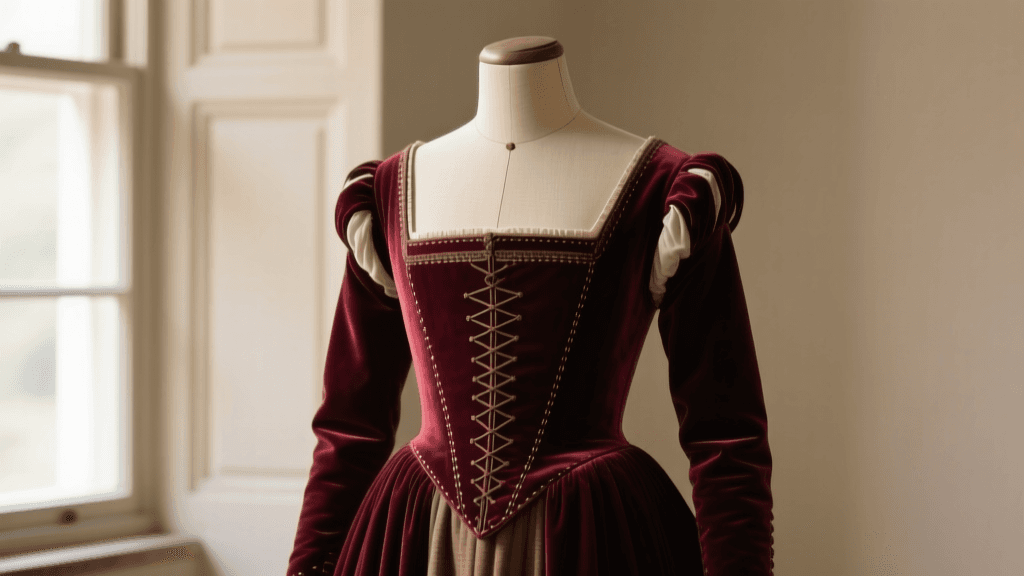
The kirtle, however, is the structural engine of the outfit. In the 15th century, the kirtle evolved into a highly supportive, tightly fitted garment that lifted and shaped the bust, allowing the outer V-neck gown to sit smoothly against the torso. Draft your kirtle using the draping method on a dress form or with a fitting partner. The kirtle should be made of a sturdy, fulled wool that possesses natural stretch and memory, fastening at the front with spiral-laced eyelets reinforced with silk buttonhole thread.
Hand-Stitching and Finishing Techniques
While modern sewing machines offer speed, they produce a lockstitch that is too rigid for heavy historical wools and linens. In 2026, the gold standard for high-end historical dress is entirely hand-sewn construction using period-accurate stitches. Hand-stitching allows the fabric to move, stretch, and drape naturally.
Essential Stitches for the Burgundian Gown
- Running Stitch: Used for long, straight seams in the skirt. When done with a fine silk thread and small, even stitches, it creates a flexible seam that can withstand significant tension.
- Backstitch: Reserved for high-stress areas such as the armholes, the V-neckline, and the bodice seams. It mimics the strength of a modern machine stitch but retains a slight give.
- Flat-Felling: All interior seams must be finished to prevent fraying. Trim one seam allowance, fold the other over it, and whipstitch it flat to the fabric. This creates a clean, durable interior without the need for modern sergers or zig-zag stitches.
- Pad Stitching: Used to attach the heavy fur or velvet collar to the bodice, ensuring it lies flat against the chest without buckling.
Thread and Tool Recommendations
To achieve museum-quality results, your toolkit must be as authentic as your textiles:
- Threads: Use 100% silk thread for wool garments and waxed linen thread for linen undergarments. Modern polyester thread will cut through natural fibers over time.
- Beeswax: Always run your thread through a block of pure beeswax before stitching. This conditions the thread, prevents tangling, and adds water resistance.
- Needles: Invest in high-quality carbon steel sharps and milliners needles. Avoid cheap, modern nickel-plated needles which can snag delicate heritage wools.
- Awl: A bone or wooden awl is essential for piercing fabric when creating lacing holes for the kirtle, pushing the threads aside rather than breaking them.
Sumptuary Laws and Color Symbolism
When selecting your color palette, it is vital to consider the sumptuary laws of the 15th century. These laws strictly regulated who could wear specific fabrics and colors based on social rank. The deep, rich blacks that became synonymous with Burgundian nobility in the late 1400s were incredibly expensive to produce, requiring multiple overdyeing processes with woad and madder. If you are portraying a member of the nobility, deep crimsons, rich blacks, and cloth-of-gold are appropriate. For merchant or artisan class portrayals, opt for softer, undyed wools, madder reds, and weld yellows. Understanding these socio-economic markers adds a profound layer of authenticity to your finished garment.
Conclusion
Crafting a 15th-century Burgundian V-neck gown is a rigorous but deeply rewarding journey into the heart of European textile history. By abandoning modern shortcuts and embracing the geometric drafting, heritage textiles, and hand-stitching techniques of the medieval tailor, you create more than just a costume; you resurrect a piece of living history. As the historical costuming community continues to elevate its standards in 2026, the dedication to authentic construction ensures that the breathtaking elegance of the Burgundian court will continue to inspire makers for generations to come.