15th-Century Burgundian Kirtle Reconstruction Guide 2026
The Resurgence of 15th-Century Burgundian Tailoring in 2026
The landscape of historical European martial arts (HEMA), living history, and traditional garment reconstruction has evolved dramatically by 2026. Enthusiasts and professional tailors alike are moving away from the theatrical, polyester-blend costumes of the early 2000s, demanding rigorous historical authenticity in their wardrobes. At the forefront of this movement is the 15th-century Burgundian kirtle, a foundational garment that defined the elegant, high-waisted, and structured silhouettes of Northern Europe from the 1430s through the 1480s. Reconstructing this garment today requires a deep understanding of medieval tailoring geometry, period-accurate textile weights, and traditional hand-stitching methodologies that modern sewing machines simply cannot replicate.
Unlike the flowing, unshaped tunics of the early medieval period, the Burgundian kirtle represents a revolutionary leap in garment construction. According to the Fashion Institute of Technology's 15th-Century Timeline, this era marked the true birth of structured tailoring, where garments were cut to follow and support the human form rather than merely draping over it. For the modern maker, achieving this fit requires abandoning modern slopers and embracing historical draping techniques.
The 15th-Century Tailoring Revolution: Armscyes and Gores
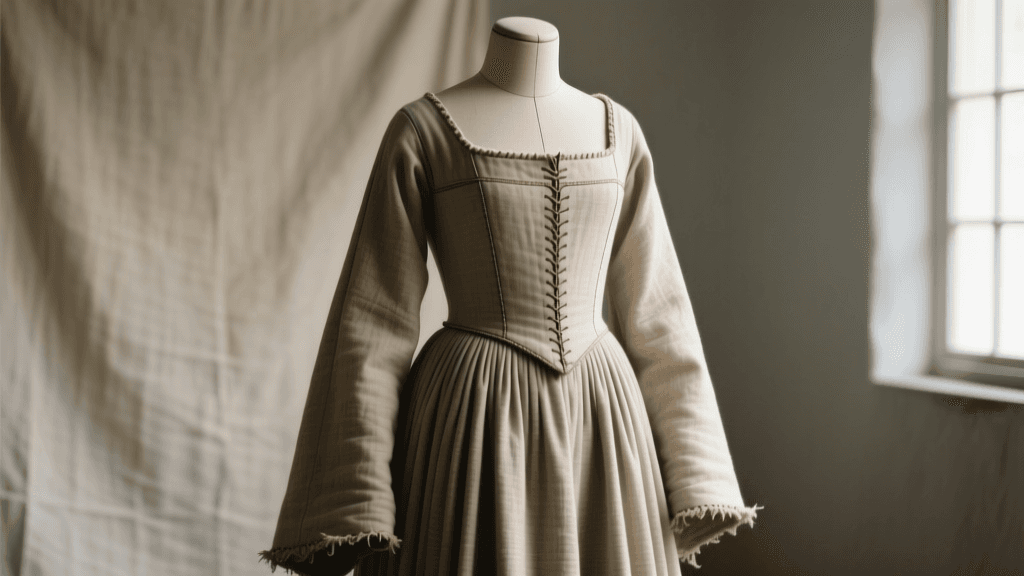
To understand the Burgundian kirtle, one must understand the structural innovations of the 14th and 15th centuries. The most critical development was the invention of the curved armscye (armhole) and the set-in sleeve. Prior to this, garments were cut as T-tunics, which restricted arm movement and created bulky fabric bunching at the armpit. The 15th-century kirtle features a deeply curved armscye that extends high into the armpit and a sleeve cap that is eased into this curve, allowing the wearer to raise their arms without pulling the entire bodice upward. Furthermore, the skirt of the kirtle is not gathered into a waistband—a distinctly modern and Victorian concept—but rather flares out from the hip line through the insertion of triangular fabric panels known as gores.
The transition from the draped garments of antiquity to the tailored, fitted clothing of the 15th century marks the true birth of modern fashion, fundamentally altering how textiles interact with the human body. — Victoria and Albert Museum, Medieval Collections
Sourcing Period-Accurate Textiles in 2026
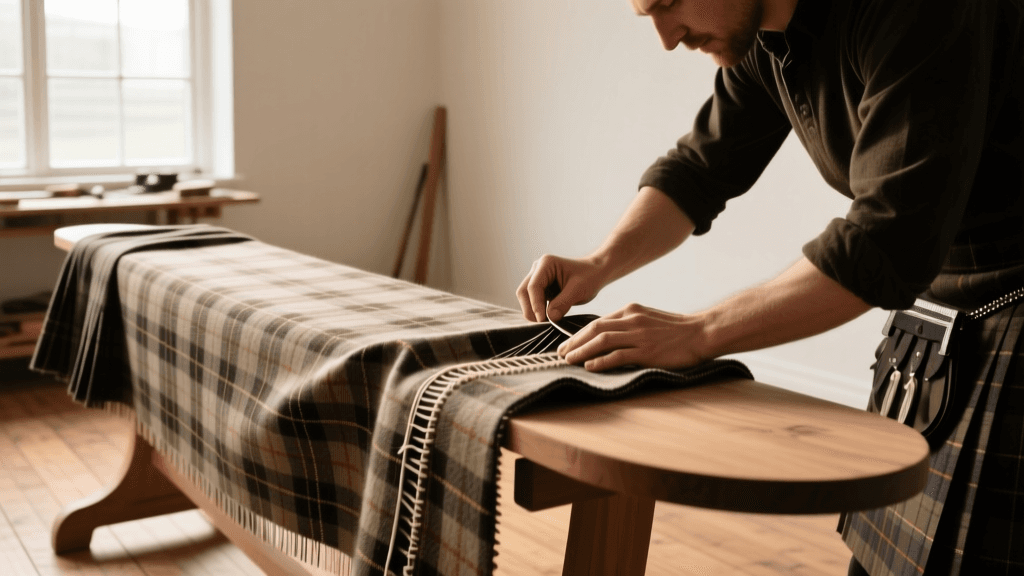
The success of your kirtle reconstruction hinges entirely on your textile choices. Modern wool flannel or suit-weight wools are entirely inappropriate for a 15th-century kirtle; they lack the necessary body, drape, and fulled edge characteristics. You must source wool broadcloth—a fabric that has been woven, heavily fulled (milled in hot water and soap to shrink and mat the fibers), napped, and sheared. This process creates a dense, weather-resistant fabric that does not fray when cut, allowing for period-accurate raw-edge seam finishes.
As of 2026, specialized heritage mills and historical textile merchants remain the only viable sources for authentic broadcloth. When purchasing, look for fabrics dyed with natural or botanically equivalent dyes, such as woad (for deep blues) or madder (for rich reds and russets). The linen used for the underlying chemise (smock) should be a crisp, tabby-weave fabric, bleached to a natural cream or bright white, depending on the wealth status you are portraying.
| Garment Layer | Historical Fabric | 2026 Sourcing Weight | Weave Structure |
|---|---|---|---|
| Chemise (Smock) | Bleached Linen | 3.5 oz to 5.0 oz (120-170 gsm) | Tabby (Plain) |
| Kirtle (Base Dress) | Wool Broadcloth | 12.0 oz to 16.0 oz (400-540 gsm) | 2/2 Twill, Heavily Fulled |
| Surcote (Overgown) | Wool Broadcloth / Damask | 14.0 oz to 18.0 oz (470-600 gsm) | 2/2 Twill or Figured Weave |
| Partlet (Filler) | Fine Linen / Silk | 2.5 oz to 3.5 oz (85-120 gsm) | Tabby or Gauze |
Pattern Drafting: The Fitted Four-Panel Kirtle
Drafting a 15th-century kirtle cannot be done accurately using flat-pattern drafting on paper. The garment must be draped directly onto the wearer's body over their linen chemise. The bodice of the kirtle acts as a supportive undergarment, providing bust lift and torso shaping without the need for rigid boning, which was not introduced until the 16th century. The support is achieved through the tension of the bias-cut fabric and the precise placement of the seams.
The standard construction utilizes four main body panels: two front panels and two back panels. The center front and center back seams are cut on the straight grain to provide stability, while the side seams are often cut with a slight curve to accommodate the waist and hips. The most crucial fitting point is the bust cleft. The center front seam must be pinned and stitched precisely to separate and lift the bust, creating the iconic 15th-century rounded silhouette. The skirt is then widened by inserting gores at the side seams and the center back. A standard middle-class kirtle will feature four to six gores, while a high-status Burgundian gown might utilize eight or more to achieve a voluminous, sweeping hemline that pools slightly on the floor.
Hand-Stitching Techniques for Historical Authenticity
To achieve a truly authentic garment, machine stitching must be entirely avoided. The 15th-century tailor relied on a specific repertoire of hand stitches, utilizing heavily waxed linen thread for structural seams and fine silk thread for visible topstitching and facings. According to Encyclopedia Britannica's History of Medieval Dress, the quality and density of a tailor's stitching was a primary indicator of a garment's value and the wearer's social standing.
- The Running Stitch: Used for long, low-stress seams. A skilled 15th-century tailor could achieve 8 to 12 stitches per inch, creating a seam that is both flexible and remarkably strong.
- The Backstitch: Reserved for high-stress areas such as the armscye, the waistline, and the lacing edges of the bodice. This stitch locks the thread in place, preventing the seam from unraveling under the immense tension required to support the bust.
- The Stab Stitch: Used for attaching facings to the inside of the V-neckline and the sleeve cuffs. The needle stabs straight down through all layers and comes back up a fraction of a millimeter away, creating an almost invisible, highly secure edge that prevents the lining from rolling outward.
- Overcasting: Because properly fulled wool broadcloth does not fray, raw edges inside the garment were often left bare. However, for fabrics prone to fraying, or for the linen chemise, edges were finished with a widely spaced overcast stitch using linen thread.
Lacing Methods: Eyelets vs. Lacing Rings
A common misconception in modern historical costuming is the ubiquitous use of metal grommets or widely spaced eyelets for closing the front or side seams of a kirtle. In the 15th century, closures were achieved through hand-bound eyelets stitched with heavy linen thread, or through the use of small, cast-brass lacing rings sewn to the inside of the garment. For a highly fitted Burgundian kirtle, spiral lacing through hand-bound eyelets provides the most historically accurate and structurally sound closure. The eyelets must be placed extremely close together—often less than an inch apart—to prevent the fabric from gaping and to distribute the tension evenly across the bodice. Spiral lacing, rather than the modern criss-cross (bunny ear) method, was the standard for continuous, adjustable tension.
2026 Project Cost and Time Investment Breakdown
Reconstructing a fully hand-stitched, period-accurate Burgundian kirtle and linen chemise is a significant investment of both time and capital. The following table outlines the estimated costs and labor hours for a middle-class to lower-nobility interpretation in the current 2026 market, assuming the maker is performing their own labor.
| Project Component | Material Requirements | Estimated 2026 Cost (USD) | Labor Hours |
|---|---|---|---|
| Linen Chemise | 4 yards (3.5 oz bleached linen) | $120 - $160 | 35 - 45 hours |
| Wool Kirtle Bodice & Skirt | 5 yards (14 oz fulled broadcloth) | $350 - $500 | 80 - 110 hours |
| Notions & Thread | Linen thread, beeswax, silk facing thread | $45 - $75 | N/A |
| Lacing & Finishing | Wool braided cord or tablet-woven lace | $30 - $60 | 10 - 15 hours |
| Total Estimated Project | Complete Base Layers | $545 - $795 | 125 - 170 hours |
Conclusion: Preserving the Sartorial Heritage of Europe
The meticulous reconstruction of the 15th-century Burgundian kirtle is more than a mere sewing project; it is an act of experimental archaeology. By sourcing the correct heavily fulled broadcloths, mastering the geometry of the curved armscye, and dedicating over a hundred hours to period-accurate hand-stitching, modern makers are keeping the sophisticated tailoring traditions of medieval Europe alive. As the living history community continues to grow and demand higher standards of authenticity in 2026, the knowledge of these ancient techniques ensures that the elegant, structured silhouettes of the Burgundian court will continue to be understood, respected, and beautifully worn for generations to come.