Burgundian Houppelande Construction Guide: 2026 Reenactment Tips
The Enduring Allure of the Burgundian Court
As we navigate the vibrant historical reenactment season of 2026, the demand for museum-quality, hyper-accurate European folk dress and medieval garments has never been higher. Among the most iconic and challenging garments to recreate is the 15th-century Burgundian houppelande. Originating in the opulent court of the Duchy of Burgundy under Philip the Good, this sweeping, voluminous gown was the ultimate status symbol of the late Middle Ages and early Renaissance. Today, top-tier reenactment groups and living history museums require strict adherence to historical tailoring methods, moving far beyond the simplistic costumes of the past.
According to the Metropolitan Museum of Art's Heilbrunn Timeline of Art History, the Burgundian court set the standard for European fashion in the 1400s, utilizing vast amounts of expensive textiles to project wealth and political power. For the modern maker, recreating a houppelande is a masterclass in fabric manipulation, structural tailoring, and historical textile sourcing. This comprehensive guide will walk you through the exact steps, materials, and 2026 market insights needed to construct an authentic Burgundian houppelande.
Deconstructing the Silhouette
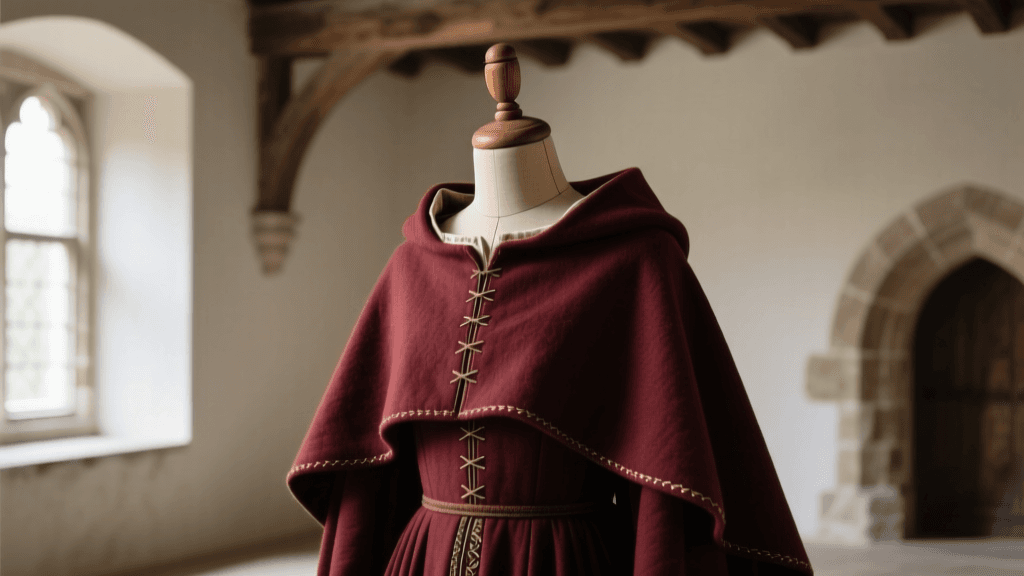
Before cutting into expensive yardage, one must understand the distinct architecture of the houppelande. Unlike the fitted cotehardie of the previous century, the houppelande is characterized by its massive, floor-sweeping skirts, high-standing collar, and enormous sleeves. For women, the garment was typically belted high, just under the bust, creating a cascading waterfall of pleats. For men, the houppelande could be floor-length for formal court occasions or cut to the knee for riding and martial activities, belted securely at the natural waist.
The Victoria and Albert Museum's Medieval Fashion guide highlights that the sheer volume of fabric was the primary indicator of wealth. A nobleman’s houppelande could easily consume upwards of eight to twelve yards of heavy fulled wool, lined entirely in contrasting silk or fur. In 2026, achieving this drape requires a deep understanding of fabric weight and bias cutting, ensuring the garment pools elegantly on the floor rather than looking stiff or costumey.
Sourcing Historical Textiles in 2026
The landscape of historical textile sourcing has evolved significantly. In 2026, sustainable and historically accurate mills in the United Kingdom, Italy, and Scandinavia offer custom-woven fulled wools that perfectly mimic 15th-century broadcloth. When sourcing your primary fabric, avoid modern suit wools, which are too lightweight and tightly woven. Instead, look for heavily fulled (felted) wool with a visible weave structure, such as diamond twill or herringbone, which were highly prized in the Burgundian court.
For deep dives into historical weave structures and archaeological textile finds, the Textile Research Centre Leiden provides an invaluable database of medieval textile fragments that can inform your fabric choices.
2026 Textile Comparison Chart for Houppelande Construction
| Fabric Type | Historical Accuracy | 2026 Avg. Cost per Yard | Best Use in Garment |
|---|---|---|---|
| Fulled Wool Broadcloth | Excellent | $45 - $75 | Primary Outer Garment |
| Silk Damask / Brocade | High (Nobility Only) | $90 - $160 | Outer Garment / Sleeve Linings |
| Medium-Weight Linen | Excellent | $25 - $45 | Inner Structural Lining |
| Shearling / Rabbit Fur | Excellent | $120 - $250 (per pelt) | Collar and Cuff Trim |
| Modern Synthetic Faux Fur | Poor (Avoid entirely) | $15 - $30 | N/A (Fails historical standards) |
Mastering the High Collar and Structural Interfacing
The most defining feature of the Burgundian houppelande is its towering, stiffened collar, which frames the face and stands high against the neck. To achieve this in 2026 without resorting to modern plastic boning, historical tailors rely on heavy linen canvas and traditional buckram. Buckram, a stiff cloth sized with glue or wheat paste, has been used since the Middle Ages to provide rigid structure to garments.
To construct the collar, cut your outer wool and inner lining fabric on the bias to allow for a smooth curve around the neck. The interlining should be cut from heavy linen canvas or historically milled buckram. Pad-stitch the canvas to the wool seam allowance, ensuring the stitches do not pierce the visible face of the outer fabric. This technique, heavily utilized in Renaissance tailoring, allows the collar to stand majestically on its own while remaining comfortable against the wearer's neck.
Cartridge Pleating: The Secret to Voluminous Skirts
The immense volume of the houppelande's skirt is not achieved through simple gathering, but through meticulous cartridge pleating. This technique allows several yards of heavy wool to be compressed into a relatively small waistband or bodice seam without adding excessive bulk. In 2026, while some modern makers attempt to use heavy-duty sewing machines for this step, authentic hand-sewn cartridge pleating remains the gold standard for high-end reenactment.
Begin by marking parallel lines along the top edge of your skirt panels, typically spaced half an inch apart. Using a heavy, waxed linen thread, sew running stitches along these lines. Once all rows are stitched, pull the threads simultaneously to draw the fabric up into tight, tubular pleats that resemble the cartridges of a firearm. These pleats are then whip-stitched individually to the finished edge of the bodice or waistband. The result is a beautifully controlled, fluted drape that cascades to the floor, perfectly capturing the 15th-century aesthetic.
Constructing the Bombard Sleeve
No Burgundian houppelande is complete without the bombard sleeve—a massive, bell-shaped sleeve that often hangs to the ground, sometimes featuring dagged (scalloped) edges. Because the sleeves are so large, they are typically lined in a contrasting fabric, such as silk taffeta or a lighter weight linen, to reduce the overall weight and provide a flash of color when the arm is raised.
When drafting the sleeve, the armscye (armhole) must be cut generously to accommodate the sheer volume of fabric gathered into it. The underside of the sleeve often features a slit at the elbow or forearm, allowing the wearer to pull their arm through for practical tasks while the massive sleeve hangs decoratively behind them. Ensure that the dagging on the hem is cut with sharp, period-accurate pinking shears or a custom die, as frayed edges will immediately detract from the garment's authenticity.
Essential Accessories: The Hennin and Chaperon
A houppelande must be paired with the correct headwear to complete the silhouette. For women, the steeple hennin—a towering conical hat draped with a sheer silk or linen veil—is the quintessential Burgundian accessory. Modern 2026 millinery techniques allow for lightweight buckram cones covered in silk, anchored securely with a velvet frontlet that sits just below the hairline. For men, the chaperon is mandatory. Originally a practical hood, by the 15th century, it had evolved into an intricate, turban-like headdress formed by wrapping the hood's liripipe (tail) and patte (cape) around the wearer's head, secured with decorative pins.
Budgeting Your 2026 Reenactment Project
Creating a museum-quality Burgundian houppelande is an investment in both time and materials. As of 2026, a complete, hand-finished wool houppelande lined in silk, complete with a buckram collar and fur trim, will typically cost between $600 and $1,200 in raw materials alone. If commissioning a professional historical tailor, expect labor costs to push the final price between $2,500 and $4,500, reflecting the dozens of hours required for hand-pleating, pad-stitching, and finishing.
However, for dedicated reenactors and cultural historians, the investment yields a garment that is not only historically defensible but also a profound connection to the textile traditions of medieval Europe. By prioritizing authentic weaves, structural tailoring, and meticulous hand-finishing, your houppelande will stand as a testament to the enduring legacy of European folk dress and Renaissance craftsmanship.