Tailoring a 15th-Century Burgundian Houppelande: 2026 Guide
Introduction to the Burgundian Houppelande in 2026 Reenactment
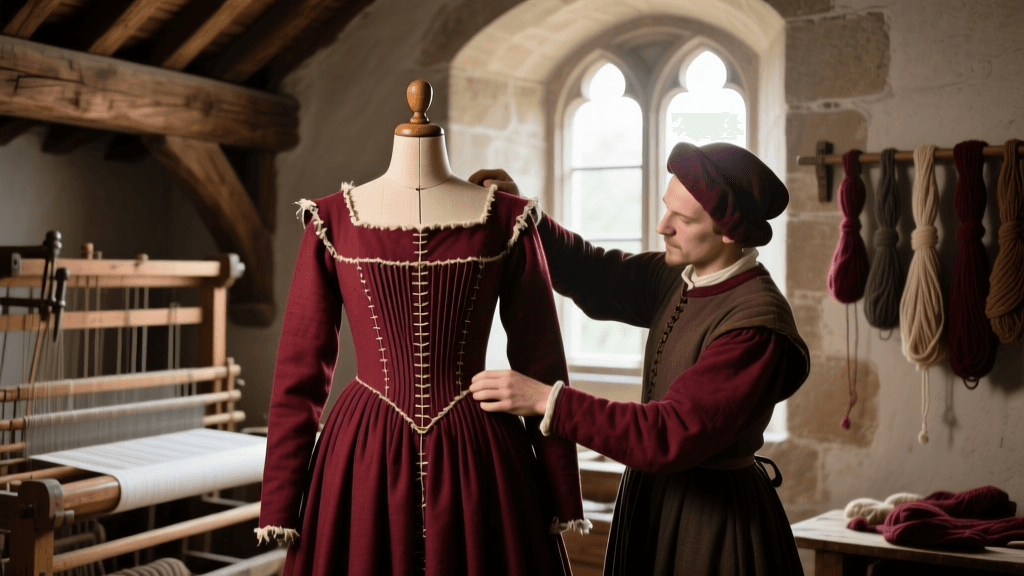
The Burgundian houppelande remains one of the most striking, opulent, and structurally complex garments of the late medieval period. Emerging in the late 14th century and reaching its zenith in the 15th century, this voluminous gown was characterized by its massive sleeves, high stiffened collar, and deep, tubular folds that cascaded to the floor. As we navigate the historical reenactment and costuming landscape in 2026, the standards for accuracy have evolved significantly. Modern enthusiasts and professional tailors no longer settle for approximations; the current 2026 guidelines from major European heritage guilds demand precise drape, historically accurate fiber content, and period-correct pleating structures. According to the Metropolitan Museum of Art's Heilbrunn Timeline of Art History, the transition from the fitted cotehardie to the expansive houppelande represented a massive shift in textile consumption and sartorial display, requiring yards of heavy, expensive fabric to achieve the desired silhouette.
Sourcing Historically Accurate Textiles for 2026 Productions
The foundation of any authentic houppelande is the textile. In 2026, the global market for heritage-milled wool has seen a renaissance, with specialized mills in Yorkshire, England, and Biella, Italy, producing broadcloths that closely mimic the fulled, dense weaves of the 1400s. However, supply chain adjustments and increased demand from global film productions mean that lead times for custom-dyed historical wools are currently averaging 8 to 12 weeks. When sourcing your primary fabric, you must prioritize weight and drape over mere color. A true winter houppelande requires a heavily fulled wool broadcloth that can hold stiff cartridge pleats without collapsing.
2026 Fabric Comparison and Sourcing Data
Below is a comprehensive breakdown of the recommended textiles for a high-status Burgundian houppelande, reflecting current 2026 market pricing and availability from heritage suppliers.
| Fabric Type | Historical Application | Weight (GSM) | 2026 Avg. Price/Yard | Drape Quality |
|---|---|---|---|---|
| Wool Broadcloth | Outer Gown, Winter Wear | 450 - 550 | $55 - $75 | Heavy, Structured, Holds Pleats |
| Worsted Wool | Summer Gowns, Linings | 250 - 350 | $35 - $45 | Fluid, Lightweight, Breathable |
| Heavyweight Linen | Interfacing, Collar Stiffening | 300 - 400 | $25 - $35 | Stiff, Supportive, Crisp |
| Silk Taffeta | Noble Trims, Sleeve Linings | 100 - 150 | $80 - $120 | Crisp, Rustling, Luxurious |
When purchasing your wool broadcloth, ensure it has been properly fulled. The fulling process shrinks and thickens the weave, obscuring the individual threads and creating a dense, almost felt-like surface that was highly prized in the Burgundian court. Avoid modern 'suiting' wools, as they are too lightweight and will result in a flimsy, anachronistic drape.
Drafting the Pattern: Geometry and Measurements
The geometry of the houppelande is fundamentally different from later Renaissance garments. It is not a simple T-tunic, nor is it tailored to the waist. Instead, it relies on massive gores or a full-circle construction to achieve its voluminous hem. For a floor-length houppelande tailored to a wearer of average height (approximately 5'6' or 167 cm), you will need a hem circumference of at least 180 to 200 inches to achieve the characteristic deep, tubular folds. This requires cutting the garment in multiple large panels.
To draft the pattern, start with a central back panel and add wide gores to the sides and front. The armholes should be cut high and tight to the shoulder joint, allowing the massive 'bombard' sleeves to hang from the upper arm rather than restricting movement. The bombard sleeve is a hallmark of the Burgundian style, featuring a tight upper arm that explodes into a wide, floor-length bell shape. In 2026, digital pattern drafting tools and large-format plotters have made scaling these massive 60-inch radius patterns significantly easier for home tailors, though traditional chalk-and-string compass methods remain perfectly valid and highly rewarding.
Constructing the Iconic Stiffened Collar (Collet)
The high, standing collar of the houppelande is one of its most defining features. To achieve this without resorting to anachronistic modern plastics, you must use a combination of heavyweight linen and millinery buckram. Cut the collar pattern on the bias to allow it to curve smoothly around the neck. Baste a layer of 300 GSM linen to a layer of stiff buckram, and then pad-stitch the layers together using a heavy linen thread. This pad-stitching technique, which has seen a major revival in historical tailoring circles this year, creates a flexible yet incredibly supportive structure that will stand up to two inches high without buckling.
Mastering the Houppe Pleat: Cartridge Pleating Techniques
The secret to the houppelande's dramatic silhouette lies in the shoulder and waist pleats, historically referred to as organ pleats or cartridge pleats. Unlike modern knife pleats, cartridge pleats are rounded and tubular, forcing the heavy wool to stand away from the body before cascading downward. This technique requires patience, precision, and the correct materials.
- Thread Selection: Do not use standard polyester or cotton sewing thread. The tension required to pull heavy wool into tight tubes will snap modern threads. Source a heavy-duty, waxed linen thread (18/3 or 30/3 weight) from specialized historical sewing suppliers.
- Marking the Grid: Use a water-soluble fabric marker to draw a precise grid on the wrong side of your wool. For a heavy broadcloth, mark your running stitch lines 1/2 inch apart, with dots spaced 1/4 inch apart along each line.
- The Running Stitch: Sew parallel rows of running stitches, ensuring that the stitches in each row align perfectly vertically with the rows above and below them. This vertical alignment is what creates the tubular effect when the threads are pulled.
- Pulling and Securing: Once your grid is stitched, gently but firmly pull the threads to gather the fabric into tight, rounded tubes. Secure the threads by wrapping them around a heavy pin in a figure-eight pattern. Finally, whip-stitch the top edge of each pleat directly to a sturdy linen waistband or shoulder yoke.
Navigating Sumptuary Laws and Color Accuracy
While modern tailors are not legally bound by historical sumptuary laws, creating an accurate portrayal requires an understanding of how color and fabric dictated social class in the 15th century. The The National Archives (UK) on Elizabethan Sumptuary Laws provides extensive documentation on how later Renaissance societies strictly regulated who could wear specific colors and textiles, a tradition rooted deeply in earlier Burgundian and French legal codes. A high-ranking Burgundian courtier would have worn deep madder reds, kermes crimsons, or rich woad blues. Avoid bright, synthetic-looking purples or neon hues. In 2026, natural dye houses offer historically accurate madder and weld-dyed wools that provide the complex, slightly muted tones characteristic of medieval luxury textiles.
Accessorizing the Silhouette: The Hennin and Chaperon
A houppelande is incomplete without its accompanying headwear. For women, the steeple hennin or the heart-shaped bourrelet are essential. Constructing a steeple hennin in 2026 is greatly aided by modern millinery wire (19-gauge) and lightweight buckram, which can be covered in silk taffeta or velvet. The translucent silk veil, often pinned to the tip of the hennin and allowed to trail down the back, should be made of lightweight silk organza rather than modern polyester chiffon, which lacks the proper stiffness and historical luster.
For men, the chaperon is the quintessential accessory. Originally a practical hood, by the mid-15th century, it had evolved into a complex, sculptural turban-like hat. The Victoria and Albert Museum's Medieval and Renaissance Collections offers invaluable visual references for the intricate draping of the chaperon's 'cornette' (the long trailing tail) and the 'liripipe'. To construct a stable, historically accurate chaperon that will not collapse during a long day at a reenactment event, tailors are currently utilizing a hidden internal armature of stiffened linen and wire, wrapped in the outer wool fabric to simulate the complex folds of the draped hood.
Final Finishing and Hemming
The hem of a houppelande takes a tremendous amount of abuse, dragging across floors and grass. Do not simply turn up the hem and stitch it. Instead, face the bottom 4 to 6 inches of the gown with a durable, contrasting fabric, such as a heavy linen or a sturdy silk taffeta. This not only protects the primary wool from fraying and moisture but also adds a beautiful flash of color when the wearer walks, a highly fashionable detail in the Burgundian court. Bind the very bottom edge with a woven wool braid or leather tape for maximum durability.
Conclusion
Tailoring a 15th-century Burgundian houppelande is a masterclass in historical geometry, textile manipulation, and structural engineering. By sourcing the correct heavyweight wools, mastering the intricate cartridge pleating techniques, and paying strict attention to the structural requirements of the collar and accessories, you can create a garment that truly breathes life into the past. As the historical costuming community continues to elevate its standards in 2026, the dedication to these precise, authentic methods ensures that the opulent legacy of the Burgundian court is preserved with the respect and accuracy it deserves.