Burgundian Houppelande Reconstruction: 2026 Pattern & Fabric Guide
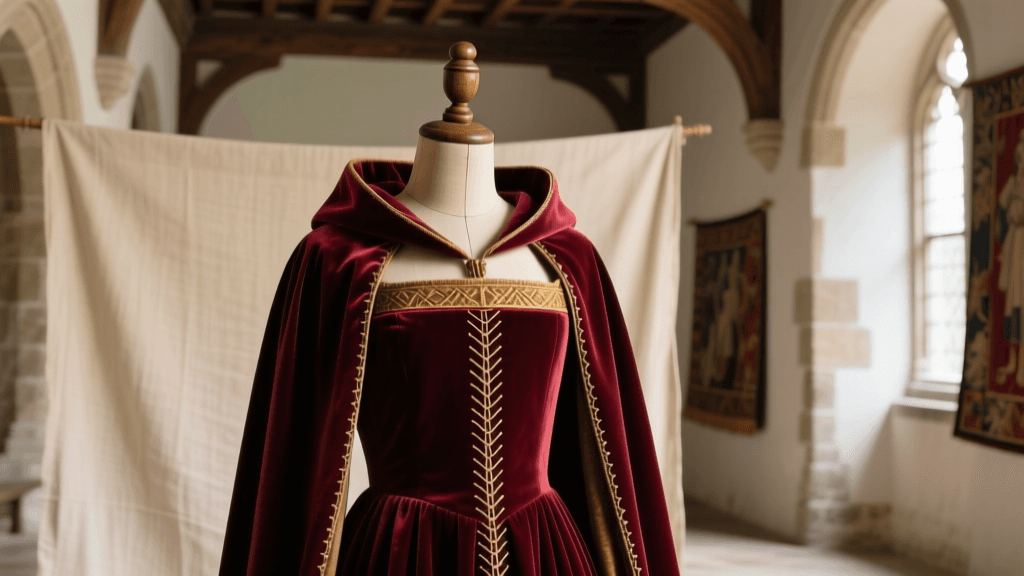
The Burgundian Houppelande: A Masterpiece of Late Medieval Fashion
As we navigate the 2026 historical reenactment and living history season, the demand for meticulous, museum-quality garment reconstruction has never been higher. Among the most iconic and structurally fascinating garments of the late medieval period is the Burgundian houppelande. Emerging in the late 14th century and reaching its zenith of opulence in the 15th century under the court of Philip the Good, the houppelande represents a critical bridge between medieval tailoring and the structured silhouettes of the early Renaissance.
Unlike the fitted cotehardie that preceded it, the houppelande was characterized by its voluminous, floor-length skirts, high standing collar, and massive sleeves. It was a garment of immense status, requiring yards of expensive broadcloth, silk, and fur. For modern historical costumers, reconstructing a houppelande in 2026 requires not only an understanding of historical geometric pattern drafting but also a strategic approach to sourcing heritage textiles in today's market.
This comprehensive guide will walk you through the anatomy of the garment, where to source authentic materials in 2026, and the step-by-step construction techniques required to bring this medieval masterpiece to life.
Anatomy of the 15th-Century Houppelande
Before cutting into expensive wool, it is vital to understand the structural components that define the houppelande. According to the Victoria and Albert Museum's Medieval and Renaissance collections, the garment's silhouette was achieved through an abundance of fabric rather than complex, curved tailoring.
- The Collar: A high, stiff standing collar that often reached the jawline, sometimes edged with fur or dagged (cut into decorative patterns).
- The Bodice and Skirt: Cut in large circular or semi-circular panels, the garment was gathered or pleated at the waist and held in place by a wide, ornate leather belt.
- The Sleeves: The most recognizable feature. Sleeves were either 'bombard' style (massively wide and bell-shaped, often trailing the ground) or 'straight' style (wide at the armhole and tapering slightly, but still highly voluminous).
- The Hem: Always floor-length for the nobility, frequently featuring elaborate dagging or fur trim along the bottom edge.
Sourcing Authentic Textiles in 2026
The textile market for historical reconstruction has evolved significantly. In 2026, there is a strong emphasis on sustainability and heritage weaving, making it easier than ever to find historically accurate wools and silks, albeit at a premium. The shift toward heritage-breed sheep farming in the UK and Scandinavia has yielded wools that closely mimic the dense, fulled broadcloth of the 15th century.
When consulting The Metropolitan Museum of Art's online collection of surviving medieval tapestries and garments, one notices the deep, rich woad blues, madder reds, and weld yellows. Modern natural dyers are now replicating these exact shades using historically documented mordants.
2026 Fabric Sourcing & Cost Comparison
| Material | Historical Equivalent | 2026 Avg. Cost (per yard) | Recommended Supplier Type |
|---|---|---|---|
| Heavyweight Melton Wool | Broadcloth / Woad-dyed Wool | $45 - $65 | Heritage Weavers / UK Mills |
| Silk Damask / Brocade | Lucca or Venetian Silk | $85 - $140 | Specialty Silk Importers |
| Medium-Weight Linen | Bleached Linen for Lining | $20 - $35 | Eastern European Linen Mills |
| High-End Faux Fur | Marten, Sable, or Ermine | $60 - $90 | Theatrical Costume Suppliers |
Note: A full-length houppelande with bombard sleeves typically requires 8 to 12 yards of 60-inch wide outer fabric, plus an equal amount of lining. Budget accordingly for the 2026 market rates.
Pattern Drafting and Essential Measurements
Medieval tailors did not use paper patterns or complex curved armholes. The houppelande was drafted using geometric shapes—primarily rectangles, triangles, and circles. To achieve the characteristic voluminous drape, the skirt is usually cut as a full circle or two half-circles, while the bodice is formed from straight rectangular panels that are pleated to fit the torso.
Key Measurements for the Houppelande
- Shoulder to Floor: Measure from the base of the neck, over the shoulder, down to the floor. Add 4 inches for hem allowance and belt blousing.
- Waist Circumference: Measure where the historical belt will sit (usually the natural waist or slightly above). This determines the finished pleated circumference of the bodice.
- Armhole Depth: Unlike modern garments, the armhole is cut as a simple slit or a very shallow curve. Measure from the collarbone down to the mid-ribcage to ensure the sleeve hangs from the shoulder point without restricting movement.
- Sleeve Length and Width: For a bombard sleeve, measure from the shoulder to the fingertips, then add 12 to 18 inches for the ground-trailing drape. The width at the hem of the sleeve should be at least 40 inches.
Step-by-Step Construction Techniques
1. Cutting and Assembling the Skirt Panels
Begin by cutting your wool into large semi-circles. Sew the straight edges together to form a massive cone. The center front should be left open, as the houppelande was typically a front-closing garment, secured by the belt and hidden hooks or ties. Finish the raw edges with a flat-felled seam or bind them with linen tape to prevent fraying, a technique well-documented in surviving 15th-century garments.
2. Pleating the Bodice
The most challenging aspect of the houppelande is attaching the voluminous skirt to the fitted bodice. In 2026, historical costumers favor cartridge pleating or rolled pleating for this step. Cartridge pleating involves folding the fabric back on itself in tight, uniform tubes, creating a stiff, structured gather that stands away from the body. Secure the pleats to a sturdy linen or canvas interlining band before attaching the outer bodice fabric.
3. Constructing the Standing Collar
The collar must stand rigidly against the neck. Cut a rectangular band of wool, interlined with heavy canvas or buckram. Pleat the neckline of the garment to fit the collar band. For an authentic finish, line the inside of the collar with a contrasting silk or a strip of faux fur. The collar should fasten at the center front with a decorative metal hook or a cloth button.
4. Attaching the Bombard Sleeves
Sew the sleeve seams, leaving the bottom 12 inches open if you wish to create a hanging lappet effect. Because the sleeves are incredibly heavy, do not rely solely on the wool to support the weight. Sew a strip of sturdy linen tape along the inside of the armhole seam to bear the tension and prevent the wool from stretching out of shape over time.
Dagging and Decorative Edge Finishing
No Burgundian houppelande is complete without 'dagging'—the art of cutting the edges of the fabric into intricate shapes such as castles, leaves, or geometric lobes. Because 15th-century broadcloth was heavily fulled (felted), it did not fray when cut. If your 2026 wool is not heavily fulled, you must stabilize the edges.
To achieve this, apply a modern fabric fray-check or a traditional beeswax and rosin mixture to the hem before cutting your dagged patterns. Use sharp, short-bladed embroidery scissors to carefully cut out the negative space. Alternatively, you can face the hem with a contrasting color of wool or silk, sew the dagged shapes, clip the curves, and turn them right-side out for a crisp, fray-proof edge.
Accessorizing the Silhouette
The houppelande was never worn in isolation; its impact relied heavily on the accompanying accessories.
- The Belt: A wide, ornate leather belt with heavy metal mounts is essential. It must be worn tightly at the waist to support the weight of the skirts and create the characteristic bloused effect over the belt.
- The Chaperon: The iconic 15th-century turban-like hat, evolved from a simple hood, is the mandatory headwear for a male Burgundian noble. In 2026, many reenactors opt for pre-tied chaperons, but learning to tie a draped chaperon from a single piece of wool adds immense authenticity to your portrayal.
- Footwear: Poulaines (shoes with elongated, pointed toes) are historically accurate. To protect the delicate leather and the trailing hem of your houppelande from mud at outdoor events, invest in a pair of wooden pattens (overshoes) to elevate your feet.
Conclusion
Reconstructing a 15th-century Burgundian houppelande in 2026 is a rewarding endeavor that bridges the gap between historical research and tangible craftsmanship. By prioritizing geometric pattern drafting, investing in high-quality heritage wools, and mastering traditional finishing techniques like cartridge pleating and dagging, you can create a garment that not only looks spectacular but moves and drapes exactly as it did in the court of Philip the Good. Whether you are preparing for a major European living history festival or expanding your museum-grade wardrobe, the houppelande remains the ultimate testament to late medieval sartorial ambition.