15th-Century Burgundian Houppelande Reconstruction Guide 2026
The 2026 Revival of Burgundian Court Fashion
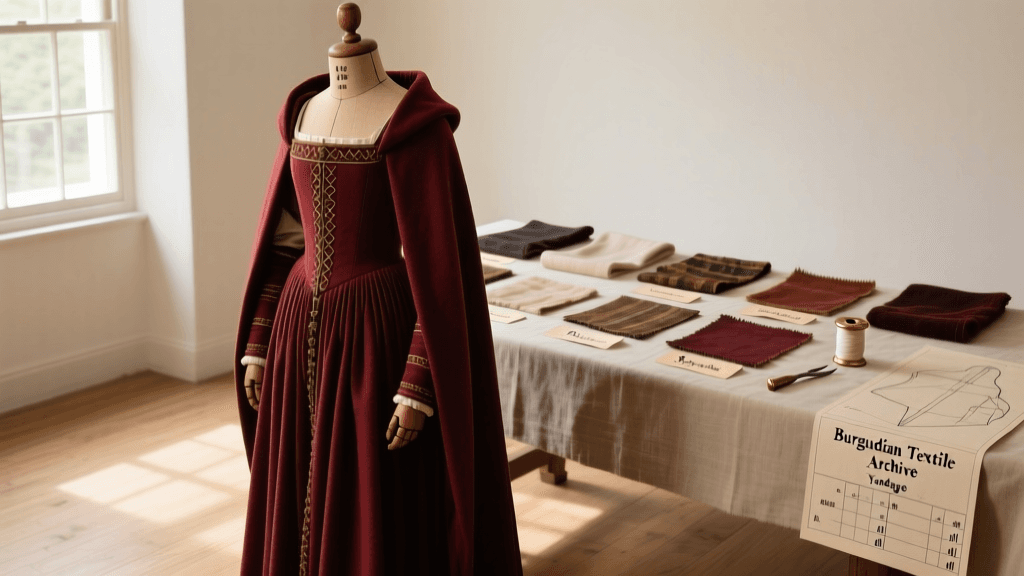
As we navigate the 2026 historical reenactment and slow-fashion seasons, there has been a remarkable surge in the recreation of late medieval European court dress. Among the most coveted and visually striking garments of this era is the Burgundian houppelande. Originating in the late 14th century and reaching its absolute zenith in the 15th-century courts of Philip the Good, the houppelande was a masterpiece of textile manipulation, characterized by its massive sleeves, high collars, and heavily pleated skirts. According to The Metropolitan Museum of Art's Heilbrunn Timeline of Art History, the 15th century in Northern Europe was defined by an opulent display of wealth through imported wools, rich dyes, and extravagant yardage, making the houppelande the ultimate status symbol of its day.
For modern makers, historical costumers, and European folk dress enthusiasts, reconstructing a houppelande in 2026 requires a delicate balance of historical accuracy and modern material sourcing. This comprehensive guide will walk you through the anatomy of the garment, how to source historically appropriate textiles using today's sustainable mills, and how to draft and construct your own 15th-century masterpiece.
Anatomy of the 15th-Century Houppelande
Before cutting into your precious yardage, it is vital to understand the structural elements that define the Burgundian silhouette. As detailed in Encyclopedia Britannica's guide to Medieval and Renaissance dress, the houppelande was a voluminous outer gown worn by both men and women, though the styling and length varied significantly by gender and social standing.
The Collar (Carcan)
The most distinctive feature of the late medieval houppelande is the high, standing collar, often referred to as a carcan. This collar was heavily stiffened and sometimes lined with contrasting fabrics or even fur. It framed the face dramatically and was often worn open at the front to reveal the underlying kirtle or chemise.
The Sleeves
The sleeves of a houppelande are where the garment truly earned its reputation for extravagance. In 2026, historical tailors generally focus on three primary sleeve variations for reconstruction:
- Bombard Sleeves: Extremely wide at the wrist, often dragging on the ground. These were popular in the early-to-mid 15th century and required massive amounts of fabric.
- Bag Sleeves: Fitted at the wrist but featuring a massive, pouch-like drape that hung down toward the floor, often with a slit for the arm to pass through.
- Angled or Straight Sleeves: More practical for everyday wear, featuring a moderate flare but lacking the ground-dragging excess of the courtly bombard.
The Bodice and Skirt
Unlike modern garments that are fitted to the natural curves of the body, the houppelande was tailored to hang from the shoulders and be gathered tightly at the waist or high hip by a heavy leather or woven belt. The skirt was constructed from multiple gores or large circular cuts, creating deep, tubular pleats that cascaded to the floor (for women and high-ranking men) or to the calf (for active men).
Sourcing Authentic Textiles in 2026
The success of your reconstruction hinges entirely on your fabric choices. Modern fast-fashion textiles will not drape, pleat, or wear like 15th-century broadcloth. In 2026, the historical sewing community has heavily pivoted toward ethically sourced, historically accurate wools produced by heritage mills in Yorkshire, England, and biodynamic weavers in Italy.
Choosing the Outer Wool
You must look for 100% wool broadcloth, melton, or heavily fulled worsted wool. The fabric should have a high GSM (grams per square meter), ideally between 350 and 500 GSM. This weight is necessary to support the deep, structured pleats of the skirt and the stiff collar. Avoid synthetic blends entirely; polyester blends will melt under the iron and will not hold historical steam-pleating techniques.
Choosing the Lining
Houppelandes were almost universally lined. While the ultra-wealthy lined theirs with imported silks or furs (such as vair or ermine), the practical modern maker should opt for medium-weight linen or, for winter garments, a lightweight wool flannel. Oatmeal, bleached white, or naturally dyed madder-red linens provide an excellent, historically grounded contrast when the sleeves and skirt are in motion.
Fabric Yardage and Measurement Chart
Calculating yardage for a houppelande can be daunting due to the sheer volume of fabric required. The table below provides baseline yardage estimates for 60-inch (152 cm) wide fabric. If you are using historically accurate narrow-loom wool (usually 27 to 36 inches wide), you will need to double these estimates and incorporate additional side gores.
| Garment Style | Sleeve Type | Outer Wool (60" wide) | Linen Lining (60" wide) | Belt/Trim Allowance |
|---|---|---|---|---|
| Women's Floor-Length | Bombard (Floor-dragging) | 8.5 - 10 Yards | 8.5 - 10 Yards | 4 Yards Tablet Weave |
| Women's Floor-Length | Bag Sleeve (Moderate) | 7 - 8 Yards | 7 - 8 Yards | 3 Yards Tablet Weave |
| Men's Calf-Length | Bombard (Ankle-length) | 5.5 - 6.5 Yards | 5.5 - 6.5 Yards | 2 Yards Leather/Weave |
| Men's Calf-Length | Straight / Angled | 4 - 5 Yards | 4 - 5 Yards | 2 Yards Leather/Weave |
Drafting the Pattern: The Circular Method
While gored skirts were used in earlier medieval periods, the most effective way to achieve the deep, concentric pleats of a 15th-century houppelande is through a modified circular cut. In 2026, pattern drafting software and digital plotters are available to hobbyists, but the traditional string-and-chalk method remains the most accurate way to draft a massive circular skirt on a home floor.
Step-by-Step Drafting
- Calculate the Waist Radius: Measure your waist (or high hip, depending on where you intend to belt the garment). Divide this measurement by 6.28 (2 x Pi) to find the radius for a full circle. Because a houppelande is heavily pleated, you will actually draft a circle with a waist hole three to four times your actual waist measurement to allow for the deep cartridge pleats.
- Draft the Skirt: Tie a piece of non-stretchy mason's line to a piece of tailor's chalk. Pin the other end to the floor. Measure out your calculated radius and draw the inner circle. Then, measure down from the inner circle to your desired hem length (plus 3 inches for hemming) and draw the outer circle.
- Draft the Bodice: The bodice of a houppelande is relatively simple, consisting of a front panel, a back panel, and side seams. It should be cut loose, as the tailoring and fit are achieved entirely through the tension of the belt and the gathering of the pleats at the waistline.
- Draft the Sleeves: For a bombard sleeve, the sleeve cap is a standard curved set-in sleeve, but the underarm seam flares out dramatically into a wide triangle, with the point of the triangle often rounded off to create the dragging hem.
Historical Sewing Techniques and Construction
To truly honor the European folk dress and medieval tailoring traditions, the construction methods should mirror historical techniques as closely as possible. While using a modern sewing machine for the long structural seams is acceptable for most 2026 reenactors, the finishing techniques must be done by hand.
Seam Finishing
Raw edges were rarely left exposed in high-status medieval garments. Use a flat-felled seam or a running stitch with the edges folded inward and whip-stitched together. This not only prevents fraying but adds structural integrity to the heavy wool.
Cartridge Pleating the Skirt
The hallmark of the houppelande is its tubular cartridge pleating. To achieve this:
- Run three parallel rows of heavy gathering stitches (using thick linen or silk buttonhole thread) along the top edge of your skirt.
- Pull the threads simultaneously to draw the fabric up into tight, uniform tubes.
- Whip-stitch the top of each individual pleat directly to the bottom edge of the bodice. This allows the skirt to flare out beautifully from the waist without adding bulk to the bodice seam.
Stiffening the Collar
The carcan collar must stand upright without collapsing. In the 15th century, this was achieved through heavy canvas interlining, starch, or even thin leather. Modern makers in 2026 often use heavy-weight buckram or multiple layers of tightly woven linen, pad-stitched together to create a flexible but rigid structure that molds to the neck over time.
Accessorizing the Burgundian Silhouette
A houppelande is never worn in isolation. To complete the 15th-century Burgundian aesthetic, you must incorporate the correct accessories.
- The Belt: A wide, heavily tooled leather belt or a tablet-woven silk sash is mandatory. The belt is worn tightly just under the bust (for women) or at the natural waist/hips (for men) to create the signature bloused effect over the waistline.
- The Chaperon: For men, the chaperon—a complex, turban-like headdress evolved from the simple hood—is the definitive headwear of the era. Drafting a chaperon requires a separate pattern, featuring a liripepe (the long trailing tail) and a patte (the decorative leaf-shaped cutouts).
- Pattens: To protect your expensive wool hem from the mud and muck of the 2026 reenactment fields, wooden pattens (overshoes with leather straps) are a highly practical and historically accurate addition to your footwear.
Conclusion
Reconstructing a 15th-century Burgundian houppelande is a labor of love that connects modern makers directly to the master tailors of the late medieval period. By prioritizing high-quality, heavy-weight wools, utilizing circular drafting techniques for maximum volume, and employing historical hand-finishing methods, you can create a garment that not only looks spectacular but moves and drrape with true historical authenticity. As the European folk dress community continues to grow and evolve in 2026, the houppelande remains a testament to the enduring power of medieval textile artistry.