2026 Guide to Drafting a 15th-Century Burgundian Houppelande
The Resurgence of the Burgundian Houppelande in 2026
The 15th-century Burgundian houppelande remains one of the most striking and opulent garments in European folk and historical dress. Characterized by its voluminous folds, high standing collar, and dramatic bombard sleeves, this iconic Renaissance-transition garment is experiencing a massive revival among historical reenactors, theatrical costumers, and heritage textile enthusiasts in 2026. With modern advancements in heritage textile milling and digital pattern drafting, recreating an authentic houppelande is more accessible than ever, provided you understand the historical geometry and fabric requirements.
This comprehensive guide will walk you through the anatomy of the garment, sourcing authentic materials in the current 2026 market, and the precise mathematical drafting techniques required to achieve that signature cascading drape without wasting expensive heritage wool.
Anatomy of the Burgundian Silhouette
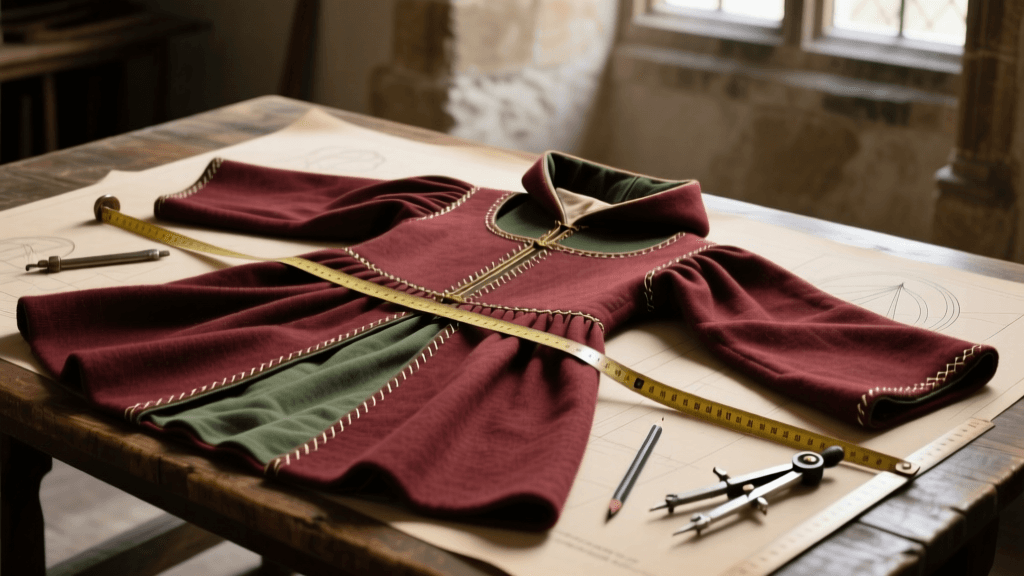
Before drafting your pattern, it is crucial to understand the structural elements that define the houppelande. Unlike the closely fitted cotehardie of the previous century, the houppelande was designed to display wealth through the sheer volume of fabric used. The garment is typically constructed from multiple gores (triangular panels) radiating from the shoulder or yoke, creating a bell-shaped skirt that pools elegantly on the floor.
Key Structural Elements:
- The Collar: A high, stiffened band that often features dagged (scalloped) edges, standing up to frame the face and the underlying linen chemise.
- The Bombard Sleeve: Extremely wide, floor-length sleeves that are open at the underarm or wrist, often lined with a contrasting silk, linen, or faux-fur to showcase the wearer's wealth.
- The Belt: A thick, ornate leather or woven belt worn high on the natural waist (for women) or at the hips (for men), which controls the massive volume of the skirt and creates the characteristic deep, vertical organ-pipe folds.
- The Train: Formal versions of the houppelande featured a trailing hem, requiring careful weight distribution in the lining to prevent the garment from pulling backward on the wearer's shoulders.
Sourcing Heritage Textiles in the 2026 Market
The success of a houppelande relies entirely on the drape and weight of the fabric. A lightweight modern wool suiting will not provide the deep, structural folds seen in 15th-century portraiture. As of 2026, the heritage textile market has seen a surge in traceable, historically accurate broadcloths and fulled wools, driven by increased demand from the global historical reenactment community.
For an authentic outer shell, you should seek out a heavily fulled wool broadcloth or a dense melton wool weighing between 450 and 600 grams per square meter (GSM). In 2026, heritage mills in Yorkshire and the Scottish Borders are producing exceptional historically-milled wools, though prices have adjusted to reflect sustainable farming practices, averaging £45 to £65 per meter. According to the extensive archives on medieval textile regulations and sumptuary laws maintained by Medievalists.net, the weight and color of your wool would have strictly indicated your social class in the 1400s. Today, we are free to choose based on aesthetic preference, though deep jewel tones (madder red, woad blue, and weld yellow) remain the most historically evocative.
For the lining, avoid modern polyester satins. Opt for a heavyweight, tightly woven linen (such as Irish linen in the 180-220 GSM range) or a high-quality plant-based faux fur if you wish to mimic the vair or ermine linings of the Burgundian court. For extant garment analysis and historical context on medieval linings, the Victoria and Albert Museum's Medieval and Renaissance collections offer invaluable visual resources and conservation notes on surviving textile fragments.
Pattern Drafting and the 2026 Digital Approach
Drafting a houppelande pattern requires a departure from modern, form-fitting slopers. The 15th-century method relied on geometric shapes—rectangles, triangles, and circles—rather than complex curved darts. In 2026, many historical costumers utilize smartphone LiDAR scanning applications to map their body's pivot points and simulate fabric drape before cutting into expensive heritage wool.
Step-by-Step Geometric Drafting:
- Establish the Yoke or Shoulder Seam: Unlike modern garments, the houppelande often features a straight shoulder seam or a slight drop. Measure from the base of your neck to your desired sleeve drop point.
- Calculate the Skirt Gores: To achieve the massive hem circumference (often exceeding 400 cm for a trailing gown), you will need to draft between 8 and 12 triangular gores. The top of each gore should be narrow enough to gather or pleat into your collar or yoke, while the base determines your hem width.
- Drafting the Bombard Sleeve: The sleeve is essentially a massive curved triangle. The cap must be large enough to accommodate the deep armscye (armhole), which historically extended much further down the torso than modern armholes to allow for movement beneath the heavy wool.
Fabric Yardage Calculator
Because the houppelande is highly volume-dependent, calculating yardage can be daunting. Below is a structured guide based on standard 140cm (55-inch) wide heritage wool, assuming a floor-length gown with a slight train and full bombard sleeves.
| Wearer Height (cm) | Fabric Width (cm) | Outer Wool Yardage (Meters) | Linen Lining Yardage (Meters) |
|---|---|---|---|
| 155 - 165 | 140 | 6.5 | 6.5 |
| 166 - 175 | 140 | 7.5 | 7.5 |
| 176 - 185 | 140 | 8.5 | 8.5 |
| 186 - 195 | 140 | 9.5 | 9.5 |
Note: If your chosen fabric features a directional nap or a woven pattern that must be matched at the seams, add an additional 1.5 meters to your total yardage.
Construction Techniques and Hand-Finishing
While modern sewing machines can handle the structural seams of a houppelande, the visible edges and hems must be finished by hand to maintain historical integrity. The Textile Research Centre in Leiden provides extensive databases on medieval stitching techniques, highlighting that 15th-century tailors relied heavily on flat-felled seams and overcast edges to prevent the fulled wool from fraying while maintaining a smooth interior against the linen undergarments.
Essential Hand-Stitches for the Houppelande:
- The Running Stitch: Used for gathering the massive skirt panels into the collar or waistband. In 2026, using a waxed linen thread (such as 35/2 or 40/2 weight) ensures the gathers hold their tension without snapping over time.
- The Catch Stitch (Herringbone):strong> The absolute best stitch for hemming heavy wool. It allows the hem to stretch and move with the drape of the fabric while remaining nearly invisible on the right side of the garment.
- The Prick Stitch: Used for attaching the heavy lining to the outer wool at the collar and sleeve cuffs. This stitch provides immense structural control, preventing the lining from rolling outward and ruining the crisp edge of the dagged collar.
'The true mastery of the medieval tailor lay not in the cutting of the cloth, but in the manipulation of its weight. The houppelande is a lesson in gravity; the belt does not merely hold the garment up, it sculpts the fabric into architecture.' — Notes from the 2026 International Symposium on Historical Dress Reconstruction.
Accessorizing the Ensemble
A houppelande is never worn in isolation. To complete the 15th-century Burgundian aesthetic, the garment must be paired with the correct accessories. For women, the iconic Hennin (the steeple-shaped headdress) or the Escoffion (a padded, horned roll) is essential. In 2026, milliners specializing in historical headwear utilize lightweight, molded buckram and ethically sourced silk organza to create these towering structures without causing neck strain.
Footwear is equally important. Because the hem of the houppelande trails on the ground, wearing historically accurate pattens (wooden or cork overshoes) is highly recommended for outdoor reenactment events to protect the delicate wool and linen from mud and moisture. Finally, the belt should be a substantial piece of leatherwork, often featuring a long, trailing end that hangs down past the knees, weighted with a decorative brass or pewter chape to keep it swinging elegantly with the wearer's movements.
Conclusion
Drafting and constructing a 15th-century Burgundian houppelande is a rewarding endeavor that bridges the gap between historical research and tangible craftsmanship. By leveraging the high-quality heritage textiles available in 2026, utilizing geometric drafting methods, and committing to authentic hand-finishing techniques, you can create a garment that not only looks spectacular but moves and drapes exactly as it did in the courts of Philip the Good. Whether you are preparing for a major Renaissance festival or contributing to a living history museum, the houppelande remains a testament to the golden age of European textile opulence.