Ancient Greek Chiton & Roman Stola Draping Guide 2026
The Enduring Legacy of Classical Antiquity Garments in 2026
The fascination with European folk dress and ancient historical garments has reached new heights in 2026. Driven by a global pivot toward sustainable, zero-waste fashion, the ancient Greek chiton and the Roman stola are no longer confined to museum archives or niche historical reenactment groups. Today, classicists, textile artists, and slow-fashion enthusiasts are reviving these masterpieces of draped antiquity. Unlike modern tailored clothing that relies on complex pattern cutting and generates significant textile waste, classical garments were woven to shape and draped directly onto the body. According to the Metropolitan Museum of Art's Heilbrunn Timeline of Art History, the genius of ancient Greek clothing lay in its uncut, rectangular construction, which allowed the fabric to flow naturally with the human form. This comprehensive 2026 guide provides an actionable approach to understanding, sourcing, and draping the foundational garments of classical antiquity: the Doric chiton, the Ionic chiton, and the Roman stola.
Understanding the Chiton: Doric vs. Ionic Styles
The Doric Chiton (Peplos)
The Doric chiton, often referred to as a peplos when constructed from heavier woolen fabrics, represents the quintessential garment of early classical Greece. Originating around the 6th century BCE, this garment was a staple of the ancient Greek wardrobe and remains a focal point for modern historical interpreters. The Doric chiton is defined by its simplicity and its distinctive overfold, known as the apotygma. This overfold not only provided an extra layer of warmth and modesty but also created a striking visual silhouette that emphasized the vertical drape of the fabric. In 2026, historical reenactment societies have updated their material guidelines to favor sustainably sourced, heavyweight linen or lightweight worsted wool, moving away from the synthetic blends that plagued early reproductions. To construct a Doric chiton, you must begin with a single rectangular piece of fabric. The width should be equal to the wearer's arm span, plus an additional 12 inches to allow for a comfortable overlap and side drape. The length must be calculated from the wearer's shoulder to the floor, plus an additional 15 to 18 inches to accommodate the apotygma overfold and a bloused effect at the waist.
The Ionic Chiton
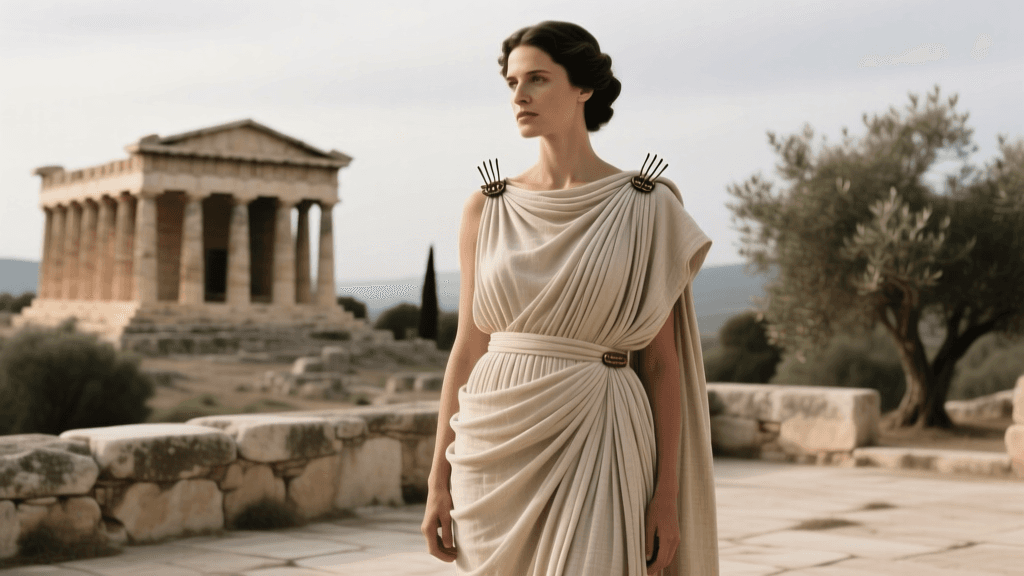
In contrast to the heavy, structured lines of the Doric style, the Ionic chiton emerged as a lighter, more fluid alternative. As detailed by the World History Encyclopedia, the Ionic chiton was typically crafted from fine, lightweight linen or imported silk, allowing for intricate pleating and a multitude of fastening points along the arms. This garment essentially created a sleeve effect through a series of small pins or brooches (fibulae) spaced evenly from the shoulder to the elbow. For contemporary practitioners in 2026, achieving the authentic Ionic silhouette requires sourcing high-quality, semi-sheer European flax linen, ideally in the 3.5 to 4.5 oz/yd² weight range. The fabric dimensions for an Ionic chiton are significantly more generous than the Doric variety. You will need a rectangle of fabric that is twice the width of the wearer's arm span. This excess width is crucial, as it is gathered into tight, deliberate pleats before being secured along the arms. The length should be the distance from the shoulder to the floor, plus 8 inches for waist blousing. The neckline is often wider and deeper than the Doric style, and the garment is typically worn with a delicate cord or leather belt woven through the bloused fabric at the waist to create an elegant, textured peplum effect.
Transitioning to Roman Elegance: The Stola
As the center of power shifted from Athens to Rome, the evolution of European folk dress adapted to new cultural norms, social hierarchies, and textile technologies. The Roman stola was the traditional, defining garment of the respectable Roman matron. Worn over a base layer tunic (the tunica interior), the stola was a long, sleeveless or short-sleeved dress suspended from the shoulders by straps or brooches. The World History Encyclopedia's guide to Roman Clothing notes that the stola was heavily associated with marital status and modesty, often featuring an instita—a woven decorative border or flounce at the hem. To recreate a stola for a 2026 museum exhibition or theatrical production, one must use a medium-weight linen or a wool-linen blend. The stola requires a rectangular piece of fabric measuring approximately 1.5 times the wearer's bust circumference in width, and the length from the shoulder to the ankle, plus 10 inches for blousing. The defining feature of the stola is the zona (belt) tied high just beneath the bust, and a second belt at the natural waist, which pulls the fabric up to create the characteristic draped folds over the midsection. While the male toga is often the most recognized Roman garment, its complex, semi-circular draping and immense weight make it highly impractical for daily modern wear, leaving the stola and the simpler Roman tunic as the preferred choices for contemporary classical revivalists.
Classical Garment Comparison Chart
| Garment Type | Era & Origin | Primary Fabric (2026 Standard) | Dimensions (W x L) | Fastening Method |
|---|---|---|---|---|
| Doric Chiton (Peplos) | 6th Century BCE, Greece | Heavyweight Linen (7.1 oz/yd²) | 1x Arm Span + 12" W; Height + 18" L | Shoulder Fibulae (Pins) |
| Ionic Chiton | 5th Century BCE, Greece | Sheer Flax Linen (3.5 oz/yd²) | 2x Arm Span W; Height + 8" L | Multiple Sleeve Fibulae |
| Roman Stola | 1st Century CE, Rome | Medium Wool-Linen Blend | 1.5x Bust W; Height + 10" L | Shoulder Straps & Belts |
Step-by-Step Draping Guide: The Doric Chiton
Draping a chiton requires patience and an understanding of how gravity interacts with natural fibers. Follow these steps to achieve an authentic classical silhouette:
- Step 1: Prepare the Overfold. Lay your rectangular fabric flat. Fold the top edge down by 15 to 18 inches to create the apotygma. This fold should face outward.
- Step 2: Wrap the Body. Hold the fabric behind your back with the top edge (the folded edge) aligned with your shoulders. Wrap the fabric around your torso, ensuring the side opposite the starting point overlaps the starting edge by at least 6 inches to prevent gaping.
- Step 3: Pin the Shoulders. Gather the front and back layers of the fabric at your shoulders, roughly three inches from the base of your neck. Secure these points using authentic bronze or silver omega pins or penannular brooches. Ensure the pins catch both the overfold and the back layer for structural integrity.
- Step 4: Belt and Blouse. Tie a woven wool or leather cord around your natural waist. Pull the fabric up and over the belt to create a bloused effect (kolpos). This adjusts the hemline to the desired ankle or calf length and secures the garment against the wind.
- Step 5: Adjust the Drape. Allow the open side of the chiton to fall naturally. In classical antiquity, the open side was often left exposed for mobility, though modern 2026 modesty standards for public reenactments frequently dictate wearing a lightweight linen under-tunic or utilizing a heavier fabric weight to ensure the drape remains closed.
Sourcing Authentic Materials and Fibulae in 2026
The success of any historical garment relies entirely on the textile. As of 2026, the most highly recommended suppliers for heritage reenactment fabrics are specialized European flax mills that produce unbleached, naturally dyed linens. Avoid modern cotton or polyester blends, as they lack the structural memory required to hold pleats and drape correctly. When purchasing linen, look for 'slubby' textures and irregularities that mimic hand-loomed historical textiles. For fastenings, the modern market offers exceptional museum-grade replica fibulae. Artisans on specialized heritage craft platforms now cast bronze brooches using lost-wax techniques identical to those used in antiquity. Investing in high-quality, historically accurate hardware elevates the garment from a simple costume piece to a genuine work of wearable historical art.
Caring for Your Historical Garments
Natural fibers require specific care to maintain their longevity and historical accuracy. Linen and wool should never be machine-washed with modern harsh detergents. Instead, soak your chiton or stola in cool water with a pH-neutral, plant-based soap. Gently agitate the water, then rinse thoroughly. To dry, lay the garment flat on a mesh screen out of direct sunlight to prevent the natural dyes from fading. Ironing should be done while the garment is still slightly damp, using a high-heat steam setting to press the pleats of an Ionic chiton or flatten the seams of a Roman stola. By adhering to these meticulous care standards, your classical garments will remain a staple of your historical wardrobe for years to come, perfectly bridging the gap between ancient artistry and 2026 sustainable fashion.