Burgundian Houppelande Construction & Fabric Guide 2026
The Silhouette of the 15th Century
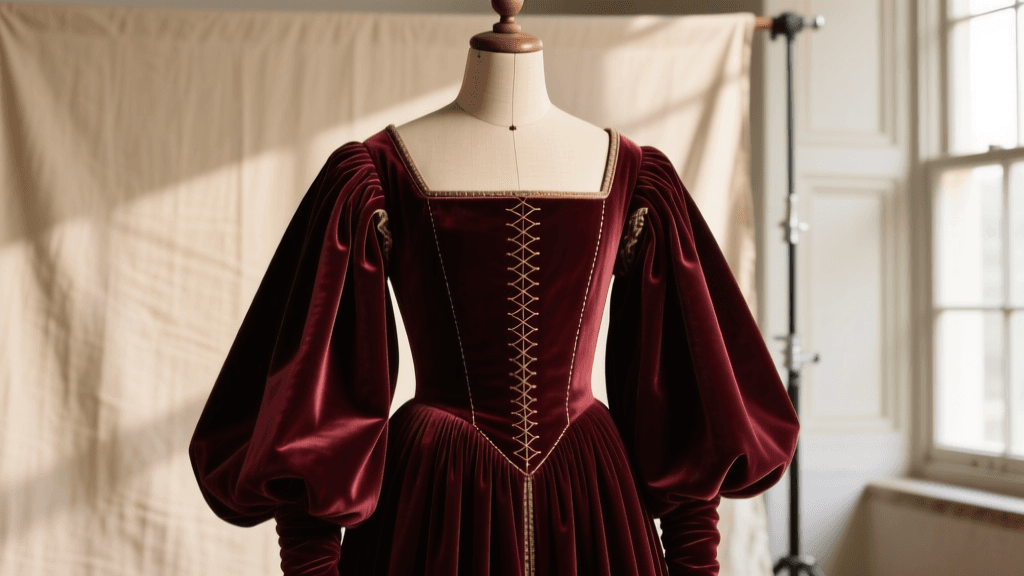
The Burgundian houppelande remains one of the most iconic and visually striking garments of the late medieval period. Characterized by its floor-length hem, voluminous bombard sleeves, and dramatic high collar, this outer garment was a staple of aristocratic and wealthy merchant wardrobes across 15th-century Europe. For historical reenactors, Renaissance festival attendees, and textile historians in 2026, constructing an authentic houppelande requires more than just sewing skills; it demands an understanding of historical geometry, fabric drape, and period-accurate tailoring techniques. According to the Encyclopedia Britannica's history of Medieval European dress, the houppelande emerged in the late 14th century as a reaction against the tightly fitted cotehardie, evolving into a symbol of opulence and status through its massive consumption of expensive textiles.
2026 Fabric Sourcing and Cost Analysis
Sourcing the correct textiles is the most critical step in your construction process. The heavy, structured drape of a houppelande cannot be achieved with modern, lightweight costume fabrics. As of early 2026, the global textile market has seen a shift in wool pricing, making pure wool melton a premium investment. However, the authenticity it provides is unmatched. You will need a heavy outer fabric, a sturdy lining, and an interlining for the collar. Studying the drape and sleeve volume of the garments depicted in the Metropolitan Museum of Art's Unicorn Tapestries reveals the necessity of using heavyweight wools and silks to achieve the deep, tubular folds characteristic of the era.
| Fabric Type | Garment Role | 2026 Est. Cost/Yard | Yardage Required |
|---|---|---|---|
| Wool Melton (16-20 oz) | Outer Shell | $38.00 - $52.00 | 6 - 8 yards |
| Heavyweight Linen (7-9 oz) | Body Lining | $15.00 - $22.00 | 6 - 8 yards |
| Silk Taffeta or Dupioni | Sleeve Accents / Dagging | $45.00 - $65.00 | 2 - 3 yards |
| Cotton Buckram / S320 | Collar Stiffening | $12.00 - $18.00 | 1 yard |
When purchasing your wool melton in 2026, look for a fabric with a high felted finish that does not fray when cut, as this will allow you to leave the inner seams and hem edges unfinished, a common period practice that reduces bulk in such a heavy garment.
Drafting the Pattern: Measurements and Geometry
Unlike modern clothing, which is drafted using complex multi-piece bodice and sleeve blocks, the 15th-century houppelande relies on geometric shapes—primarily circles and rectangles. The body of the garment is essentially a massive circle or a series of gores that create a sweeping hemline. To draft the body, measure from the base of your neck down to the floor, then add 4 inches for hem allowance and ground clearance. This radius will dictate the sweep of your hem.
The Bombard Sleeve
The bombard sleeve is the defining feature of the Burgundian style. To draft this sleeve, you must measure from the shoulder apex down to the floor, and then add exactly 14 to 18 inches. This extra length is not an error; it is designed to create the characteristic 'puddling' effect at the wrist and ground. The sleeve cap is cut as a wide, shallow curve, while the bottom of the sleeve flares out into a massive bell or tube shape. The armhole itself should be cut generously deep, extending down to the lower ribcage, which allows for the massive volume of fabric to be gathered without restricting the wearer's movement.
Step-by-Step Construction and Cartridge Pleating
The most challenging and rewarding aspect of constructing a houppelande is the cartridge pleating (historically referred to as 'piping' or 'organ pleating') used to attach the voluminous skirt to the fitted bodice or yoke, and to gather the massive collar. As noted in The Met's Heilbrunn Timeline of Art History on Medieval Dress, the transition to highly tailored, pleated outer garments marked a significant leap in European textile engineering during the 1400s.
Executing the Cartridge Pleats
- Marking the Grid: On the wrong side of your wool fabric, use a water-soluble pen or tailor's chalk to mark a grid of dots. Space the dots exactly 1/4 inch apart horizontally and 1/4 inch apart vertically. This tight grid is essential for achieving the deep, rounded tubes of a proper 15th-century pleat.
- Running the Threads: Thread a heavy-duty upholstery needle with strong, waxed linen or polyester buttonhole thread. Run parallel rows of running stitches through the dots. You will need at least three to four parallel rows to control the thick wool.
- Pulling and Setting: Once your rows are stitched, gently pull the threads to gather the fabric. The wool will naturally roll into tight, cylindrical tubes. Wrap the threads securely around a pin in a figure-eight pattern to hold the tension.
- Attachment: Do not use a modern sewing machine for this step. Cartridge pleats must be attached to the bodice or collar band by hand. Use a heavy whipstitch or backstitch, catching the very top edge of each pleat tube and stitching it directly to the finished edge of your lining or yoke. Expect to spend 8 to 12 hours hand-stitching the waistline alone.
Collar Stiffening and Sleeve Attachment
The high, flared collar of the Burgundian houppelande must stand rigidly away from the neck and frame the face without collapsing. To achieve this in 2026 without relying on uncomfortable modern plastics, use a heavyweight cotton buckram or a modern thermoplastic interfacing like Vilene S320. Cut the interfacing on the bias so it curves smoothly around the neck. Sandwich the stiffening between your outer wool and your silk or linen lining, stitching the layers together at the seam allowances before turning the collar right side out.
When attaching the bombard sleeves, the sheer weight of the wool can cause the shoulder seam to tear over time. To prevent this, reinforce the armhole seam with a strip of sturdy linen tape. Stitch the tape directly over the seam allowance on the inside of the garment, anchoring it to the bodice lining. This historical reinforcement technique distributes the weight of the heavy sleeves across the entire shoulder and chest, ensuring your garment survives years of festival wear and reenactment events.
Authentic Accessories and Layering for 2026 Festivals
A houppelande is never worn in isolation. To complete your 15th-century Burgundian silhouette, you must consider the layers beneath and the accessories above. Beneath the houppelande, men and women would wear a linen chemise and a fitted wool kirtle. For men, wool hose attached to the kirtle with brass points are essential, as the high slits of the houppelande will reveal the legs during movement.
For headwear, the chaperon (for men) or the steeple hennin (for women) are non-negotiable for a complete aristocratic look. The chaperon, originally a practical hood, evolved into a complex, sculptural turban-like headdress by the mid-15th century. When sourcing accessories for the 2026 reenactment season, prioritize hand-forged brass or pewter belt buckles and aglets. A heavy, tooled leather belt worn at the high waist (for women) or the hips (for men) will help control the massive volume of the wool skirt and provide a place to hang a period-accurate pouch or dagger. By combining historically accurate geometric drafting, premium 2026 textiles, and meticulous hand-finishing techniques, your Burgundian houppelande will not only look authentic but will drape, move, and endure exactly as it did in the courts of 15th-century Europe.