Renaissance Burgundian Houppelande Tailoring Guide 2026
The Resurgence of the Burgundian Silhouette in 2026
The fascination with late medieval and early Renaissance European clothing has reached new heights in 2026, driven by a global surge in historically accurate reenactment, HEMA (Historical European Martial Arts) adjacent fashion, and advanced textile archaeology. At the pinnacle of this sartorial hierarchy sits the Burgundian Court dress of the 15th century. Characterized by its sweeping lines, opulent fabrics, and dramatic proportions, the Burgundian silhouette remains one of the most challenging and rewarding garments for modern historical tailors to reconstruct. According to the Met Museum's Heilbrunn Timeline of Art History, the Burgundian court under Philip the Good set the standard for European luxury, utilizing fashion as a potent tool of diplomatic and economic power.
This comprehensive guide explores the meticulous construction of the 15th-century Burgundian houppelande and its foundational kirtle layer. We will cover 2026 textile sourcing, accurate yardage conversions, and the complex mathematics of cartridge pleating and bombard sleeves, providing actionable advice for garment makers seeking museum-quality authenticity.
Anatomy of the 15th-Century Layering System
The Chemise and Kirtle Base
Before constructing the voluminous houppelande, a tailor must master the base layers. The foundation begins with the linen chemise, a simple T-tunic or gathered undergarment designed to protect the outer wools and silks from body oils. In 2026, historical dressmakers favor unbleached or naturally off-white medium-weight linen (approximately 5.3 oz/yd²) for authenticity, avoiding the harsh optical whites of modern commercial linens.
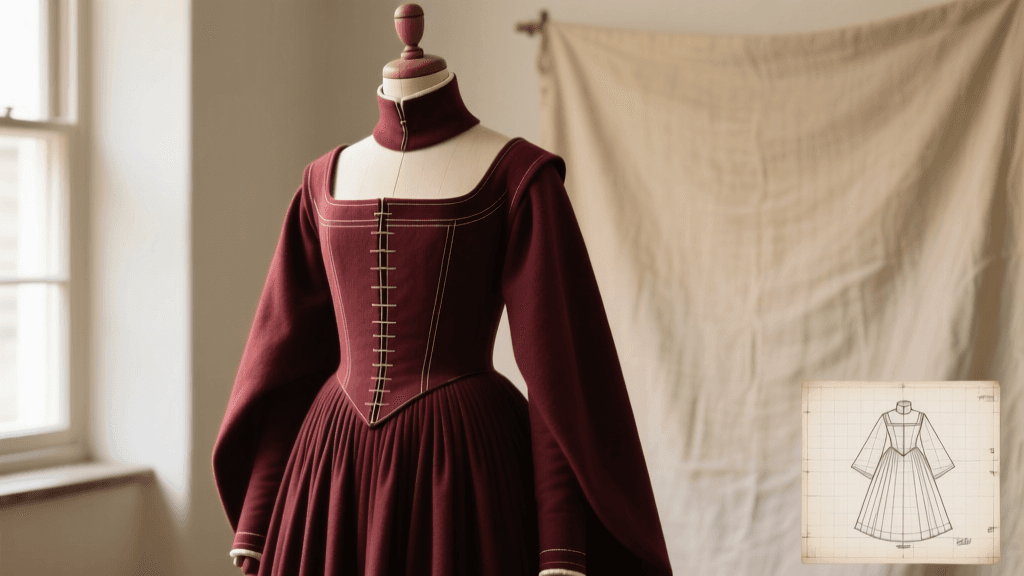
Over the chemise lies the kirtle. By the mid-15th century, the kirtle had evolved into a highly structured, supportive garment. For women, the kirtle was often tightly fitted through the torso, utilizing curved side seams and a front or back lacing closure to achieve the smooth, elongated torso silhouette prized in Burgundian art. The skirt of the kirtle was widened using triangular gores inserted into the side and back seams. Tailoring the kirtle requires a precise understanding of the bias; inserting gores on the bias allows the heavy wool to drape and flare beautifully without adding excessive bulk at the waist.
The Houppelande: Construction and Drape
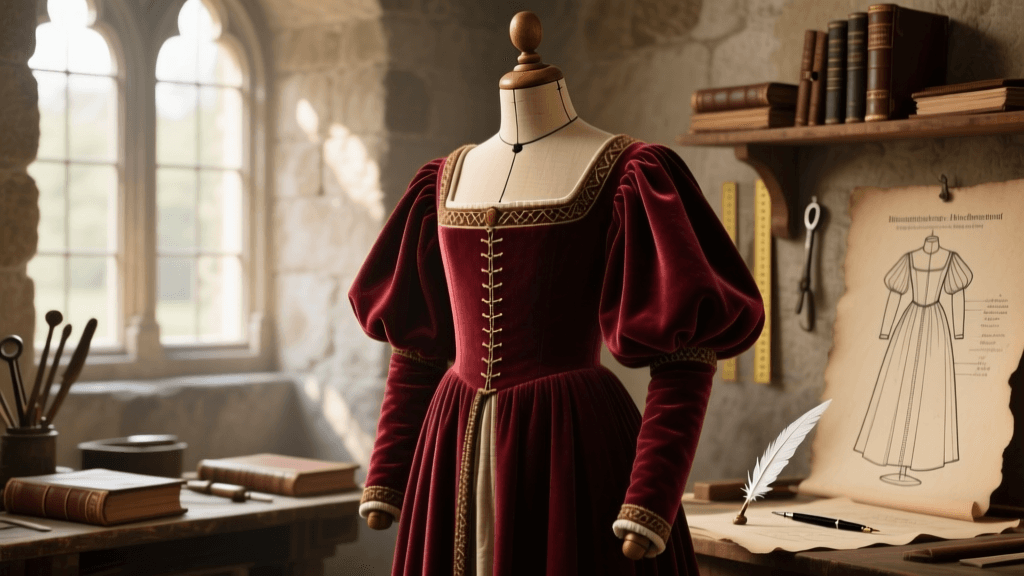
The houppelande is the crowning glory of the Burgundian wardrobe. It is a massive, floor-sweeping outer gown characterized by a high, stiffened collar, immense volume gathered at the high waist or shoulders, and extravagantly large sleeves. The Victoria and Albert Museum's fashion archives frequently highlight how these garments were less about practical warmth and more about displaying immense wealth through the sheer yardage of imported silk and fine Flemish wool.
The most iconic sleeve of the Burgundian houppelande is the bombard sleeve. This sleeve is cut as a massive half-circle or full-circle, with the wrist opening so wide that it often brushed the floor when the arms were lowered. To draft a historically accurate bombard sleeve in 2026, tailors must abandon modern set-in sleeve patterns. Instead, the sleeve is drafted directly from the shoulder point, utilizing a deep curve that creates the signature pooling effect at the elbow and wrist.
2026 Textile Sourcing: Wool, Silk, and Linen
Sourcing historically accurate textiles remains a primary hurdle for modern reenactors. As of 2026, the market for heritage wool broadcloth has stabilized, though import tariffs on specialized European weavers have slightly driven up prices. Authentic 100% wool broadcloth, which features a heavily fulled and brushed nap that hides the weave and prevents fraying, currently averages $55 to $85 per yard from specialized historical vendors.
When selecting wool for a houppelande, the weight and drape are paramount. A mid-to-heavy weight broadcloth (12 to 16 oz per yard) is essential for the deep, structured folds of the cartridge pleats. For linings, historical accuracy dictates the use of silk or fur. In 2026, ethical and legal restrictions on animal furs have led most historical societies to accept high-quality faux furs or, more accurately, silk linings dyed in contrasting colors. Habotai or charmeuse silks are often used, though a heavier silk twill or dupioni provides a more authentic structural support and a satisfying acoustic rustle.
Dyeing and Color Accuracy
Color in the 15th century was heavily regulated by sumptuary laws and dictated by the immense cost of dyestuffs. The most prized color in the Burgundian court was not a bright hue, but a deep, complex black. Achieving "Burgundian Black" required multiple overdyeing processes, typically combining woad (blue) and madder (red) with an iron and tannin mordant. Modern artisans in 2026 are increasingly turning to botanical dyeing to replicate these complex shades, moving away from flat, synthetic aniline blacks that look harsh and historically inaccurate under natural light.
Yardage and Measurement Conversion Chart
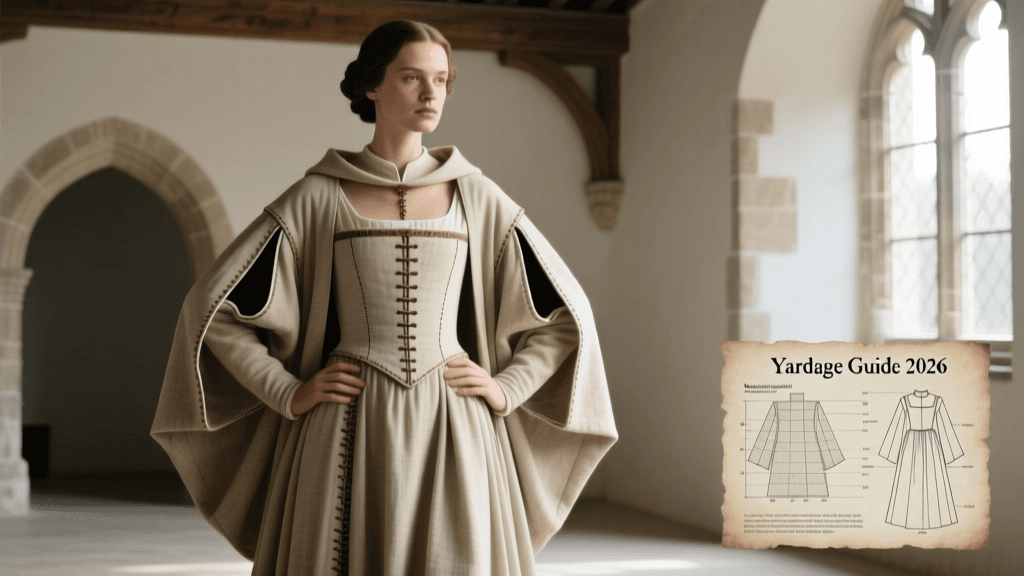
One of the most common mistakes modern tailors make is applying modern 60-inch fabric width logic to medieval patterns. 15th-century broadclooms produced fabric roughly 27 to 30 inches wide. This narrow width necessitated numerous vertical seams, which were not viewed as flaws but as structural necessities that added to the garment's drape. The table below outlines the yardage requirements for a standard women's Burgundian ensemble, converting historical narrow-loom requirements to modern 60-inch widths for 2026 purchasing.
| Garment Layer | Historical Loom Width (27") | Modern Loom Width (60") | 2026 Est. Yardage Needed | 2026 Avg. Cost (USD) |
|---|---|---|---|---|
| Linen Chemise | 4.5 yards | 2.5 yards | 2.5 - 3 yards | $35 - $50 |
| Wool Kirtle (with gores) | 8 yards | 5 yards | 5 - 6 yards | $120 - $180 |
| Wool Houppelande | 12+ yards | 7 - 9 yards | 8 - 10 yards | $440 - $850 |
| Silk Lining (Houppelande) | 12+ yards | 7 - 9 yards | 8 - 10 yards | $160 - $300 |
| Contrast Fabric (Collar/Cuffs) | 1.5 yards | 1 yard | 1 yard | $25 - $60 |
Mastering Cartridge Pleating and Tailoring
The immense volume of the houppelande is controlled at the high waist or shoulder line through cartridge pleating (also known as gauging). Unlike knife pleats or box pleats, cartridge pleats stand out perpendicular to the garment, creating a rounded, tubular fold that mimics the organ pipes seen in 15th-century illuminated manuscripts.
Step-by-Step Cartridge Pleating Guide:
- Preparation: Hem the top edge of your skirt panels. Do not fold the fabric over multiple times, as bulk is the enemy of a clean cartridge pleat. Finish the raw edge with a simple whip stitch or a modern serger hidden by a silk binding.
- Marking the Grid: Using a water-soluble pen or tailor's chalk, mark a grid of dots on the wrong side of the fabric. For heavy wool broadcloth, mark dots 1/2 inch apart horizontally and 1/2 inch apart vertically. You will need at least two to three horizontal rows of dots to create the structural "tube" of the pleat.
- Running Stitch: Thread a heavy-duty buttonhole twist or waxed linen thread. Run a simple basting stitch through the dots, ensuring you pick up only a small amount of fabric at each mark. Leave long tails of thread at the ends.
- Pulling and Setting: Gently pull the threads to gather the fabric. The heavy wool will naturally fold into tight, rounded tubes. Pin the pleats to a sturdy, reinforced waistband or directly to the fitted bodice of the kirtle.
- Securing: Using a strong whip stitch, secure the top of each individual pleat to the waistband. For historical accuracy and maximum durability, stitch through the top fold of the pleat and then back down through the side, ensuring each pleat is anchored independently.
Accessories: The Hennin and Poulaines
No Burgundian houppelande is complete without its accompanying accessories. The hennin—the iconic conical or heart-shaped headdress—was a marvel of structural engineering. In 2026, milliners crafting historical hennins utilize lightweight buckram or thermoplastic felt to create the rigid cone, which is then covered in silk velvet and draped with a sheer linen veil. The veil's length and the height of the hennin were strictly dictated by the wearer's social rank, with the tallest steeple hennins reserved exclusively for the highest nobility.
Footwear consisted of poulaines, leather shoes featuring exaggerated, pointed toes. The length of the toe was again subject to sumptuary laws. Modern cordwainers (shoemakers) specializing in medieval footwear construct these using vegetable-tanned leather and traditional turnshoe methods, where the shoe is sewn inside out and then turned right-side-out while damp, ensuring a seamless, historically accurate finish.
Conclusion
Reconstructing the 15th-century Burgundian houppelande and kirtle in 2026 is a profound exercise in historical empathy and technical mastery. By understanding the geometry of the bombard sleeve, the physics of cartridge pleating, and the economic realities of historical textiles, modern tailors can breathe life into the opulent silhouettes of the Burgundian court. Whether you are preparing for a high-level historical exhibition or simply seeking to master advanced traditional tailoring techniques, the rigorous standards of 2026 textile research provide all the tools necessary to achieve unparalleled authenticity.