Drafting the Burgundian Houppelande: 2026 Maker's Guide
Introduction to the Burgundian Houppelande
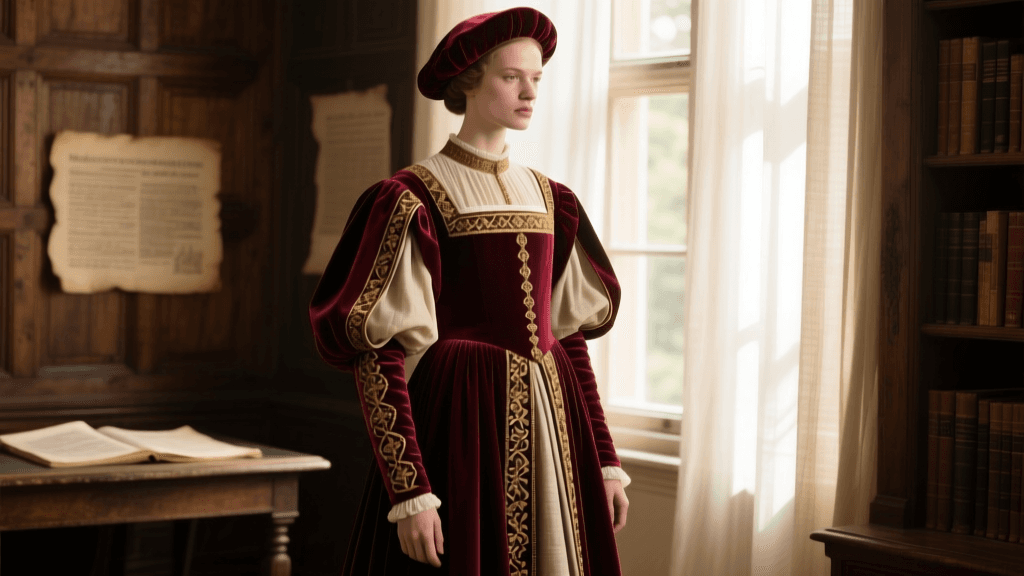
The Burgundian houppelande remains one of the most striking, opulent, and structurally fascinating silhouettes in European folk and court dress history. Emerging in the late 14th century and reaching its zenith in the mid-15th century under the Dukes of Burgundy, this voluminous outer garment was a definitive status symbol. Characterized by its high standing collar, massive trailing sleeves, and floor-sweeping hem, the houppelande was heavily belted to create deep, luxurious folds. For historical sewists, reenactors, and costume historians in 2026, reconstructing this garment offers a masterclass in medieval geometric pattern drafting and textile manipulation. This guide provides a comprehensive, actionable approach to drafting, sourcing, and constructing an authentic 15th-century Burgundian houppelande using modern 2026 techniques and heritage textiles.
The Historical Context of the Houppelande
Before cutting into expensive yardage, it is crucial to understand the garment's structural philosophy. Unlike the highly tailored, body-hugging cotehardie that preceded it, the houppelande relied on the sheer volume and drape of the fabric to create its silhouette. According to the Victoria and Albert Museum's overview of medieval fashion, the transition to these voluminous robes reflected both a desire for conspicuous consumption and a shift in medieval sartorial aesthetics toward draped elegance. The garment was worn by both men and women, though the length and belting placement varied by gender. Men often wore shorter, knee-length versions for riding, while the courtly Burgundian ideal for both sexes favored the extravagant, floor-length version with bombard sleeves that practically swept the cobblestones.
Sourcing Historically Accurate Textiles in 2026
The success of a houppelande reconstruction hinges entirely on textile weight and drape. A fabric that is too light will not hold the deep, tubular folds required at the belt line, while a fabric that is too stiff will look like a bell rather than a cascading waterfall of wool. In 2026, the historical reenactment community has seen a massive shift toward sustainable, heritage-milled textiles, with specialized mills in Yorkshire, England, and Biella, Italy, producing custom broadcloth runs specifically for historical societies.
When sourcing your outer shell, you must look for heavily fulled wool broadcloth or a dense wool melton. The fulling process shrinks and mats the wool fibers, creating a dense, windproof fabric that holds a cut edge without fraying—a vital feature for the dagged (decoratively cut) hems popular in the Burgundian court. For linings, historical accuracy demands silk taffeta, silk damask, or, for winter garments, ethically sourced vintage furs or high-quality modern faux furs that mimic the dense pile of medieval squirrel or marten.
2026 Textile Sourcing & Specifications Table
| Garment Layer | Recommended 2026 Textile | Weight / Weave | Sourcing & Preparation Notes |
|---|---|---|---|
| Outer Shell | Fulled Wool Broadcloth | 450-600 GSM, Twill or Tabby | Must be heavily milled to prevent fraying when dagged. Pre-wash in hot water to ensure maximum shrinkage before cutting. |
| Primary Lining | Silk Taffeta or Dupioni | 19-22 momme | Provides the necessary structural "rustle" and body. Avoid slippery charmeuse, which lacks historical accuracy and structural grip. |
| Collar Interfacing | Heavyweight Linen Canvas | 12-14 oz | Required to support the standing collar. Modern buckram can be used, but layered linen canvas stitched with pad-stitching is more authentic. |
| Edge Trims | Tablet-Woven Silk Braid | Variable width | Used to bind the hem and collar edges if dagging is not employed. Sourced from specialized 2026 tablet-weaving artisans. |
Pattern Drafting: The Geometry of Volume
Medieval pattern drafting was rooted in geometry rather than complex curved tailoring. The houppelande is essentially constructed from rectangles, circles, and triangular gores. In 2026, makers have the distinct advantage of using smartphone LiDAR scanning apps to take precise volumetric measurements over their foundational undergarments (such as the linen chemise and wool kirtle), ensuring the houppelande accommodates the bulk of the layers beneath it.
Drafting the Core Body Panels
The most common and historically supported method for drafting the body of a houppelande is the "rectangle and gore" method.
- Front and Back Panels: Cut two large rectangles. The width of each rectangle should be at least 1.5 to 2 times your chest/hip circumference to allow for the deep belted folds. The length should be measured from the base of the neck to the floor, plus an additional 4 inches for a hem allowance and ground drag.
- Side Gores: To achieve the massive hem circumference without adding bulk to the shoulders, insert large triangular gores at the side seams. These gores should begin at the underarm and flare out dramatically to the hem.
- The High Collar: The signature Burgundian collar is a curved rectangle. Draft a strip of fabric that matches the circumference of your neck plus 2 inches for overlap, and a height of 4 to 6 inches. This must be heavily interfaced with linen canvas and pad-stitched to maintain its rigid, standing posture without collapsing against the neck.
Constructing the Signature Bombard Sleeve
The bombard sleeve is the defining feature of the mid-15th-century houppelande. It is incredibly wide at the armhole, tapering slightly down the arm before exploding into a massive, floor-length bell or bag shape. The challenge in 2026 is patterning the curve so that the sleeve hangs correctly from the shoulder without twisting or pulling the bodice out of alignment.
To draft the bombard sleeve, start with a standard sleeve block. Extend the underarm seam downward in a sweeping curve that reaches its lowest point around the knee level of the wearer, before curving back up to the wrist. The wrist opening itself should remain relatively fitted, or feature a small slit for the hand to pass through, allowing the massive bulk of the sleeve to drape behind the arm. When sewing the sleeve to the body, use a reinforced backstitch or a modern machine equivalent, as the weight of the heavy wool and silk lining will place immense stress on the armhole seam. Finish the interior armhole seam with a flat-felled stitch or bind it with linen tape to prevent fraying and distribute the tension.
Edge Treatments, Dagging, and Finishing
One of the most visually spectacular elements of Burgundian dress is "dagging"—the art of cutting decorative shapes into the raw edges of the fabric. Because heavily fulled wool broadcloth does not fray, medieval tailors could cut intricate scallops, leaf motifs, and geometric patterns into the hems of the sleeves and the skirt. The Metropolitan Museum of Art's Heilbrunn Timeline on Medieval Europe features numerous tapestries and illuminations that clearly depict these elaborate dagged edges on courtly garments.
While 15th-century tailors used specialized chisels and mallets to punch these shapes, modern makers in 2026 have adopted innovative techniques. Many historical costumers now design their dagging patterns in CAD software and use 3D-printed, steel-reinforced die stamps. By placing the wool on a dense end-grain wooden block and striking the custom die with a heavy mallet, you can achieve perfectly uniform, historically accurate scallops and castellation patterns in seconds, eliminating the uneven edges that often result from cutting complex shapes freehand with shears.
Belts and Accessories: Completing the Silhouette
The houppelande is never worn unbelted; the belt is the structural anchor that creates the garment's iconic bloused effect. For women, a wide, ornate belt is worn high on the natural waist or just under the bust (an empire waist), pulling the heavy wool up and allowing it to blouse over the belt, hiding the waistline entirely and creating a columnar, elegant silhouette. For men, the belt is typically worn at the natural waist or slightly lower, blousing the fabric to create a broad-shouldered, narrow-waisted profile.
Invest in a tooled leather belt with a heavy brass or pewter buckle, or commission a tablet-woven silk sash. The belt should be wide enough (at least 1.5 to 2 inches) to support the heavy folds of the 500 GSM wool without cutting into the wearer or buckling under the weight. Pair the finished houppelande with a matching chaperon (a complex, draped turban-like headdress) and period-accurate leather turnshoes to fully ground the ensemble in the 1430s Burgundian court.
Conclusion
Reconstructing the Burgundian houppelande in 2026 is a deeply rewarding endeavor that bridges the gap between medieval art history and modern textile craftsmanship. By respecting the geometric origins of the pattern, investing in heavily fulled heritage wools, and utilizing modern tools like 3D-printed dagging dies and LiDAR measurements, today's makers can achieve a level of historical accuracy and structural integrity that brings the opulent courts of the 15th century vividly back to life. Whether worn for high-level historical interpretation, museum exhibitions, or personal study, the houppelande remains a testament to the enduring power of European folk and courtly dress traditions.