Constructing the 15th-Century Burgundian Houppelande: 2026 Guide
Introduction to the Burgundian Houppelande
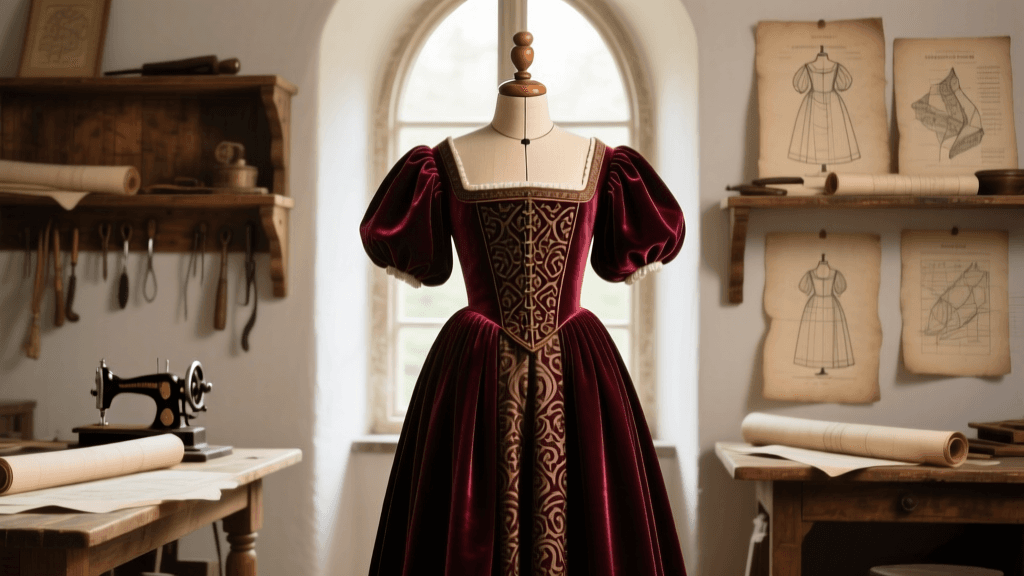
The 15th-century Burgundian houppelande remains one of the most striking and opulent garments in the history of European court fashion and regional folk dress. Originating in the late 14th century and reaching its zenith in the Burgundian court of the 1400s, this voluminous outer garment was a definitive marker of wealth, status, and sartorial elegance. For historical costumers, reenactors, and textile enthusiasts in 2026, recreating the houppelande offers a masterclass in draping, pleating, and working with heavy, luxurious fabrics. Unlike the closely fitted cotehardie that preceded it, the houppelande is characterized by its massive, flowing sleeves, floor-length skirts, and an iconic, towering high collar. This comprehensive guide will walk you through the historical context, 2026 material sourcing, and the precise tailoring techniques required to construct an authentic Burgundian houppelande.
Historical Context and the Burgundian Silhouette
The Duchy of Burgundy was the epicenter of European fashion in the 15th century. The dukes of Burgundy utilized clothing as a political tool, enforcing strict sumptuary laws while simultaneously setting trends that rippled across the continent. According to the Victoria and Albert Museum's Medieval and Renaissance archives, the houppelande was worn by both men and women, though the female iteration typically featured a floor-length hemline and a deeply V-necked or high-collared bodice, often cinched with a wide, jeweled girdle just under the bust. Historical silhouettes documented in Britannica's comprehensive guide to Middle Ages dress emphasize the dramatic, almost architectural lines of the garment, achieved through heavy wool or silk fabrics and meticulous pleating at the shoulders and waist.
In 2026, the revival of medieval European folk dress has moved beyond simplistic costume approximations. Modern makers prioritize historical accuracy, utilizing extant tailoring fragments and illuminated manuscripts to draft patterns that respect the original geometry of the garment. The goal is to achieve the heavy, statuesque drape that defined the Burgundian court, avoiding the stiff, lightweight fabrics that often plague amateur reproductions.
Sourcing Authentic Materials in the 2026 Textile Market
The success of a houppelande relies entirely on the weight, drape, and fiber content of the chosen fabric. As of 2026, the global textile market has seen a resurgence in heritage milling, particularly in the United Kingdom and Italy, making it easier than ever to source historically accurate textiles. However, shipping costs and raw material prices have shifted, requiring makers to budget carefully.
| Material | Historical Accuracy | 2026 Avg. Cost (per yard) | Best Use Case |
|---|---|---|---|
| Heavy Melton Wool | High | $45 - $65 | Winter outer garments, structured collars |
| Wool Broadcloth | Very High | $70 - $95 | Flowing skirts, drape-heavy bodices |
| Silk Damask | High (for nobility) | $85 - $120 | Linings, contrast sleeves, girdles |
| Heavyweight Linen | Moderate (as lining) | $25 - $40 | Base linings, interlinings, summer wear |
For the primary outer shell, a heavily fulled wool broadcloth or Melton wool is essential. These fabrics possess the necessary weight to pull the deep pleats taut and create the dramatic, fluted hemline seen in 15th-century tapestries. For the lining, modern makers in 2026 often turn to high-quality linen or, for those portraying the highest nobility, ethically sourced faux furs and heavy silk damasks. Avoid modern polyester blends; they lack the breathability and the specific light-absorbing qualities of natural fibers, which are crucial for historical authenticity in photography and public exhibitions.
Patterning and Measurements for the Modern Maker
The houppelande is fundamentally an exercise in geometric tailoring. Rather than relying on complex, multi-piece modern slopers, the 15th-century tailors utilized variations of circles, rectangles, and gores to maximize fabric width and minimize waste. To draft your pattern, you will need the following core measurements: base of the neck to the floor (for the skirt length), shoulder circumference, high bust, and the desired sleeve length (which often extended past the fingertips to the floor).
Drafting the Iconic High Collar
The most recognizable feature of the Burgundian houppelande is the high standing collar, which frames the face and extends anywhere from 4 to 8 inches above the neckline. To achieve this in 2026 without the collar collapsing, you must use a robust interlining. Traditional buckram is still available from specialized historical tailoring suppliers, but many modern costumers utilize heavy hemp canvas layered with a modern thermoplastic interfacing for added rigidity. The collar should be cut as a curved rectangle, slightly wider at the top than at the base, allowing it to flare elegantly around the jawline. Ensure the center back seam is reinforced with a heavy silk buttonhole stitch to prevent fraying under the tension of the stiffened layers.
The Pleated Bodice and Flowing Skirt
Unlike modern garments that use darts for shaping, the houppelande achieves its fit through deep, structured pleating. The bodice is typically cut as a large rectangle or half-circle, with the excess fabric gathered into the neckline and the armholes. Cartridge pleating or deep, overlapping knife pleats are the most historically defensible methods. For a female garment, the pleats are often concentrated at the front and back neckline, allowing the sides to fall relatively smoothly over the hips before flaring into the massive skirt. Use a heavy-duty linen thread for your pleating stitches; standard cotton thread will snap under the weight of 8 to 12 yards of wool broadcloth.
Constructing the Bombarde Sleeves
The sleeves of a high-status houppelande are legendary for their volume. Known as bombarde sleeves, they are cut as massive bells or elongated triangles, often so long that the wearer had to tie them in a knot or pin them up to avoid dragging them in the mud. When drafting the sleeve, the armscye (armhole) must be cut high and tight on the shoulder to support the immense weight of the fabric. The sleeve itself should be lined with a contrasting fabric—such as a vibrant silk taffeta or a rich, patterned damask—so that when the sleeve is pinned back, the luxurious interior is displayed to onlookers.
Assembly, Linings, and Hand-Finishing
Constructing a garment of this magnitude requires patience and a respect for historical assembly methods. Research from the Metropolitan Museum of Art's Medieval Art department highlights that extant fragments of 15th-century clothing frequently exhibit a combination of structural machine-like running stitches and decorative finishing stitches. While modern makers may use a sewing machine for the long, straight structural seams of the skirt panels, all visible edges, hems, and collar attachments should be finished by hand.
The 'bag lining' method is highly recommended for the bodice and collar. By sewing the outer wool shell and the inner lining right-sides together and turning them through a strategically left opening, you achieve a perfectly clean edge without the need for modern bias tape or topstitching, both of which are anachronistic to the 1400s. Once turned, the opening is closed with a nearly invisible ladder stitch. The hem of the skirt should be faced with a wide band of heavy linen or a contrasting wool to protect the bottom edge from wear and tear, a common practice documented in medieval wardrobe accounts.
Accessorizing the 15th-Century Ensemble
No Burgundian houppelande is complete without its accompanying accessories. For women, the steeple hennin—a conical headdress draped with a sheer silk veil—is the quintessential pairing. In 2026, lightweight thermoplastic boning and 3D-printed structural bases have revolutionized hennin construction, allowing for towering heights that remain comfortable for all-day wear at historical festivals. For men, the chaperon—a complex, draped turban-like hat evolved from the humble hood—remains the headwear of choice.
Finally, the garment must be belted. A wide, jeweled girdle worn high on the waist (for women) or low on the hips (for men) is essential for breaking up the massive expanse of fabric and defining the silhouette. Modern reproduction jewelers and leatherworkers offer stunning, museum-quality cast brass and enameled belt fittings that perfectly replicate the opulent metalwork of the Burgundian court. By combining meticulous historical patterning, premium 2026 textiles, and authentic hand-finishing techniques, you can create a Burgundian houppelande that not only honors the legacy of European folk dress but stands as a wearable masterpiece of medieval tailoring.