Best Japanese Fashion School Kimono Workshops & Online Courses 2026
The Renaissance of Wafuku Education in 2026
The global fascination with traditional Japanese clothing has reached unprecedented heights in 2026. From the runways of Paris to the streets of Brooklyn, the kimono, yukata, and haori are no longer viewed merely as historical artifacts but as dynamic, wearable art forms. This surge in international interest has prompted Japan’s most prestigious fashion institutions to radically expand their educational offerings. Today, aspiring designers and textile enthusiasts can access elite Japanese fashion school workshops and online learning programs dedicated to wafuku (traditional Japanese clothing). Whether you are looking to master the precise geometry of kimono tailoring or the intricate resist-dyeing techniques of Kyoto, the 2026 academic landscape offers unparalleled access to centuries-old craftsmanship.
Top In-Person Workshops at Elite Tokyo Institutions
For those able to travel to Japan, the in-person workshop experience remains the gold standard. Tokyo’s fashion districts serve as the backdrop for intensive, short-term masterclasses designed specifically for international cohorts.
Bunka Fashion College: Traditional Textiles & Modern Silhouettes
While globally renowned for avant-garde Western fashion, Bunka Fashion College offers a highly coveted four-week summer intensive focused on traditional Japanese textiles. In 2026, their "Heritage to Haute Couture" workshop allows students to study the structural integrity of the kimono and apply its modular design principles to contemporary garment creation. Students work directly with vintage tanmono (fabric bolts) and learn the meticulous art of shitsuke-ito (basting), which is the foundational step in all Japanese sewing.
Sugino Fashion College: The Kimono Department Masterclasses
Sugino Fashion College houses one of the most comprehensive historical garment archives in Asia. Their two-week "Kimono Pattern Drafting and Draping" workshop is a masterclass in spatial geometry. Unlike Western tailoring, which relies on curved seams and darts to contour the body, traditional Japanese tailoring utilizes straight lines and strategic folding. Sugino’s 2026 curriculum includes hands-on sessions in the college’s climate-controlled archive, where students analyze Edo-period construction methods before replicating them using modern, sustainable textiles.
The Rise of High-Fidelity Online Kimono Tailoring
The most significant breakthrough in 2026 is the refinement of online learning platforms tailored specifically for textile arts. Early pandemic-era video calls were woefully inadequate for teaching the micro-movements required for sashiko stitching or shibori binding. Today, Japanese fashion schools utilize multi-angle 4K macro-lens streaming setups.
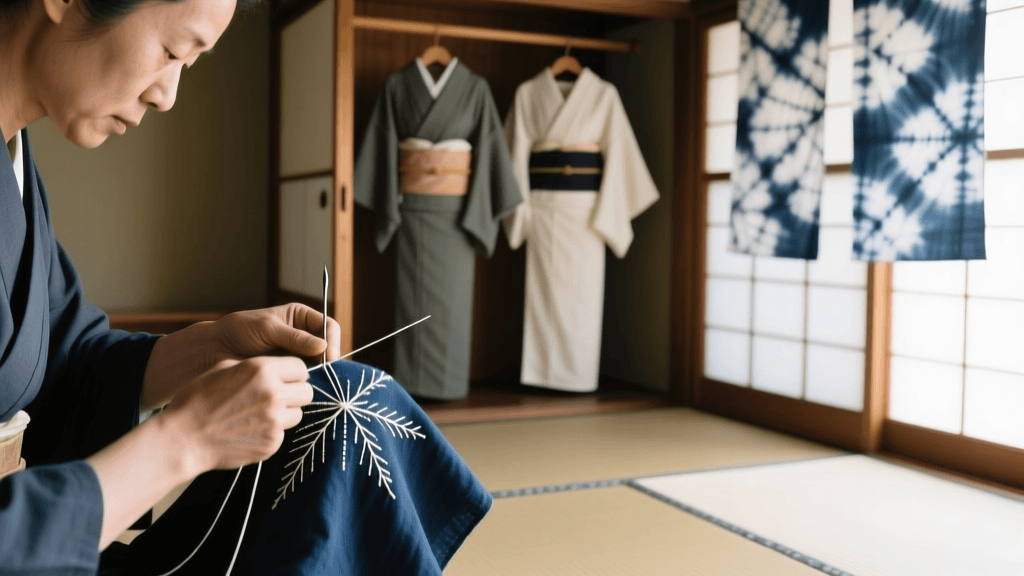
When you enroll in an online wafuku tailoring course from a Tokyo-based institution, you receive a comprehensive physical material kit shipped via international courier before the course begins. This kit includes pre-washed silk and cotton tanmono, specialized thimbles (yubinuki), and heritage-forged needles. During live sessions, instructors use overhead macro-cameras to demonstrate the exact tension required for the chikushi-nui (running stitch) used in sashiko, while students use secondary cameras to show their hand positioning for real-time correction. Furthermore, augmented reality (AR) applications provided by the schools allow online students to project digital pattern templates directly onto their physical cutting tables, ensuring millimeter-perfect accuracy.
2026 Workshop Comparison: In-Person vs. Online Learning
Choosing between flying to Tokyo or learning from your home studio depends on your goals, budget, and learning style. Below is a comparative breakdown of the standard 2026 offerings from top Japanese fashion schools.
| Feature | In-Person Tokyo/Kyoto Workshops | Live Online Masterclasses (2026) |
|---|---|---|
| Duration | 2 to 4 Weeks (Intensive) | 8 to 12 Weeks (Part-time evenings) |
| Tuition Cost | ¥350,000 - ¥500,000 | ¥120,000 - ¥180,000 |
| Material Kits | Provided in-studio; access to industrial dye vats | Shipped globally; includes home-safe indigo vats |
| Primary Focus | Full kimono assembly, Yuzen dyeing, archive access | Sashiko, Shibori, Haori construction, pattern drafting |
| Language Support | Live bilingual assistants and translation headsets | Real-time AI captioning and translated digital manuals |
Essential Techniques Covered in the Curriculum
Whether studying in-person or online, the 2026 curriculum at these elite institutions focuses on three core pillars of traditional Japanese garment creation.
Wafuku-Saiho (Japanese Garment Sewing)
The backbone of kimono making is wafuku-saiho. Students learn that a kimono is essentially a modular puzzle made from rectangular pieces cut from a single bolt of fabric. The curriculum emphasizes the unagi-nui (blind stitch) and the precise folding techniques that allow a kimono to be entirely disassembled, washed, and resewn—a hallmark of traditional Japanese sustainability that is highly relevant to modern eco-fashion movements.
Sashiko and Boro Textile Arts
Originally a peasant technique for mending and reinforcing workwear, sashiko has evolved into a highly respected decorative art. Fashion schools now teach the mathematical precision of hitome-zashi (stitching that creates geometric patterns like the asanoha hemp leaf or seigaiha ocean waves). Students learn to calculate stitch distribution to ensure the fabric gathers evenly, creating a textured, three-dimensional surface.
Shibori Resist Dyeing
For those interested in surface design, shibori workshops are incredibly popular. The 2026 syllabus heavily features kanoko shibori (fawn-spot tie-dye) and itajime shibori (shape-resist using carved wooden blocks). Online students are taught how to manage the chemical balance of a home indigo vat, monitoring pH levels and oxidation times to achieve the coveted deep kame-nozoki (jar-peek) and kon (navy) shades.
Preparing Your Toolkit for the 2026 Intake
If you are enrolling in an online program, your school will provide the core textiles, but serious students are encouraged to invest in specialized Japanese sewing tools to enhance their practice.
- Heritage Sashiko Needles: Look for hand-forged needles from Hiroshima, which offer superior flexibility and sharpness compared to mass-produced alternatives.
- Yubinuki (Thimble Ring): A traditional leather and silk-thread wrapped ring worn on the middle finger to push the needle through thick, layered indigo cottons.
- Shitsuke-ito (Basting Thread): Unlike Western basting thread, Japanese basting thread is slightly twisted and designed to glide through silk without snagging or leaving residue.
- Chakubari (Tailor's Chalk): Water-soluble marking tools essential for drafting the precise straight lines required for kimono panels.
Organizations like the Japan Kogei Association frequently publish directories of certified traditional craft artisans where international students can source authentic, high-quality tools directly from the makers.
Application Logistics and Language Support
Applying for the 2026 academic year requires foresight, particularly for in-person workshops. Short-term vocational visas or cultural activity visas are often required for stays exceeding 90 days, though many two-week intensives fall under standard tourist visa waivers for eligible countries. It is crucial to apply at least six months in advance, as international cohort slots at Bunka and Sugino are strictly capped to ensure personalized instruction.
Language barriers, once a significant hurdle, have been largely mitigated in 2026. In-person workshops now provide lightweight, real-time translation headsets, allowing students to hear the instructor’s Japanese nuances simultaneously translated into English, Mandarin, or French. Online platforms utilize advanced AI-driven captioning that accurately translates specialized textile terminology—ensuring that words like tate-ito (warp thread) and yoko-ito (weft thread) are correctly contextualized.
Ultimately, whether you are draping silk in a Tokyo studio or binding indigo cotton in your home atelier, the 2026 offerings from Japanese fashion schools provide a profound, authentic connection to Asia’s rich sartorial heritage. By bridging the gap between ancient artisanry and modern technology, these programs ensure that the art of the kimono and its related textiles will continue to evolve and inspire the global fashion landscape for generations to come.