Best Japanese Fashion Schools & Apprenticeships 2026
The Renaissance of Traditional Japanese Garment Education in 2026
The global shift towards sustainable, slow fashion has sparked an unprecedented renaissance in traditional Japanese garment education. As we navigate 2026, international students and domestic enthusiasts alike are flocking to Japan to study the meticulous arts of kimono tailoring, Nishijin weaving, and Kyo-yuzen dyeing. Unlike fast-fashion design programs, these curricula focus on the preservation of heritage techniques, teaching students how to manipulate silk, hemp, and ramie using methods that have remained largely unchanged for centuries. Whether you are looking to enroll in a formalized academic institution or seek out a rigorous master-disciple apprenticeship, understanding the landscape of Japanese fashion education in 2026 is critical for your journey into the world of traditional Asian textiles.
Premier Institutions for Traditional Japanese Fashion
Japan offers a unique blend of vocational schools, specialized art universities, and municipal colleges dedicated entirely to traditional crafts. In 2026, these institutions have updated their curricula to better accommodate international students while maintaining the strict, disciplined standards of the shokunin (artisan) ethos.
Bunka Fashion College (Tokyo)
While globally renowned for its avant-garde contemporary fashion programs, Bunka Fashion College also houses specialized modules dedicated to Japanese dressmaking and traditional textile manipulation. For the 2026 academic year, Bunka has expanded its elective courses in sashiko (decorative reinforcement stitching) and shibori (manual resist dyeing). Students in the Fashion Creation program can opt for a specialized track that focuses on the geometric pattern-making unique to the kimono, which relies on straight-line cutting and zero-waste fabric utilization. Tuition for the 2026 intake hovers around 1,450,000 JPY annually, and applicants are expected to hold a minimum JLPT N3 certification to grasp the nuanced terminology of traditional Japanese tailoring.
Kyoto Traditional Arts Super College
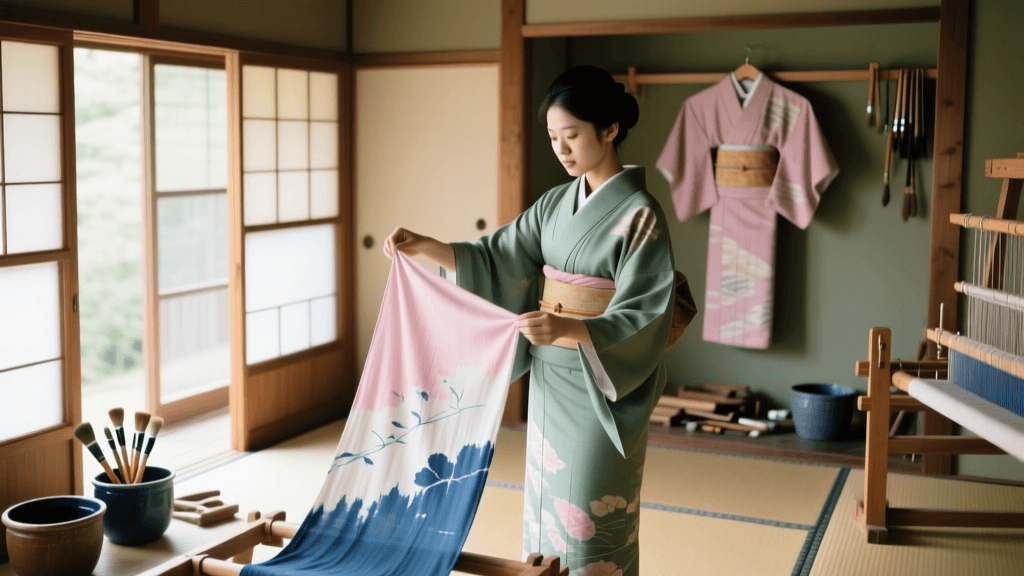
Located in the cultural heartland of Japan, this municipal institution is heavily subsidized by the Kyoto city government to combat the aging demographic of master artisans. The college offers intensive two-year diplomas in specific regional crafts, including Nishijin brocade weaving and Kyo-yuzen resist dyeing. The 2026 curriculum places a heavy emphasis on the chemistry of natural dyes, utilizing indigo, madder, and persimmon tannin. Because the school operates as a preservation initiative, tuition is remarkably accessible, though the physical and mental demands of the program are immense. Students spend up to eight hours a day at the loom or dye vat, mastering the use of traditional tools like the shinshi (bamboo fabric stretchers) and kata-bori (stencil carving knives).
The Shokunin Path: Modern Apprenticeships (Deshi)
For those who prefer immersive, hands-on training over classroom theory, the traditional deshi (apprenticeship) system remains the gold standard for mastering Japanese garment crafts. In 2026, the apprenticeship model has evolved. While the traditional commitment required a decade of unpaid or minimally compensated labor under a single master, modern ateliers in Kyoto and Kanazawa now offer 'micro-apprenticeships' ranging from one to three years, specifically designed to teach foreign and domestic students a focused set of skills.
Securing an apprenticeship in a Yuzen dyeing atelier or a bespoke kimono tailoring shop requires more than just an application; it requires an introduction (shokai) and a demonstration of profound respect for the craft. Apprentices in 2026 can expect to spend their first six months exclusively on studio maintenance, tool preparation, and fabric washing (mizumoto) before ever touching a dye brush or sewing needle. According to the preservation societies documented by Kogei Japan, this foundational period is deemed essential for cultivating the patience and observational skills required of a true artisan. Stipends for apprentices in 2026 typically range from 120,000 to 160,000 JPY per month, which is generally enough to cover basic shared housing and living expenses in regional craft hubs.
2026 Comparison Chart: Education Paths
Choosing between a formal school and an independent apprenticeship depends on your career goals, language proficiency, and financial resources. Below is a comparison of the primary pathways available for the 2026 academic and fiscal year.
| Institution / Path | Location | 2026 Annual Cost (JPY) | Duration | Primary Focus | Visa Type |
|---|---|---|---|---|---|
| Bunka Fashion College | Tokyo | ~1,450,000 | 2 Years | Pattern making, modern integration, sashiko | Student Visa |
| Kyoto Traditional Arts Super College | Kyoto | ~400,000 (Subsidized) | 2 Years | Nishijin weaving, Kyo-yuzen dyeing | Student Visa |
| Independent Atelier Deshi | Kanazawa / Kyoto | Earns ~1,500,000 stipend | 1 - 5 Years | Specialized master-disciple technique transfer | Cultural Activities / Work |
| Tokyo Kimono Academy | Tokyo | ~900,000 | 1 Year | Kitsuke (dressing), tailoring, care | Student Visa |
Actionable Steps for 2026 Intake Applications
If you are planning to immerse yourself in Japanese traditional fashion education, preparation must begin at least 12 to 18 months in advance. Follow these actionable steps to secure your placement for the 2026 intakes:
- Language Preparation: While some Kyoto-based craft workshops offer English translation via senior international students, formal schools require Japanese proficiency. Aim for JLPT N2 for degree programs, or N3 for vocational workshops. Understanding terms like tachi-kiri (cutting on the bias) and kuke (blind stitching) is impossible without foundational language skills.
- Portfolio Development: Admissions committees for traditional arts do not want to see digital fashion illustrations. Your portfolio should feature high-resolution photographs of hand-stitched garments, natural dyeing experiments, and woven textiles. Document your process, including the failures and material waste, as this demonstrates an understanding of the physical realities of textile work.
- Secure an Introduction (For Apprenticeships): If pursuing the deshi route, cold-emailing masters is rarely effective. Utilize cultural exchange organizations, attend international textile symposiums, or leverage university alumni networks to secure a formal letter of introduction to an atelier master.
Navigating Visas and Funding in 2026
International students must navigate Japan's immigration framework carefully. Those enrolling in accredited institutions like Bunka or the Kyoto Super College will apply for a standard Student Visa, which permits up to 28 hours of part-time work per week. However, those entering independent apprenticeships often face visa hurdles. In 2026, many independent artisans sponsor foreign apprentices under the 'Cultural Activities' visa, which strictly prohibits compensated labor. To circumvent this, some apprentices secure a secondary part-time job (such as teaching English) on a designated permit, or they apply for the highly specific 'Traditional Craft Artisan' work visa, a category that the Japanese government has been actively streamlining to encourage foreign preservationists.
Funding is available for dedicated students. The Japanese government's MEXT scholarship program, detailed on the official Study in Japan portal, occasionally covers specialized research in traditional arts for graduate-level students. Additionally, the Kyoto Municipal Government offers the 'Next-Generation Craft Preservation Grant' for 2026, which provides a one-time 300,000 JPY stipend to international students who commit to working in a local Kyoto textile business for at least three years post-graduation.
Conclusion
The pursuit of traditional Japanese garment education in 2026 is a rigorous, deeply rewarding endeavor that bridges the gap between ancient heritage and contemporary sustainability. Whether you are threading a Nishijin loom in Kyoto or mastering the geometric precision of kimono tailoring in Tokyo, the skills you acquire will position you at the forefront of the global slow-fashion movement. By carefully selecting the right institution or apprenticeship and preparing for the cultural and linguistic demands of the shokunin lifestyle, you can play a vital role in preserving the magnificent textile traditions of Japan for future generations.