Learn Kimono Design: Top Japanese Fashion Schools 2026
The Renaissance of Wafuku in Global Fashion Education
As we navigate the fashion landscape of 2026, the global appetite for authentic wafuku (traditional Japanese clothing) has evolved from mere appreciation to active, technical participation. International designers, textile artists, and fashion students are no longer satisfied with superficial motifs; they are seeking rigorous, structural training in traditional Japanese garment construction. The straight-line cutting methods, zero-waste pattern drafting, and intricate textile manipulations inherent to kimono, haori, and jinbei are now recognized as masterclasses in sustainable and modular fashion design.
Japanese fashion schools have responded to this surging demand by expanding their educational accessibility. In 2026, institutions that once guarded their traditional techniques for domestic students alone are now offering robust hybrid learning models, intensive short-term workshops, and fully supported online programs. Whether you are looking to master the precise draping of a silk crepe chirimen kimono or digitize traditional shibori patterns using advanced 3D rendering software, Japan's premier educational institutions have structured pathways to accommodate global learners.
Premier Japanese Fashion Schools Offering Kimono Workshops
When discussing the intersection of traditional Asian garments and modern fashion education, a few institutions stand at the absolute forefront. These schools have successfully integrated heritage craftsmanship into contemporary design curricula, ensuring that ancient techniques survive and thrive in the modern wardrobe.
Bunka Fashion College: The Epicenter of Japanese Draping
Located in the heart of Shinjuku, Tokyo, Bunka Fashion College remains the most prestigious fashion institution in Asia. While globally renowned for the 'Bunka Sloper' and its contributions to Western-style pattern making, Bunka's traditional garment departments are equally formidable. In 2026, their 'Wafuku Design and Construction' short-term intensive is highly sought after by international professionals.
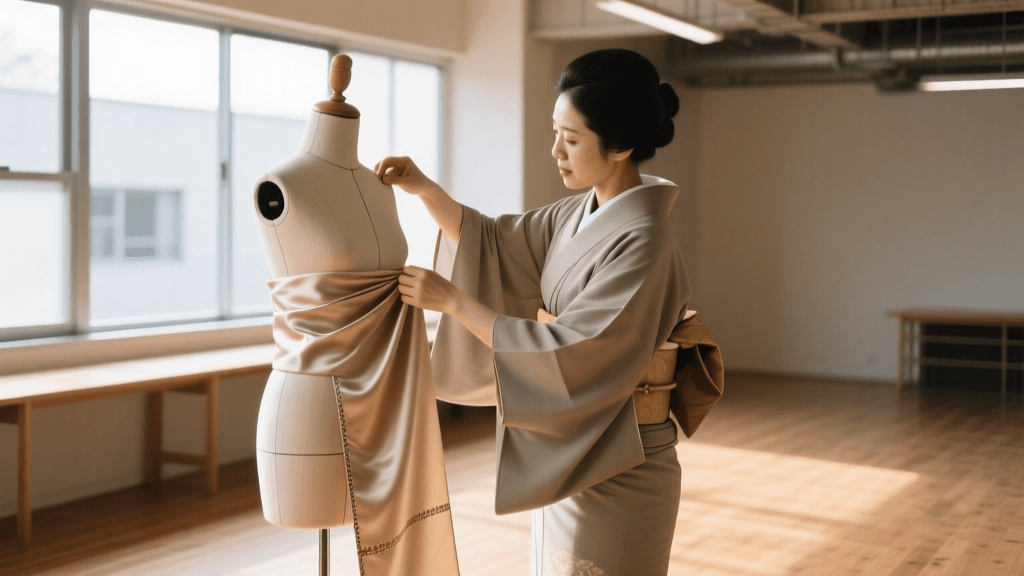
The workshop focuses heavily on the geometry of the kimono. Unlike Western garments that rely on complex curved seams to contour the body, the kimono is constructed from straight bolts of fabric (known as a tan), typically measuring about 38 centimeters in width. Students learn the mathematics of zero-waste cutting, the precise placement of the okumi (front panel), and the structural integrity of the eri (collar). Bunka's 2026 curriculum also introduces sustainable practices, teaching students how to deconstruct and re-weave vintage Meiji and Taisho-era silks into modern, modular haori jackets.
Kyoto Traditional Arts Super College: Mastering Artisan Techniques
For those whose focus leans heavily toward textiles and surface design rather than structural pattern making, Kyoto remains the undisputed capital of Japanese artisan crafts. The intensive summer workshops hosted in Kyoto's historic artisan districts offer unparalleled access to master dyers and weavers. In 2026, the 'Kyoto Textile Heritage' program allows international students to spend four weeks studying yuzen (resist dyeing), kanoko shibori (intricate tie-dyeing), and nishijin-ori (brocade weaving).
These workshops are deeply tactile and immersive. Students do not merely observe; they operate traditional wooden looms and mix natural dyes derived from indigo, madder root, and persimmon tannin. The physical demands of these workshops are significant, but the resulting mastery over natural fibers and traditional color theory provides a foundation that cannot be replicated in a standard Western textile lab.
Esmod Tokyo: Bridging Streetwear and Traditional Wafuku
Esmod Tokyo offers a distinctly contemporary take on traditional garments. Their 2026 'Neo-Wafuku' workshop is designed for streetwear and avant-garde designers looking to fuse traditional Japanese silhouettes with modern urban aesthetics. Here, students experiment with integrating the voluminous sleeves of a furisode into technical outerwear, or adapting the wrap-and-tie closure systems of the jubanis (under-kimono) for modern modular athleisure. It is an excellent program for designers who respect the traditional rules of wafuku but wish to intentionally break them for a global market.
The Rise of Hybrid and Online Kimono Design Courses
Not every aspiring designer can relocate to Tokyo or Kyoto for a multi-month intensive. Recognizing this, Japanese fashion schools have heavily invested in hybrid and online learning infrastructures by 2026, ensuring that the nuances of traditional garment making can be taught across borders.
Virtual Draping and 3D Pattern Making
One of the most significant advancements in online traditional garment education is the integration of 3D fashion software. Online modules now teach students how to translate the physical properties of traditional Japanese textiles into digital environments. Using advanced physics engines, students can simulate the heavy drape of tsumugi (slub silk) versus the fluid, crepe-like movement of chirimen. Instructors provide digital pattern files of traditional kimono components, and students are tasked with assembling them in a virtual space, adjusting the ohashori (the waist fold that allows for length adjustment) to fit diverse digital avatars.
Shipped Material Kits: The Tactile Online Experience
To bridge the gap between digital theory and physical reality, top-tier online programs now ship physical 'Wafuku Construction Kits' globally. These kits, dispatched directly from the school's campus in Japan, include pre-measured cotton practice fabrics (shirokiji), traditional bamboo rulers (shaku), specialized silk thread, and the heavy irons required for traditional seam pressing. Live-streamed workshops allow instructors to closely observe a student's stitching technique via high-definition multi-camera setups, offering real-time corrections on the tension and spacing of the unui (blind stitch) used to finish kimono hems.
2026 Program Comparison Chart
To help you navigate the options available this year, below is a structured comparison of the leading traditional Japanese garment programs for international students.
| Institution | Program Name | Format | 2026 Tuition (Est.) | Duration | Primary Focus |
|---|---|---|---|---|---|
| Bunka Fashion College | Wafuku Structure Intensive | In-Person (Tokyo) | ¥450,000 JPY | 4 Weeks | Zero-waste pattern drafting, straight-line cutting |
| Kyoto Traditional Arts | Textile Heritage Summer | In-Person (Kyoto) | ¥380,000 JPY | 6 Weeks | Natural dyeing, shibori, hand-weaving |
| Esmod Tokyo | Neo-Wafuku Fusion Lab | Hybrid | ¥220,000 JPY | 8 Weeks | Modernizing traditional silhouettes for streetwear |
| Bunka Online Division | Digital Kimono Draping | 100% Online | ¥120,000 JPY | 12 Weeks | 3D simulation, digital pattern assembly, virtual textiles |
Actionable Advice for Enrolling in 2026
Securing a spot in these highly competitive programs requires strategic planning. If you are aiming to study traditional Japanese garments in Japan this year, follow these critical steps:
- Language Proficiency: While some short-term workshops offer English translation via headset or bilingual assistants, full immersion programs generally require a minimum JLPT N3 (Japanese Language Proficiency Test) certification. For advanced artisan apprenticeships in Kyoto, JLPT N2 is the standard. Begin your language preparation at least 18 months prior to your intended enrollment.
- Visa Navigation: For programs lasting longer than 90 days, you will need a Student Visa. The Japanese immigration process for 2026 requires a Certificate of Eligibility (COE), which the host school applies for on your behalf. According to the Study in Japan official government portal, you must provide proof of financial stability and a clear academic intent to secure the COE smoothly.
- Portfolio Preparation: Even for beginner-level traditional workshops, admissions committees want to see your dedication to the craft. Your portfolio should not necessarily feature perfect kimono designs; rather, it should demonstrate a deep understanding of fabric manipulation, an interest in Asian cultural heritage, and meticulous attention to detail in your current work.
- Tool Acquisition: If you are enrolling in an online or hybrid course, do not wait for the school's kit to arrive to begin practicing. Purchase a traditional shaku (ruler) and practice converting metric measurements into the traditional Japanese measuring system, as pattern instructions in advanced modules often rely on these historical units.
Conclusion
The study of traditional Japanese garments is an exercise in patience, precision, and profound respect for materials. As the fashion industry continues to grapple with issues of waste and overproduction in 2026, the zero-waste philosophy and modular construction of the kimono offer vital lessons for the future of global design. Whether you are walking into a sunlit studio in Kyoto to dye your first yard of silk, or logging into a virtual draping session from across the globe, Japanese fashion schools are providing the essential bridge between ancient heritage and the future of sustainable fashion.