Top Japanese Kimono Tailoring School Workshops 2026
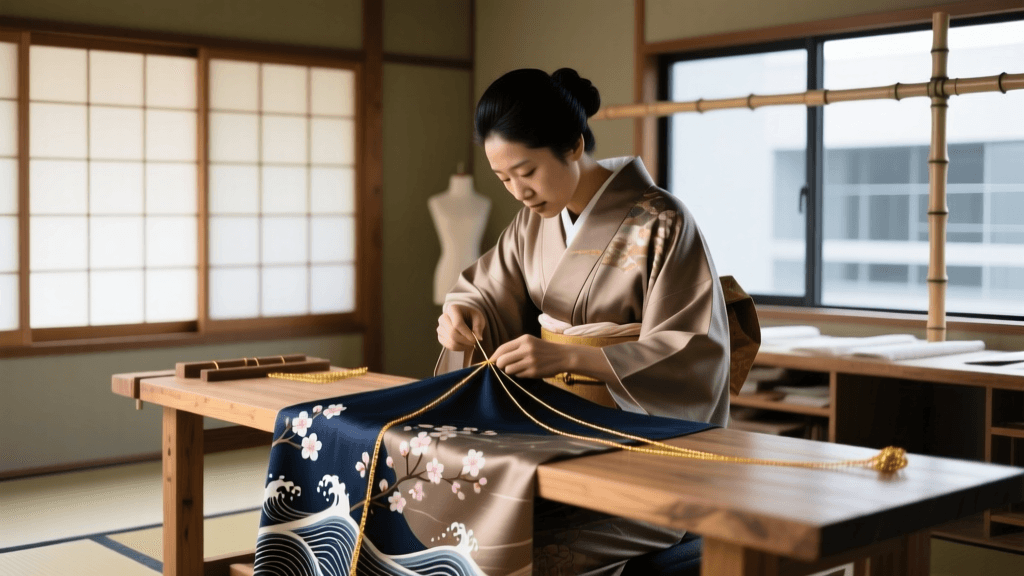
The 2026 Renaissance of Wasai (Japanese Tailoring)
The global fashion landscape in 2026 is witnessing an unprecedented reverence for heritage craftsmanship, sustainable textiles, and slow fashion. At the heart of this movement is wasai, the traditional art of Japanese kimono tailoring. Unlike Western tailoring (yosai), which relies on complex curved patterns and permanent cuts to fit the human form, wasai utilizes a straight-line cutting method (chokusen-dachi). Garments are constructed from rectangular panels of fabric that can be entirely disassembled, washed, and re-tailored, making them inherently sustainable and modular.
For international designers, textile artists, and dedicated hobbyists, accessing authentic education in this centuries-old craft has never been more accessible. Japanese fashion schools and specialized artisan academies have fully embraced hybrid learning models for 2026, combining intensive in-person workshops in Tokyo and Kyoto with advanced virtual reality (VR) and augmented reality (AR) online modules. Whether you are looking to master the delicate silk stitching of a formal uchikake or the robust indigo-dyed cotton of a casual yukata, the educational pathways available this year are both rigorous and deeply immersive.
Premier In-Person Workshops: Tokyo and Kyoto
Bunka Fashion College: Summer Intensive in Wasai
Located in the heart of Shinjuku, Tokyo, Bunka Fashion College remains the undisputed titan of Japanese fashion education. While globally renowned for its avant-garde contemporary design alumni, Bunka's traditional garment department offers a highly sought-after 4-week Summer Intensive in Wasai specifically tailored for international students in 2026.
The 2026 curriculum focuses heavily on the transition from basic yukata construction to the complex layering and lining techniques required for a formal awase (lined kimono). Students spend over 120 hours in the studio learning how to manipulate silk using traditional tension clips (harite) and bamboo marking spatulas (hera). The tuition for the 2026 summer cohort is approximately 280,000 JPY (roughly $1,900 USD), which includes access to Bunka's extensive textile archive and a starter toolkit of traditional Japanese sewing implements.
Kyoto University of the Arts: Textile and Dyeing Masterclasses
While Tokyo excels in garment construction, Kyoto is the undisputed capital of textile dyeing and weaving. The Kyoto University of the Arts offers weekend and month-long masterclasses focusing on the pre-tailoring phases of kimono creation. Their 2026 spring schedule features intensive workshops in Kyo-Yuzen (resist dyeing) and Shibori (intricate tie-dyeing).
These workshops are ideal for fashion students who want to understand the complete lifecycle of a traditional garment, from the raw silk thread to the finished, dyed bolt of fabric (tanmono). Participants work directly with local Kyoto artisans in their multi-generational studios, bridging the gap between academic theory and living heritage.
The Online Evolution: Virtual Looms and Digital Pattern Drafting
For those unable to travel to Japan, 2026 has brought remarkable innovations in online craft education. Several specialized platforms and university extension programs now offer synchronous online wasai classes. The primary challenge of teaching traditional Japanese tailoring online has always been the tactile nature of the fabric and the precise tension required for hand-stitching (unshin).
To solve this, top-tier online programs in 2026 utilize multi-angle 4K macro cameras that allow instructors to demonstrate the exact needle angle and thread tension required for the hon-geshi (main seam). Furthermore, students are mailed standardized practice kits containing pre-marked cotton tanmono bolts, ensuring that everyone in the virtual classroom is working with the exact same dimensions and fabric weight. Digital pattern drafting software, updated in 2026 to include specific wasai modular blocks, allows students to visualize how the straight-line panels will fold and drape on various body types before cutting into their physical fabric.
2026 Workshop Comparison Chart
Choosing the right program depends on your current skill level, budget, and specific area of interest within traditional Japanese garments. Below is a comparison of the top educational pathways available in 2026.
| Institution / Platform | Format | Primary Focus Area | 2026 Est. Cost | Duration |
|---|---|---|---|---|
| Bunka Fashion College | In-Person (Tokyo) | Garment Construction (Wasai) | 280,000 JPY | 4 Weeks |
| Kyoto Univ. of the Arts | In-Person (Kyoto) | Textile Dyeing (Yuzen/Shibori) | 150,000 JPY | 2 Weeks |
| Japan Traditional Crafts Online | Online (Synchronous) | Basic Yukata & Jinbei | 85,000 JPY | 8 Weeks |
| Artisan Apprenticeship Guild | Hybrid (Online + 1 week Kyoto) | Advanced Silk & Lining | 450,000 JPY | 6 Months |
Essential Toolkit for the Modern Wasai Student
Whether you are attending an in-person workshop in Tokyo or logging into a virtual classroom from abroad, you will need a specific set of traditional tools. Western sewing kits are largely incompatible with wasai. Here are the essential items required for 2026 students, along with their specific uses:
- Shaku (Bamboo Ruler): Unlike standard metric rulers, the traditional shaku is approximately 37.8 cm long and marked in traditional Japanese units (sun and bu). Modern workshops often provide dual-marked bamboo rulers, but learning to read the traditional measurements is crucial for following antique pattern books.
- Hera (Bamboo Spatula): Used instead of chalk or tracing wheels. The hera is rubbed along the bamboo ruler to leave a temporary, slightly indented mark on the silk or cotton fabric. This prevents any chemical stains on delicate textiles.
- Harite (Tension Clips): Heavy, specialized clips attached to the edge of the sewing board and the fabric. They hold the silk taut, allowing the sewer to use both hands to manipulate the needle and thread, which is essential for the running stitch (unshin) technique.
- Kote (Traditional Iron): While modern steam irons are sometimes used for cotton yukata, silk kimono require a specialized, low-heat, dry iron to press the seams without damaging the fibers or flattening the natural luster of the silk.
- Kake-jita (Hanging Board): Used to hang and air out the garment during the construction process, allowing the fabric's natural weight to settle the seams before the final pressing.
Funding and Cultural Grants in 2026
Recognizing the urgent need to preserve intangible cultural heritage, several organizations offer financial support for international students pursuing traditional Japanese crafts. The Japan Foundation continues to be a primary resource, offering cultural exchange grants and fellowship programs for 2026 that can subsidize tuition and living expenses for students enrolled in accredited traditional arts programs.
Additionally, the Japanese Ministry of Economy, Trade and Industry (METI) has expanded its 'Traditional Craft Industry Support' initiative in 2026, which occasionally partners with fashion schools to offer subsidized workshop seats to foreign designers who commit to incorporating traditional Japanese techniques into sustainable, global fashion lines. Applicants are encouraged to review the Japan Foundation's grant cycles, which typically open in early autumn for the following year's summer intensives.
Final Thoughts on Mastering the Craft
Learning the art of traditional Japanese garment making is not merely about acquiring a new sewing technique; it is an immersion into a philosophy of respect for materials, modularity, and mindful creation. The straight-line cutting method teaches the tailor to work with the fabric's grain and dimensions, rather than forcing it into an arbitrary shape. As the sustainable fashion movement continues to dictate industry standards in 2026, the lessons learned in a wasai workshop—zero-waste pattern drafting, modular construction, and garment longevity—are invaluable. Whether you choose the bustling studios of Bunka Fashion College or a virtual loom in your home studio, the path to mastering the kimono is a deeply rewarding journey that bridges the ancient past with the sustainable future of global fashion.