Bunka Fashion College 2026: Kimono & Shibori Workshops Guide
The Evolution of Japanese Garment Education in 2026
The global appreciation for traditional Japanese clothing, known collectively as wafuku, has reached new heights in 2026. As sustainable fashion and slow-craft movements dominate the global apparel industry, international students and designers are increasingly seeking authentic education in Japanese textile arts. Leading this educational renaissance is Bunka Fashion College in Tokyo, an institution that has seamlessly blended centuries-old garment construction techniques with cutting-edge hybrid learning models. Whether you are looking to master the intricate resist-dyeing methods of shibori or understand the geometric precision of kimono pattern drafting, the 2026 curriculum offers unprecedented access to Japan's sartorial heritage.
Historically, mastering the art of wasai (traditional Japanese sewing) or natural dyeing required years of apprenticeship in rural workshops. Today, top-tier fashion schools have democratized this knowledge. By combining intensive, in-person tactile workshops with comprehensive online theory modules, students from around the world can now achieve professional proficiency in traditional Japanese garment creation without relocating to Japan for a decade. This guide explores the premier workshop and online learning tracks available in 2026, helping you choose the right path for your textile education.
Bunka Fashion College: In-Person Shibori & Pattern Workshops
For those who prioritize tactile feedback and hands-on mentorship, Bunka Fashion College's in-person intensive workshops remain the gold standard. In 2026, the college has expanded its short-term visa-friendly programs specifically tailored for international designers. The most sought-after track is the Traditional Shibori & Natural Dyeing Intensive, a rigorous four-week program held at the college's state-of-the-art dyeing laboratories in Shibuya.
Mastering the Art of Resist Dyeing
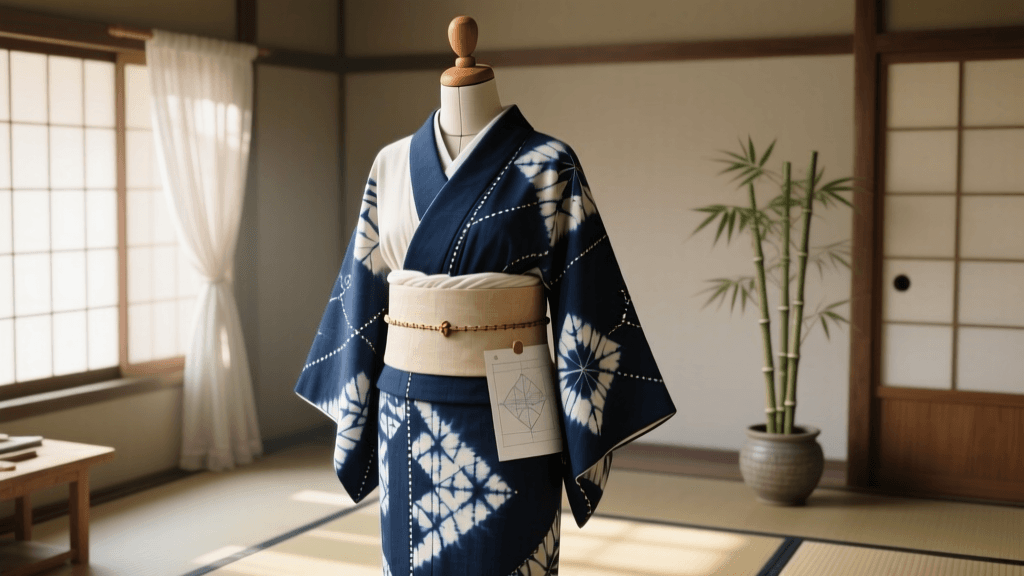
Shibori is not merely tie-dye; it is a complex sculptural process that manipulates fabric to create intricate, three-dimensional patterns. During the in-person workshop, students are immersed in the physical realities of the craft. The curriculum covers foundational techniques such as:
- Kanoko Shibori: The meticulous binding of fabric with thread to create precise, dot-like patterns. Students learn the exact tension required to prevent indigo from seeping into the bound areas.
- Miura Shibori: A looped-binding technique that yields a flowing, water-like aesthetic, requiring rapid, rhythmic hand movements.
- Itajime Shibori: Shape-resist dyeing using carved wooden blocks and acrylic clamps to produce sharp, geometric symmetries.
Beyond dyeing, the in-person track includes a two-week module on hon-bitate (traditional kimono hand-sewing). Unlike Western tailoring, which relies on curved seams and darts to contour the body, kimono construction utilizes straight-line cutting from a single bolt of fabric (tanmono). Students learn to use the shaku (traditional bamboo ruler) and practice the specialized hidden stitches that allow the garment to be entirely disassembled, washed, and re-sewn—a hallmark of Japanese sustainable design.
Online Learning Tracks: Kimono Styling & Textile Theory
While the physical manipulation of indigo vats requires a laboratory, the theoretical, historical, and structural foundations of Japanese garments have been brilliantly adapted for the digital classroom. Bunka's 2026 Digital Wafuku Initiative offers a robust online learning track that caters to global students, fashion historians, and digital fashion designers.
Virtual Classrooms and 3D Garment Modeling
The online program leverages advanced 3D modeling software specifically calibrated for the unique drape and weight of silk, ramie, and hemp textiles. Students learn how the straight-line cut of a kimono interacts with gravity and the human form. Through virtual simulations, learners can adjust the ohashori (the waist fold used to customize the kimono's length) and experiment with digital obi (sash) tying techniques.
Furthermore, the online modules provide deep dives into textile history and regional variations. Guided by digital archives that rival the Victoria and Albert Museum's Asian Collections, students analyze high-resolution macro photography of Edo-period kosode and Meiji-era uchikake. This theoretical grounding is essential for modern designers who wish to incorporate traditional motifs—such as the seigaiha (blue ocean waves) or shippou (seven treasures)—into contemporary collections with cultural accuracy and respect.
Comparison Chart: 2026 Workshop vs. Online Modules
Choosing between the visceral experience of the dyeing lab and the flexibility of the digital classroom depends on your learning style, budget, and career goals. Below is a detailed comparison of the two primary educational tracks available in 2026.
| Feature | In-Person Shibori & Wasai Intensive | Online Digital Wafuku & Theory Track |
|---|---|---|
| Duration | 6 Weeks (Full-Time, 40 hrs/week) | 12 Weeks (Part-Time, Self-Paced) |
| Tuition (2026) | ¥380,000 (approx. $2,550 USD) | ¥120,000 (approx. $800 USD) |
| Primary Focus | Tactile dyeing, hand-sewing, material prep | Pattern geometry, history, 3D digital drape |
| Materials Provided | Silk tanmono, indigo vats, sewing tools | Digital asset packs, 3D software licenses |
| Best For | Artisans, slow-fashion brand founders | Digital designers, historians, stylists |
| Certification | Bunka Traditional Craft Practitioner Cert | Bunka Digital Wafuku Theory Certificate |
Essential Tools for the 2026 Hybrid Student
For students enrolled in the online track, or those preparing for their in-person intensive, acquiring the correct traditional tools is a vital part of the educational journey. In 2026, Bunka offers a globally shipped Hybrid Starter Kit that bridges the gap between digital theory and physical practice. If you are assembling your own toolkit, ensure you include the following specialized items:
- Shaku (Traditional Ruler): Unlike the metric system, the traditional Japanese measuring system uses the shaku (approx. 37.8 cm). Understanding this measurement is crucial for drafting authentic kimono patterns.
- Hera (Bamboo Spatula): Used to crease fabric and mark guidelines without leaving ink or chalk residue on delicate silks.
- Kakehari (Tension Device): A specialized tool clamped to the edge of the fabric and weighted to maintain perfect tension while hand-sewing long, straight seams.
- Kotedai (Sleeve Ironing Board): A small, cylindrical cushion used to press the curved seams of the kimono sleeves without flattening the three-dimensional structure of the fabric.
- Basting Thread (Shitsuke-ito): A uniquely spun, weak cotton thread designed to hold layers together during sewing but pull away cleanly without damaging the textile fibers.
Preserving Intangible Cultural Heritage
The push to modernize and globalize Japanese garment education is not merely an academic endeavor; it is a critical effort to preserve intangible cultural heritage. As the population of master artisans in rural dyeing towns like Arimatsu and Kyoto's Nishijin weaving district ages, institutions like Bunka Fashion College serve as vital conduits for knowledge transfer. Organizations such as The Japan Foundation actively support these educational initiatives, providing grants and cultural exchange programs that allow international students to study these endangered crafts.
By participating in the 2026 workshops and online modules, students do more than acquire a new technical skill set. They become part of a global network of custodians dedicated to keeping the philosophy of mottainai (a sense of regret concerning waste) and the profound beauty of Japanese textile arts alive for future generations. Whether you are binding silk in an indigo vat in Shibuya or manipulating a 3D kimono model from a studio in London, the dedication to mastering these traditions ensures that the legacy of Asian garment craftsmanship continues to evolve and inspire the modern world.