Best Japanese Fashion Workshops 2026: Kimono & Textile Courses
The Global Renaissance of Wafuku Education in 2026
As we navigate the fashion landscape of 2026, the intersection of heritage craftsmanship and modern education has never been more vibrant. The global appreciation for traditional Japanese garments—collectively known as wafuku—has surged, driven by a growing desire for sustainable, slow fashion and deep cultural connection. For international designers, textile artists, and cultural enthusiasts, Japanese fashion schools and specialized artisan workshops offer unparalleled access to centuries-old techniques. Whether you are looking to master the precise geometry of kimono pattern drafting, the intricate blind stitching of kuke, or the fluid artistry of shibori dyeing, the educational pathways available this year are more accessible and technologically integrated than ever before.
In 2026, top-tier institutions have fully embraced hybrid learning models. This means students can now complete theoretical modules and historical textile analysis online before arriving in Japan for intensive, hands-on studio practicums. This guide explores the premier Japanese fashion school workshops and online learning platforms available in 2026, providing actionable advice on curricula, essential tools, and application strategies for mastering traditional Japanese garment construction.
Bunka Fashion College: The Gold Standard for Wafuku Construction
When discussing fashion education in Japan, Bunka Fashion College remains the undisputed vanguard. While globally renowned for its avant-garde contemporary design alumni, Bunka’s 2026 short-term intensive programs in traditional Japanese garment construction are highly sought after by international students. The college’s approach to wafuku is uniquely analytical, bridging the gap between traditional flat-pattern drafting and modern ergonomic research.
The 2026 Traditional Garment Intensive
Bunka’s flagship 4-week summer intensive focuses on the structural anatomy of the kimono and haori. Unlike Western tailoring, which relies on complex curved seams to mold fabric to the body, traditional Japanese sewing utilizes straight lines, standard widths of silk (tanmono), and strategic folding. Students in the 2026 cohort learn the critical concept of hon-busui (true seam allowances) and the art of kise, a technique where seams are folded back to create a soft, flexible edge that prevents the silk from tearing under tension.
Tuition for the 2026 summer intensive is approximately $2,800 USD, excluding materials. Students are required to purchase their own silk bolts from the college’s affiliated textile suppliers in Shinjuku, which typically adds another $400 to $600 to the overall budget. The workshop culminates in the creation of a fully lined, hand-stitched yukata and an unlined silk haori.
Kyoto Traditional Arts Super College & Artisan Guilds
While Tokyo excels in structural pattern making, Kyoto remains the beating heart of Japanese textile embellishment. The Kyoto Traditional Arts Super College, alongside various local artisan guilds, offers specialized workshops focusing on surface design. In 2026, their hybrid Yuzen dyeing program has become a benchmark for international textile students.
Yuzen is a resist-dyeing technique that allows for the creation of elaborate, multi-colored pictorial designs on silk. The 8-week hybrid program begins with four weeks of online instruction covering the chemistry of natural dyes, the history of Edo-period motifs, and digital drafting of stencil patterns. Students then travel to Kyoto for a 4-week residency, working directly under master dyers to apply the itome-nori (rice paste resist) and hand-paint their own furosoki (tea ceremony garments) and kimono panels.
Tokyo Mode Gakuen: Bridging Heritage and Innovation
For those interested in how traditional textiles can be integrated into modern, global fashion systems, Tokyo Mode Gakuen offers a unique perspective. Their 2026 "Textile Innovation and Heritage" workshop focuses on the preservation and modernization of Nishijin-ori (Nishijin weaving). Students learn how to operate both traditional wooden Jacquard looms and modern computerized weaving machines, exploring how heritage silk threads can be blended with contemporary sustainable fibers like recycled cupro and bio-based polymers.
2026 Workshop & Online Program Comparison Chart
To help you navigate the options, we have compiled a comparison of the top traditional Japanese garment and textile programs available for the 2026 academic year.
| Institution / Platform | Focus Area | Format | Duration | 2026 Tuition (USD) |
|---|---|---|---|---|
| Bunka Fashion College | Wafuku Pattern Drafting & Sewing | In-Person (Tokyo) | 4 Weeks | $2,800 |
| Kyoto Traditional Arts | Yuzen Resist Dyeing | Hybrid (Online + Kyoto) | 8 Weeks | $1,500 |
| Tokyo Mode Gakuen | Nishijin Weaving Innovation | In-Person (Tokyo) | 6 Weeks | $3,200 |
| Japan Craft Experience | Shibori & Natural Indigo Basics | Online Live Studio | 2 Weeks | $450 |
The Rise of Hybrid Online Learning in 2026
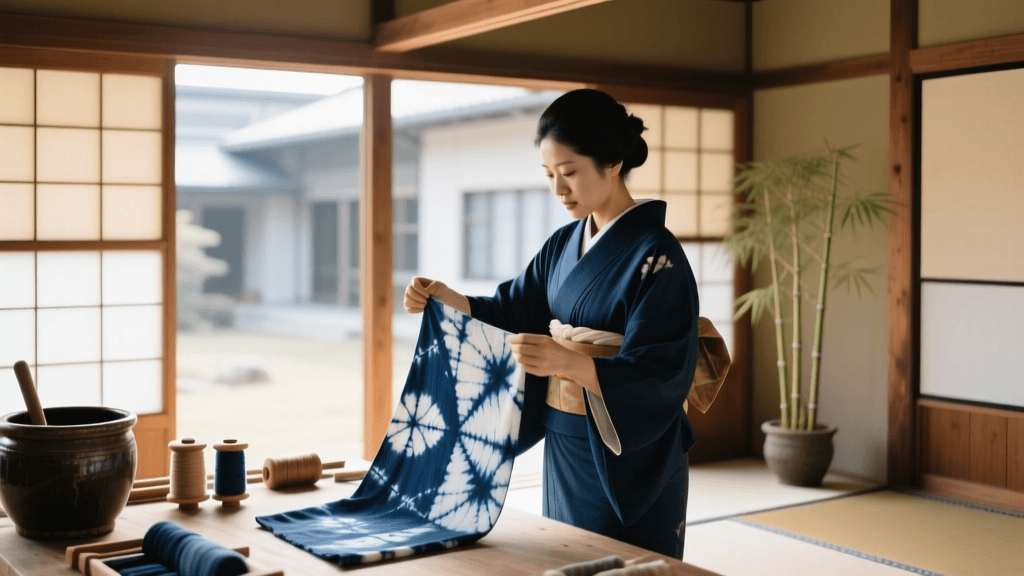
The landscape of online craft education has evolved dramatically. In 2026, platforms supported by The Japan Foundation and independent cultural trusts offer high-definition, multi-camera live streams that allow remote students to see the minute details of hand-stitching. The "Japan Craft Experience" online Shibori module, for instance, ships a physical toolkit—including arimaki (wooden clamps), copper wire, and pre-mordanted cotton—to students globally before the live sessions begin.
Furthermore, the integration of 3D fashion software like CLO and Marvelous Designer into traditional curricula has revolutionized remote learning. Instructors at Bunka now teach students how to translate 2D traditional wafuku patterns into 3D digital environments, allowing remote learners to simulate the drape and weight of different silk weaves (such as chirimen crepe versus rinzu damask) before cutting into expensive physical fabrics.
Essential Tools for At-Home Wafuku Sewing
If you are embarking on an online learning journey or preparing for an in-person workshop, acquiring the correct traditional tools is non-negotiable. Western sewing kits are insufficient for the specific demands of silk kimono construction. Here is the essential 2026 toolkit for at-home wafuku study:
- Shaku (Traditional Ruler): Unlike the standard 30cm ruler, the traditional shaku measures approximately 37.8cm. It is typically made of bamboo and is essential for reading vintage Japanese pattern books and drafting tanmono widths accurately.
- Hera (Bamboo Spatula): Used for creasing silk seams before stitching. Unlike a Western bone folder, the bamboo hera has a specific flexibility that prevents crushing or damaging delicate silk fibers.
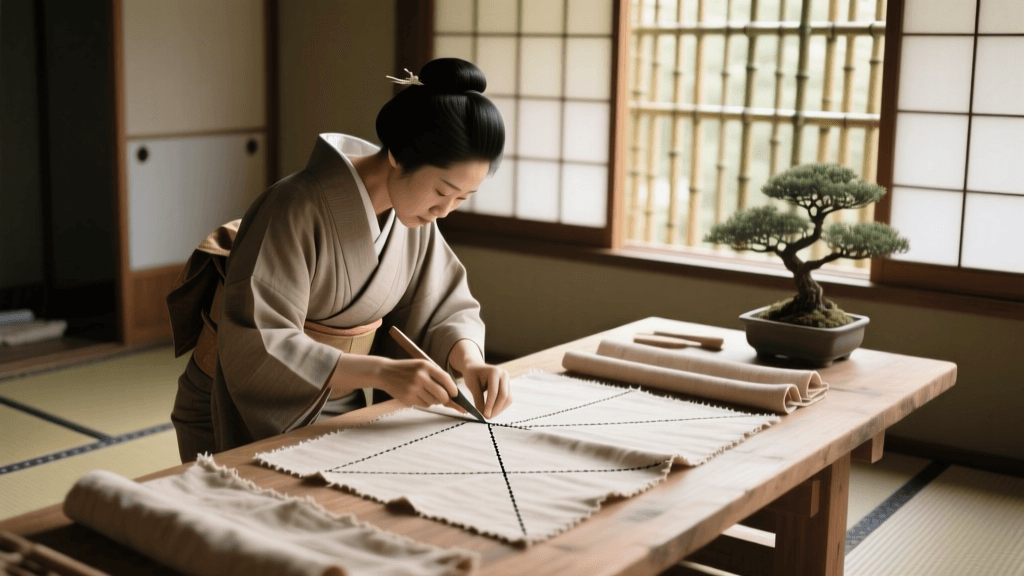
- Kakehari (Tension Tool): A vital wooden clamp with a needle at one end. It is attached to the edge of the fabric and held in place by a weight, keeping the silk taut while the artisan performs kuke (blind hemming and seam finishing).
- Chako (Tailor’s Chalk): Traditional Japanese chalk is made from finely ground clay rather than wax. It brushes off silk effortlessly without leaving oily residue, which is critical when working with unlined hitoe garments.
- Mekugiri (Awl): Used to pierce tiny holes in thick silk brocades or when attaching the eri (collar) to ensure perfectly aligned, invisible stitches.
Navigating the 2026 Application Process
Applying for short-term workshops in Japan requires careful logistical planning. For programs lasting under 90 days, citizens of many Western nations can enter Japan on a standard Temporary Visitor visa, which permits participation in unpaid, short-term cultural workshops. However, if you are enrolling in a comprehensive 6-month or 1-year traditional garment diploma program at Bunka or Mode Gakuen, you must apply for a Student Visa.
The 2026 application cycle for summer intensives typically closes by late March. Prospective students must submit a portfolio demonstrating basic sewing competency, a statement of purpose detailing their interest in Japanese textile heritage, and proof of financial stability. Language requirements vary; while the international short-term courses at Bunka are taught in English with bilingual assistants, advanced workshops in Kyoto often require a minimum of JLPT N4 Japanese proficiency to understand nuanced artisan terminology.
Conclusion: Preserving the Future of Heritage Garments
The educational pathways for traditional Japanese garments in 2026 represent a beautiful synthesis of ancestral knowledge and modern pedagogical tools. Whether you are sitting in a sunlit studio in Kyoto applying rice paste resist to silk, or logging into a live 3D pattern-drafting session from your home studio, the opportunity to master wafuku is more accessible than ever. By investing in these specialized workshops and online courses, students are not merely learning to sew; they are becoming active participants in the preservation and evolution of one of the world's most profound sartorial traditions.