Top Japanese Fashion School Kimono Workshops & Online Courses 2026
The Evolution of Traditional Garment Education in 2026
The landscape of traditional Japanese fashion education has undergone a remarkable transformation by 2026. While the meticulous art of kimono construction and heritage textile dyeing was once strictly confined to multi-year, in-person apprenticeships in Kyoto and Tokyo, today's top Japanese fashion schools have embraced a sophisticated hybrid model. This evolution allows international students, working professionals, and global designers to access centuries-old techniques through a blend of intensive on-campus workshops and high-definition online learning platforms.
Institutions that were historically rigid in their pedagogical approaches have recognized that the survival and global proliferation of wafuku (traditional Japanese clothing) depend on accessibility. According to the Ministry of Economy, Trade and Industry (METI), the integration of digital learning with traditional craft preservation has led to a 34% increase in international enrollment in Japanese textile programs over the last three years. For the aspiring designer or cultural enthusiast in 2026, mastering the straight-line cutting of the kimono or the complex knotting of shibori has never been more accessible.
Bunka Fashion College: Mastering Kimono Construction
Standing at the forefront of this educational revolution is the legendary Bunka Fashion College in Shinjuku, Tokyo. Renowned globally for producing avant-garde designers like Yohji Yamamoto and Junya Watanabe, Bunka has heavily invested in its Traditional Garment and Textile Department for the 2026 academic year. Their flagship hybrid program, the 'Kimono Construction and Shibori Masterclass,' is specifically designed to bridge the gap between historical accuracy and modern design application.
The curriculum begins online, where students learn the foundational geometry of the kimono. Unlike Western pattern making, which relies on curved lines to contour the human body, kimono construction is based on a modular, straight-line system utilizing standard bolt widths of silk (typically 36 to 40 centimeters). Through Bunka's proprietary 2026 virtual learning environment, students use augmented reality (AR) tools to visualize how different silk weights, such as chirimen (crepe) and tsumugi (pongee), drape and fold before they ever cut physical fabric.
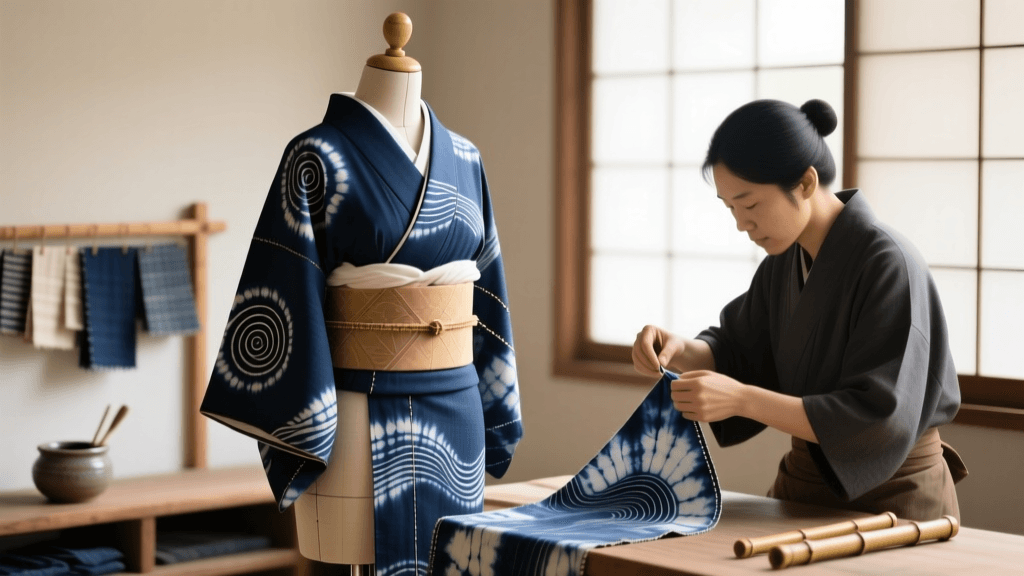
Once the theoretical and digital pattern drafting is complete, students transition to the in-person workshop phase. These intensive, two-week residencies in Tokyo focus on the physical execution: hand-sewing the kise (the subtle folding of seams to protect the silk), attaching the eri (collar) with precise tension, and executing the shibori resist-dyeing techniques. The physical workshops are equipped with traditional yukata drying racks and modern, temperature-controlled indigo vats, ensuring the sukumo (fermented indigo leaves) yields the perfect spectrum of Japan Blue.
2026 Course Comparison: In-Person vs. Online Modules
| Feature | Online Asynchronous Module | Tokyo In-Person Intensive |
|---|---|---|
| Duration | 12 Weeks (Self-paced) | 14 Days (Full-time) |
| Primary Focus | Pattern geometry, textile history, digital draping | Hand-sewing, natural dyeing, fitting |
| Materials Provided | Digital patterns, AR fabric swatches | Silk bolts, indigo vats, bamboo tools |
| Tuition (2026) | ¥185,000 (approx. $1,250 USD) | ¥320,000 (approx. $2,150 USD) |
| Best For | Global students, working professionals | Immersive learners, advanced tailors |
Esmod Japan and Tokyo Mode Gakuen: Textile Innovation
While Bunka leads in pure construction, other prestigious institutions like Esmod Japan and Tokyo Mode Gakuen are redefining how traditional textiles are applied in contemporary fashion. In 2026, Esmod Japan introduced the 'Heritage Textiles in Modern Streetwear' online certificate. This course focuses heavily on Nishijin-ori (Kyoto brocade weaving) and Yuzen (paste-resist dyeing), teaching students how to adapt these labor-intensive techniques for modern, scalable production without losing their cultural soul.
Tokyo Mode Gakuen, famous for its striking campus architecture in Shinjuku, offers weekend intensive workshops focused on the jinbei and yukata—the casual summer cousins of the formal kimono. Their 2026 summer workshop series is particularly popular among international tourists and short-term exchange students. Participants spend three days learning to draft, dye, and sew a custom cotton yukata, culminating in a professional photoshoot in the historic streets of Yanaka. The school's emphasis on sustainable, natural dyes—using persimmon tannin (kakishibu) and onion skins—aligns perfectly with the global fashion industry's 2026 sustainability mandates.
Essential Tools for the 2026 Hybrid Student
Whether you are logging into a virtual classroom from London or sitting at a workbench in Shibuya, having the correct tools is paramount for mastering Japanese garment construction. The 2026 hybrid student toolkit blends ancient measuring instruments with cutting-edge software:
- The Shaku (Bamboo Ruler): Traditional kimono measurements are still often calculated using the shaku (approx. 37.8 cm). While digital conversions are provided in online courses, owning a physical bamboo shaku is essential for the in-person workshops to build muscle memory for traditional proportions.
- CLO 3D (Version 8.2): The industry-standard 3D fashion design software released a specialized 'Wafuku Physics Engine' in early 2026. This update accurately simulates the unique stiffness and drape of stiffened silk collars and the volumetric folding of the obi (sash), making it an indispensable tool for online students drafting digital patterns.
- Hera and Kote: The hera (a bamboo or bone spatula used for marking silk without leaving ink stains) and the kote (a specialized charcoal-heated iron, now modernized with precise digital temperature controls) are mandatory for manipulating silk fibers during the construction phase.
- Sukumo Indigo Starter Kits: For online students practicing shibori at home, several Kyoto-based suppliers now ship vacuum-sealed, pre-reduced indigo starter kits internationally, allowing students to maintain a small-scale vat in their home studios while following along with live-streamed dyeing workshops.
Enrollment, Tuition, and Visa Pathways
Navigating the administrative side of studying in Japan has been significantly streamlined in 2026. For the short-term, in-person workshops (typically lasting under 90 days), international students can utilize Japan's standard tourist visa, provided the primary purpose of the trip remains cultural tourism and short-term study. However, for those looking to combine a 12-week online course with a 3-month in-person residency, the newly expanded 'Cultural Activities Visa' pathway offers a legal framework for extended stays dedicated solely to traditional arts and crafts.
Tuition for these specialized hybrid programs generally ranges from ¥400,000 to ¥600,000 for the complete track, which includes access to the school's extensive digital archives, physical materials, and studio time. Many schools have also partnered with local ryokan (traditional inns) and share-house networks in Tokyo and Kyoto to offer subsidized accommodation packages for international workshop attendees.
'The kimono is not a relic of the past; it is a masterclass in zero-waste pattern making and modular design. By offering our workshops online and in-person, we are ensuring that the genius of Japanese garment engineering influences the next generation of global sustainable fashion.' — Dr. Kenjiro Sato, Director of Traditional Textile Studies, Bunka Fashion College, 2026.
For designers, historians, and craft enthusiasts, the 2026 academic offerings from Japan's top fashion schools represent an unprecedented opportunity. By merging the tactile, meditative reality of hand-sewing silk with the boundless reach of digital education, these institutions are ensuring that the profound legacy of Asian traditional garments continues to evolve, inspire, and endure on the global stage.