Drafting the Traditional Bunad Skjorte: Zero-Waste Patterns 2026
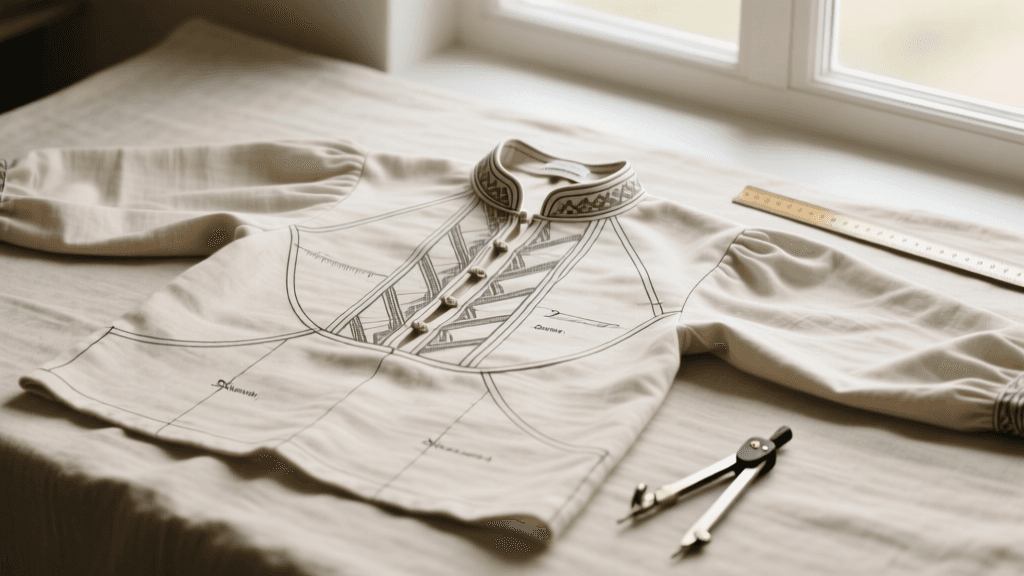
The Renaissance of Zero-Waste Historical Sewing in 2026
As the global fashion industry grapples with sustainability, modern makers and historical costumers in 2026 are looking backward to move forward. The traditional Norwegian bunad skjorte (folk shirt) represents a masterclass in zero-waste pattern cutting. Long before the advent of modern sizing charts and curved armholes, European peasant dress relied on strict geometric precision to ensure that not a single scrap of precious handwoven linen was wasted. Today, the revival of these traditional European folk dress construction patterns is not just an exercise in historical reenactment; it is a highly practical, eco-conscious approach to garment making. In this comprehensive guide, we will break down the exact measurements, drafting techniques, and sewing methods required to construct an authentic, zero-waste bunad skjorte using 2026 standards for materials and fit.
Understanding the Geometry of European Peasant Dress
Unlike contemporary commercial patterns that rely on complex curves, darts, and shaped armholes to contour the body, traditional European folk shirts are fundamentally rectilinear. The loom widths of historical textiles dictated the shapes of the garments. Fabric was an incredibly valuable commodity, often representing months of labor from flax cultivation to weaving. Therefore, the pattern drafting philosophy was simple: use rectangles, squares, and triangles. By utilizing strategic inserts—specifically the underarm gusset (kile) and the side godet (sidelengde)—tailors created three-dimensional mobility from two-dimensional geometric shapes. This mathematical approach to pattern cutting ensures that the entire width and length of the fabric is utilized, leaving zero waste on the cutting room floor.
Sourcing Materials: Linen and Thread Standards for 2026
To achieve an authentic drape and historical accuracy, material selection is paramount. In 2026, the market for high-quality, European-grown flax linen has stabilized, with premium half-bleached or unbleached linen weighing between 150g/m² and 200g/m² costing approximately €28 to €42 per meter. When sourcing linen for a bunad skjorte, look for fabrics certified by the European Flax organization to guarantee both authenticity and sustainable agricultural practices.
For the construction threads, avoid modern polyester core-spun threads, which can cut through natural fibers over time. Instead, opt for 100% long-staple linen thread. A 60/2 weight is ideal for flat-felled seams and general construction, while a finer 100/2 or 120/2 weight is necessary for delicate drawn thread work (dragverk) and hemstitching. According to the Norwegian Bunad and Folk Dress Council, maintaining traditional material integrity is essential for the garment's longevity and its acceptance in formal folk dress contexts.
Drafting the Core Rectangles: Body and Sleeves
The foundation of the bunad skjorte consists of four primary rectangles: two for the body and two for the sleeves. Because there are no shoulder seams, the body panels are cut as one continuous length of fabric that folds over the shoulder, or as two separate rectangles joined at the shoulder with a straight seam. For ease of modern fabric widths (typically 140cm to 150cm), cutting two separate body panels is often more fabric-efficient.
- Body Panel Width: Calculate by taking the wearer's full chest circumference, dividing by two, and adding 10cm to 15cm of ease, plus 2cm for seam allowances. For a standard 100cm chest, the panel width will be roughly 62cm.
- Body Panel Length: Measure from the highest point of the shoulder down to the desired hemline (traditionally mid-thigh or just above the knee), adding 4cm for the bottom hem and 2cm for the shoulder seam allowance.
- Sleeve Width: Measure the bicep circumference and add a minimum of 12cm of ease to allow for the gathering at the cuff and the structural stress of the gusset. Add 2cm for seam allowances.
- Sleeve Length: Measure from the shoulder edge (where the body panel drops off) to the wrist bone, adding 6cm for the cuff casing and hem.
Archival examples housed in DigitaltMuseum demonstrate that historical sleeve widths were often remarkably generous, sometimes exceeding 50cm in circumference, to create the dramatic, voluminous gathers characteristic of regional Norwegian folk costumes.
The Underarm Gusset (Kile): Engineering Mobility
The most critical component of the zero-waste European folk shirt is the underarm gusset, or kile. Because the sleeve is attached to the body panel at a strict 90-degree angle, lifting the arm would pull the entire side seam upward, restricting movement and tearing the fabric. The gusset solves this engineering problem brilliantly.
The gusset is a perfect square of linen, typically measuring between 12cm x 12cm and 16cm x 16cm, depending on the wearer's size and desired mobility. It is inserted into the intersection of the sleeve seam and the side body seam. When the square is folded on the diagonal into a diamond shape, it acts as a pivoting hinge. This allows the arm to lift freely without disturbing the drape of the shirt's body. To draft this without wasting fabric, the gusset squares are cut from the negative spaces left over when tapering the side godets or from the ends of the fabric bolt. In a true zero-waste layout, the 15cm gusset squares are nested perfectly alongside the straight cuts of the main body panels.
The Side Godet (Sidelengde): Creating the Flare
To allow the shirt to be tucked into heavy wool breeches or skirts while still permitting the wearer to walk, sit, and work, the lower half of the side seams are left open and a godet is inserted. The sidelengde is a long, tapered triangle or a rectangle cut on a steep angle. It is inserted into a slit cut into the side of the body panel, starting just below the gusset and extending to the hem. This insertion adds significant circumference to the hemline, creating a beautiful, flared silhouette that drapes elegantly over the hips. The angle of the taper is calculated so that the base of the godet aligns perfectly with the remaining width of the linen bolt, ensuring absolute zero waste.
Zero-Waste Fabric Layout and Measurement Table
The following table illustrates a highly optimized, zero-waste cutting layout for a standard medium-sized bunad skjorte, utilizing a 150cm wide linen bolt. By nesting the smaller geometric shapes into the voids left by the larger rectangles, the entire 3.5-meter length of fabric is consumed.
| Garment Component | Dimensions (cm) | Grainline | Zero-Waste Layout Function |
|---|---|---|---|
| Body Panels (x2) | 62 x 90 | Straight (Warp) | Primary blocks; placed side-by-side across the 150cm width (using 124cm + selvedge). |
| Sleeves (x2) | 55 x 70 | Straight (Warp) | Placed below body panels; utilizes the remaining 70cm length of the primary cutting block. |
| Side Godets (x2) | 40 x 60 (Tapered) | Straight/Bias edge | Cut from the 26cm void left beside the body panels (150 - 124 = 26cm) and nested into sleeve offcuts. |
| Underarm Gussets (x2) | 15 x 15 (Square) | Straight (Warp/Weft) | Cut from the negative triangular spaces generated by tapering the side godets. |
| Cuff and Collar Bands | Variable widths | Straight (Warp) | Cut from the remaining narrow horizontal strips at the very end of the fabric bolt. |
Traditional Seam Finishes and Hemstitching
Constructing a bunad skjorte requires seam finishes that are as durable as they are beautiful. Because the garment is subjected to rigorous laundering and physical labor, raw edges are never left exposed. The traditional method is the flat-felled seam, known in Norway as runande saum or running seam. This technique encloses both raw edges within the seam itself, creating a strong, flat ridge that lies comfortably against the skin. In 2026, while modern sewists might be tempted to use a serger, the historical flat-felled seam remains the gold standard for folk dress authenticity and linen preservation.
For the decorative elements, the neckline, cuffs, and sometimes the front placket feature intricate drawn thread work (dragverk) or hemstitching. This technique involves carefully withdrawing specific warp or weft threads from the linen and bundling the remaining threads with a needle and fine linen thread to create openwork, lace-like geometric patterns. This not only serves as a beautiful embellishment but also reinforces the edges of the fabric. The neckline is typically finished with a narrow, straight-grain linen band, gathering the excess fabric of the body panels into tight, even pleats that sit comfortably around the collarbone.
Conclusion
The traditional Norwegian bunad skjorte is a testament to the ingenuity of historical European tailors. By embracing the strict geometry of rectangles, squares, and triangles, modern makers can construct garments that are not only historically accurate and highly functional but also perfectly aligned with the zero-waste sustainability goals of 2026. Mastering the drafting of the underarm gusset and the side godet unlocks a profound understanding of how flat textiles can be transformed into dynamic, three-dimensional clothing without generating waste. Whether you are crafting a shirt for a formal bunad ensemble or simply seeking to elevate your historical sewing practice, these time-tested construction patterns offer a flawless blueprint for the future of sustainable garment making.