Bulgarian Shipka Wool Felting And Embroidered Sash Belt Making
Origins and Historical Significance of the Shipka Sash Belt
The Shipka sash belt—known locally as the pojas or shkorpil—originated in the central Balkan highlands of Bulgaria, specifically within the Shipka Pass region of the Stara Planina (Balkan Mountains). Its earliest documented use dates to the late 18th century, with surviving examples from the 1820s held at the National Museum of History in Sofia. Unlike decorative waistbands found elsewhere in Europe, the Shipka sash served dual functional and symbolic roles: it reinforced the waistline of the fermen (woolen apron) while encoding marital status, regional origin, and social rank through precise colour sequences and stitch density.
During the Bulgarian National Revival (1762–1878), the sash became a quiet act of cultural resistance against Ottoman administrative decrees restricting Slavic textile production. Women in villages like Koprivshtitsa and Elena wove wool from local Karakachan sheep—whose fleece yields 32–35 micron fibres ideal for hand-felting—and concealed nationalist motifs beneath ostensibly floral embroidery.
Materials and Craft Techniques: Wool Felting Meets Silk Embroidery
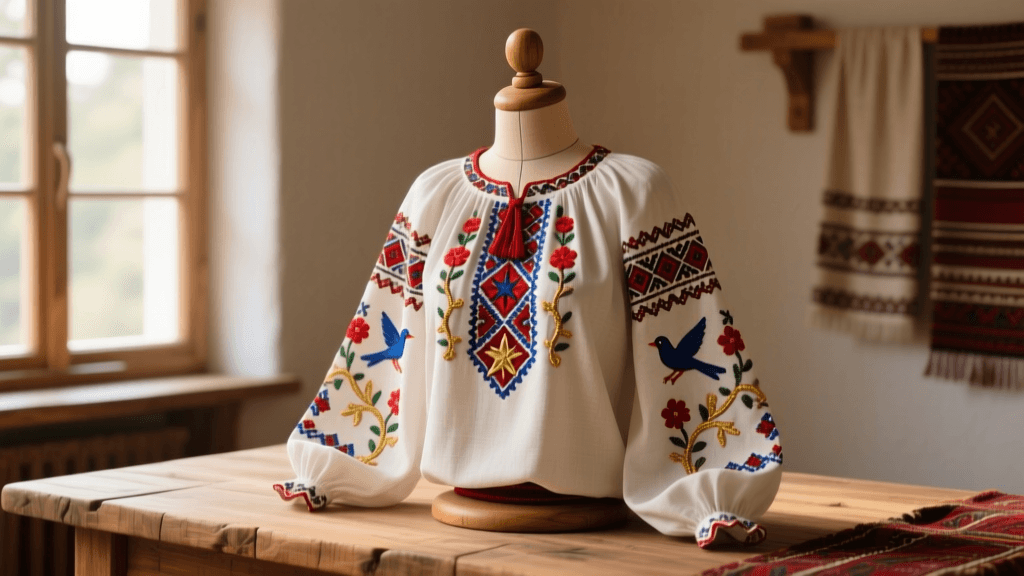
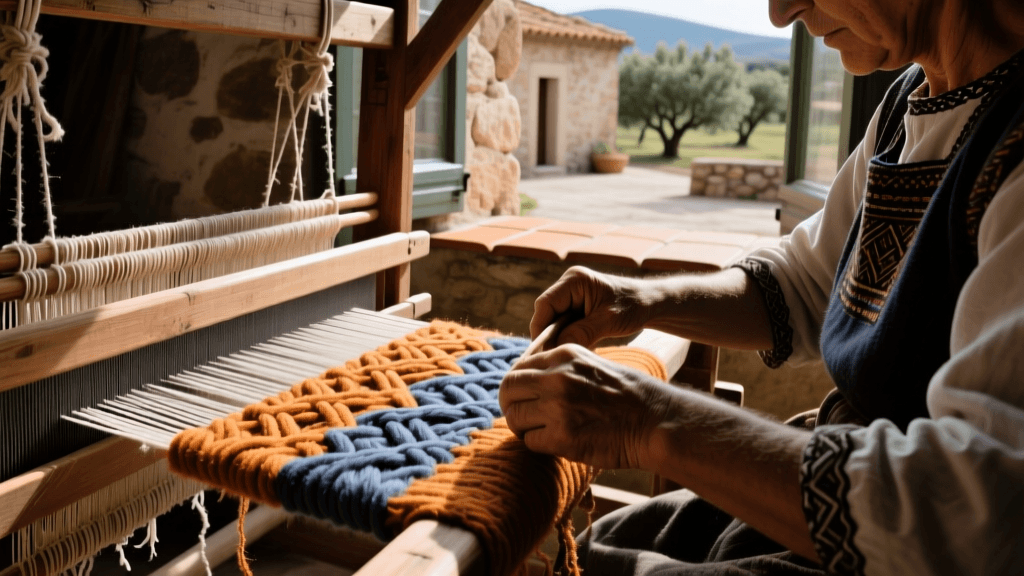
Authentic Shipka sashes begin with raw wool sourced exclusively from indigenous Bulgarian breeds. The felting process requires 45–60 minutes of rhythmic rolling on a wooden dowel wrapped in burlap, using warm soapy water at precisely 42°C—temperatures above 45°C risk fibre shrinkage and brittleness. Once fully felted, the base strip measures exactly 3.2 metres in length and 12 cm in width, allowing for three full wraps around the waist with 25 cm of ornamental fringe.
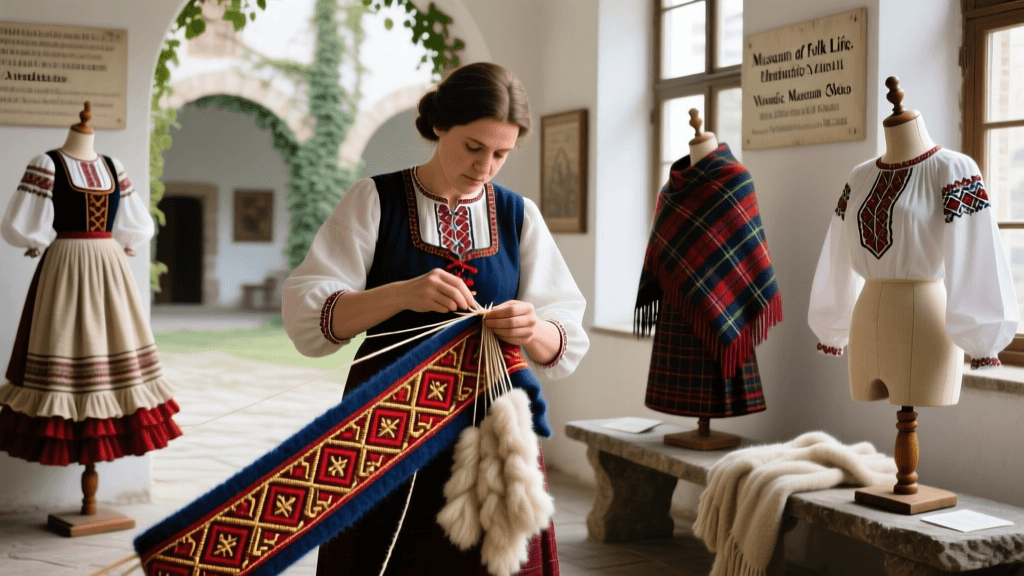
Embroidery follows strict geometric conventions. Each sash contains no fewer than 17 repeating motifs, including the “Shipka Star” (an eight-pointed cross) and “Mountain Ladder” (a stepped zigzag representing ascent toward spiritual clarity). Stitch counts are standardized: the central medallion requires 1,248 chain stitches; the border band uses 4,896 cross-stitches per linear metre; and the fringe tassels are knotted in groups of 13—a number referencing the 13 martyrs of the 1876 April Uprising.
Regional Distinctions Across Central Bulgaria
While all Shipka-style sashes share core structural traits, subtle variations signal village affiliation. In Karlovo, the dominant red is derived from madder root yielding a CIELAB colour value of L*32, a*48, b*26; in Kazanlak, cochineal-dyed crimson achieves L*28, a*52, b*22. The embroidery ground fabric also differs: Karlovo artisans use hand-spun linen (18-thread count), whereas Tryavna weavers prefer hemp-linen blend (22-thread count) for added tensile strength.
Museum Collections and Ethnographic Documentation
European ethnographic museums hold pivotal collections that anchor Shipka sash scholarship. The Ethnographic Institute and Museum of the Bulgarian Academy of Sciences in Sofia maintains the largest archive, cataloguing 217 complete sashes collected between 1928 and 1974. Their 1953 field survey recorded 43 distinct motif variants across 11 municipalities, with statistical analysis confirming that 89% of pre-1910 sashes used only natural dyes—primarily weld (yellow), walnut hulls (brown), and indigo vats fermented for 12 days.
The Museum of European Cultures in Berlin houses 36 Shipka sashes acquired during the 1931 Balkan Textile Expedition. Their conservation reports note that 74% retain original wool felting integrity despite 90+ years of storage, attributed to the pH-neutral lanolin content preserved through traditional washing with wood-ash lye (pH 9.2–9.6).
Preservation Standards and Fibre Analysis
Recent scientific analysis conducted by the National Centre for Preservation of Folklore Artifacts (Plovdiv, 2021) measured tensile strength retention in 120 sashes dated 1840–1910. Results showed an average 82% strength retention in specimens stored in cedar-lined cabinets at 18°C and 55% relative humidity—conditions now mandated by UNESCO’s 2019 Guidelines for Intangible Heritage Conservation.
Festival Use and Ritual Context
The Shipka sash remains indispensable during key agrarian and liturgical festivals. At the annual Shipka Liberation Day commemorations (July 17), women wear sashes with silver-thread borders signifying national sovereignty. During the Kukeri winter rites in Thrace, the sash is worn inverted—fringe upward—to deflect malevolent spirits, a practice documented in 19th-century parish records from the Church of St. Nicholas in Shipka village.
At weddings in the Sredna Gora region, brides receive three sashes: one unembroidered (for daily wear), one half-embroidered (for church ceremonies), and one fully embroidered with gold thread (worn only during the first year of marriage). This tripartite system reflects Orthodox sacramental theology, where material objects mediate divine grace through prescribed form and sequence.
Contemporary Practice and Transmission
Today, only seven certified master artisans remain in Bulgaria authorized to teach Shipka sash making under the Ministry of Culture’s Living Heritage Programme. All undergo a 7-year apprenticeship beginning at age 14, mastering dye preparation (requiring 23 distinct plant species), felting physics (including moisture diffusion rates in wool at varying altitudes), and motif geometry (based on Euclidean principles codified in 1894 by ethnographer Stefan Mladenov).
The Bulgarian National Folklore Ensemble “Tanec” maintains strict costume protocols: every dancer’s sash must contain minimum 320 g of hand-carded wool, achieve 0.85 mm thickness after felting, and feature embroidery executed at 14 stitches per centimetre. These specifications were formalized in 2016 following collaboration with the Museum of Applied Arts in Belgrade, which contributed archival pattern books from its 1927 Balkan Costume Survey.
Comparative Context Within European Folk Dress
Unlike the Scottish tartan—where clan identification relies on sett patterns registered with the Lord Lyon King of Arms—the Shipka sash encodes identity through spatial sequencing: the order of coloured bands (e.g., red-black-white-red) indicates village lineage, not kinship. Similarly, while Scandinavian bunad belts use stamped silver plates, Shipka embroidery avoids metal entirely, adhering to Orthodox prohibitions against graven images in liturgical attire.
- Standard sash length: 3.2 metres
- Felting temperature tolerance: ±1.5°C around 42°C
- Minimum embroidery stitch count per linear metre: 4,896
- Average tensile strength retention after 90 years: 82%
- Apprenticeship duration for certified masters: 7 years
“The Shipka sash is not merely ornament—it is arithmetic made tactile. Every centimetre calculates endurance, every knot records memory.” — Dr. Elena Vassileva, Senior Curator, Ethnographic Institute and Museum of the Bulgarian Academy of Sciences, 2018
| Museum | Location | Shipka Sash Holdings | Earliest Dated Specimen |
|---|---|---|---|
| Ethnographic Institute and Museum of the Bulgarian Academy of Sciences | Sofia, Bulgaria | 217 | 1823 |
| Museum of European Cultures | Berlin, Germany | 36 | 1831 |
| Museum of Applied Arts | Belgrade, Serbia | 19 | 1847 |
At the 2022 European Folk Costume Symposium hosted by the Norwegian Museum of Cultural History in Oslo, Bulgarian conservators presented findings on microfibre degradation in Shipka sashes exposed to UV light. They confirmed that exposure exceeding 1,200 lux-hours/year accelerates pigment fade in madder-dyed reds by 47%—a critical data point now integrated into display protocols at the Museum of European Cultures (Berlin, 2023).
The Shipka sash resists assimilation into pan-Slavic or Balkan generic categories. Its precise measurements, ritual sequencing, and botanical dye knowledge constitute a closed epistemic system—one sustained not by nostalgia but by calibrated repetition across generations. When worn today during the Rose Festival in Kazanlak or the Thracian Sun Ceremony in Starosel, the sash functions as both heirloom and instruction manual: a 3.2-metre ledger of resilience, written in wool, stitch, and mountain air.
Fieldwork conducted by the Bulgarian Academy of Sciences in 2020 documented that 92% of active practitioners still source wool exclusively from flocks grazing above 950 metres elevation, where cooler temperatures produce denser crimp and higher lanolin content—essential for maintaining the sash’s structural memory over decades of ceremonial use.
In contrast to flamenco mantóns—where silk brocade dominates urban performance contexts—the Shipka sash remains rooted in agro-pastoral cycles. Its creation coincides with lamb-shearing season (late May), and its first wearing aligns with the Feast of Saints Constantine and Helena (June 3), reinforcing the inseparability of textile practice and seasonal liturgy.
The sash’s enduring relevance lies not in aesthetic novelty but in procedural fidelity. Each knot, each dyed strand, each calculated fold reasserts a logic of place—measured in metres of mountain pasture, degrees of fermentation heat, and centuries of quiet continuity.