Crafting the 15th-Century Houppelande: A 2026 Maker's Guide
Introduction to the Burgundian Houppelande
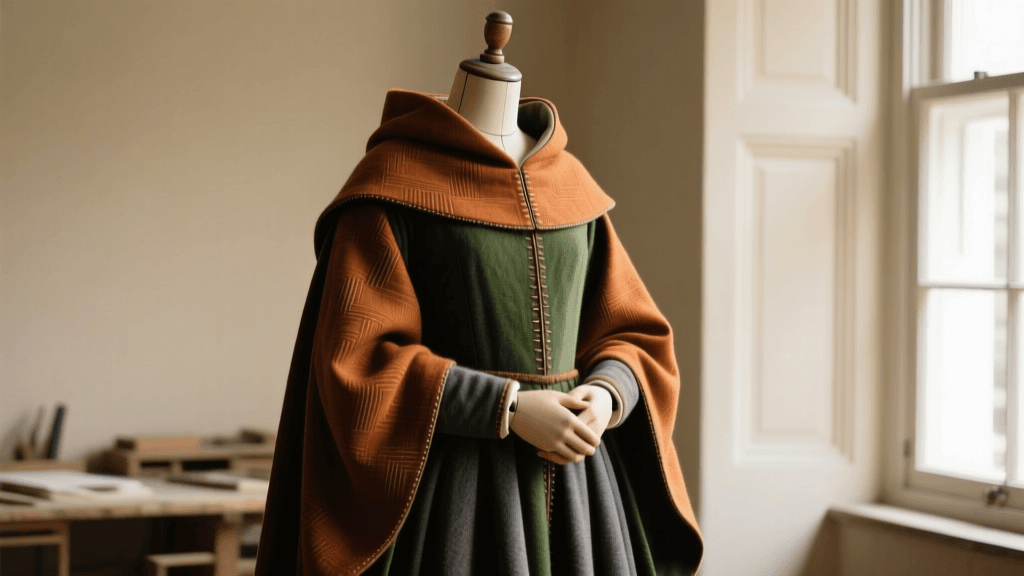
The Burgundian houppelande remains one of the most striking, opulent, and structurally fascinating garments of the 15th century. For historical reenactors, costumers, and slow-fashion enthusiasts in 2026, recreating this masterpiece requires far more than just a modern sewing machine; it demands a deep understanding of historical geometry, textile drape, and period-accurate tailoring. Unlike modern garments that rely on complex curved seams to fit the human form, the medieval houppelande achieves its dramatic, fluted silhouette through the masterful manipulation of flat, geometric shapes and heavy, fulled wools.
This comprehensive guide explores the exact steps to draft, source, and construct an authentic 15th-century houppelande. Whether you are preparing for the 2026 reenactment season or building a museum-quality reproduction, understanding the intersection of historical constraints and modern textile availability is paramount to your success.
Historical Context and the Power of Drape
Originating in the late 14th century and reaching its zenith in the 15th-century Burgundian court under Philip the Good, the houppelande was a profound symbol of wealth and status. Characterized by its high, stiffened collar (the carcan), massive trailing sleeves, and deep, organ-like folds, the garment was heavily regulated by the era's strict social codes. According to sumptuary laws documented by Britannica, the length of the garment's train, the volume of fabric used, and the specific types of fur permitted for lining were strictly dictated by one's social rank and income.
Today, while modern makers are no longer bound by these medieval edicts, adhering to them adds profound authenticity to reproductions. As noted by the Victoria and Albert Museum's medieval fashion archives, the sheer volume of fabric was the primary indicator of status. Cloth was incredibly expensive, and wearing yards of heavy wool that trailed on the ground was a deliberate display of economic power. Therefore, the weight and drape of your chosen wool are not merely aesthetic choices; they are the foundational elements of the garment's historical accuracy.
Sourcing Authentic Wool Broadcloth in 2026
Finding the correct textile is the most critical and challenging step for modern makers. Standard 2026 suit wools are entirely unsuitable; they are worsted, tightly woven, and far too light to hold the deep, tubular folds required for a houppelande. You must source woolen broadcloth.
Understanding the Broadcloth Process
Historically, broadcloth was woven on wide looms and then subjected to a rigorous finishing process. It was washed in alkaline solutions and beaten (fulled) to shrink the fabric by up to 30%. This process caused the woolen fibers to mat and felt together, creating a dense, weather-resistant fabric with a non-fraying edge that could be cut without hemming. After fulling, the cloth was teaselled to raise a nap and sheared to create a smooth, velvety finish.
Top Sourcing Strategies for 2026
- Weight and GSM: Look for 100% wool fabrics weighing between 450 and 650 grams per square meter (GSM). Anything lighter will collapse; anything heavier will be too stiff to pleat.
- Heritage Mills: Seek out specialized historical textile suppliers such as Wm. Booth Draper or Renaissance Fabrics, which continue to stock heavily fulled, reenactment-grade wools that mimic the historical finishing process.
- Natural Dyes: For the highest level of authenticity, prioritize wools dyed with historical botanicals. Madder (for deep reds), weld (for bright yellows), and woad (for rich blues) offer a depth of color that modern synthetic dyes simply cannot replicate.
Pattern Drafting: The Geometry of Volume
The houppelande is fundamentally an exercise in geometric cutting. It relies on circles, rectangles, and triangles, gathered at the shoulders and belted tightly at the waist to create its iconic volume.
The Bodice and Skirt
The most historically accurate method for achieving the deep, fluted folds seen in period illuminations (such as the Très Riches Heures du Duc de Berry) is the circle cut. By drafting the skirt panels as full or half-circles and cartridge-pleating them into a fitted inner bodice or directly to a heavy belt, the heavy wool naturally forms deep, tubular columns. The bodice itself is relatively simple, often cut as a slight trapezoid that fits smoothly over the shoulders before exploding into gathered volume at the chest and waist.
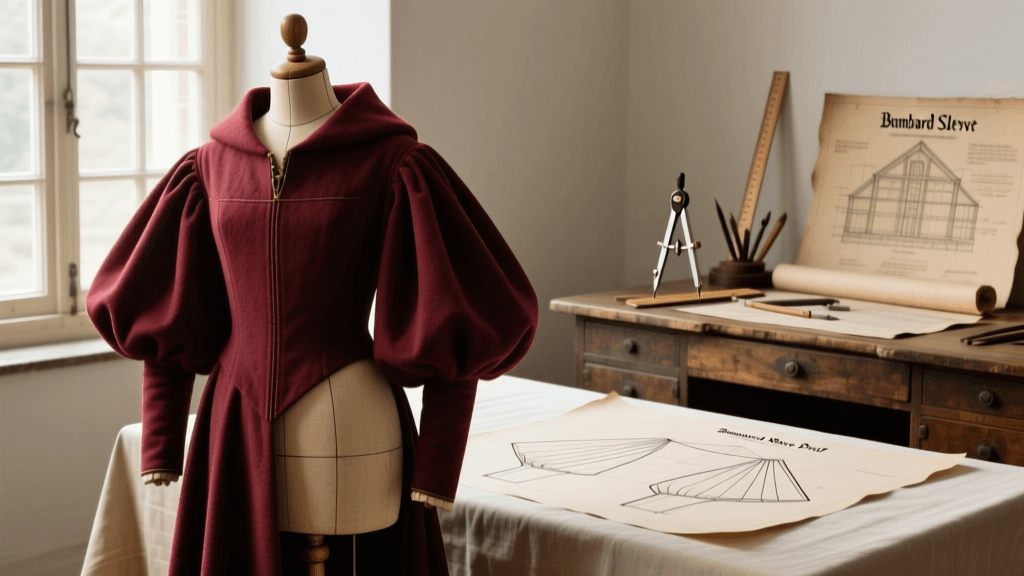
Drafting the Bombard Sleeve
The bombard sleeve is the defining feature of the Burgundian houppelande. It is cut as a massive elongated triangle or half-circle. To draft this in 2026:
- Measure from your shoulder point, down over your bent arm, to the floor.
- Use this measurement as the radius for a half-circle.
- The wrist opening is left wide and trailing, while the arm actually exits through a vertical slit cut higher up on the sleeve, near the elbow or bicep.
Fabric Requirements and 2026 Cost Breakdown
Because the houppelande relies on extreme volume, fabric consumption is high. Below is an estimated breakdown for a full-length, floor-sweeping houppelande tailored for an average adult, utilizing 60-inch wide heritage wool.
| Component | Fabric Type | Estimated Yardage (60" width) | 2026 Avg. Cost per Yard | Total Est. Cost |
|---|---|---|---|---|
| Outer Shell | Heavy Wool Broadcloth (550gsm) | 8 - 10 yards | $75.00 | $600 - $750 |
| Body Lining | Heavyweight Linen or Ethical Faux Fur | 8 - 10 yards | $28.00 | $224 - $280 |
| Sleeve Lining | Contrasting Silk Taffeta or Velvet | 4 - 6 yards | $65.00 | $260 - $390 |
| Collar & Cuffs | Silk Velvet or Contrasting Wool | 2 yards | $85.00 | $170.00 |
| Thread & Trims | Silk Buttonhole Twist, Waxed Linen Thread | N/A | N/A | $55.00 |
| Total Project | 22 - 28 yards | $1,309 - $1,645 |
Construction and Sewing Techniques
While modern sewing machines are ubiquitous in 2026, the historical reenactment community heavily favors hand-finished seams for high-status outerwear. The thickness of fulled broadcloth can easily snap modern machine needles or jam walking feet.
Historical Stitches for Modern Makers
- The Backstitch: Use a heavy, beeswax-coated linen thread for all high-stress structural seams, such as the shoulder and sleeve attachments. The backstitch provides the necessary tensile strength to support the massive weight of the trailing sleeves.
- The Running Stitch: Ideal for long, low-stress side seams and basting. When done in tightly spaced rows, it creates a surprisingly strong and flexible seam.
- The Felling Stitch: Used to secure the lining to the outer shell. The 'bag lining' technique—where the wool and linen are sewn right-sides together, turned, and then the edges are slip-stitched closed—is historically accurate and provides a clean, durable edge without the need for modern hem tapes.
Maker's Tip for 2026: When cartridge pleating the heavy wool skirt to the bodice, use a modern silicone-based thread conditioner rather than traditional beeswax if you are working in a humid climate. It reduces friction and prevents the thick linen thread from snapping during the gathering process.
Finishing Touches: Linings, Collars, and Accessories
The structural integrity of the high collar (carcan) is vital. It must be heavily interlined with modern buckram or traditional canvas to stand up stiffly around the neck and frame the face, mimicking the portraits of the Burgundian nobility. Do not rely on the wool alone; it will collapse.
For the lining, while historical nobles would have used vair, miniver, or ermine, modern makers in 2026 have access to incredibly high-quality, ethically sourced faux furs that perfectly mimic the guard hairs and dense undercoats of medieval pelts. Alternatively, a heavy, naturally dyed linen provides a beautiful, breathable contrast that allows the garment to be worn during warmer summer reenactment events.
Finally, the silhouette is incomplete without a proper girdle belt. A tooled leather belt with a brass chape, worn tightly at the natural waist or slightly above, is what creates the iconic blousing effect. The belt hides the actual waistline seam, supports the immense weight of the skirt, and allows the heavy wool to cascade downward in perfect, uninterrupted columns.
Conclusion
Crafting a 15th-century Burgundian houppelande in 2026 is a demanding but deeply rewarding labor of love. It bridges the gap between modern textile appreciation and medieval sartorial splendor. By prioritizing heavy, fulled wools, adhering to geometric pattern drafting, and utilizing historical hand-sewing techniques, modern makers can achieve a breathtaking garment that moves, drapes, and commands attention exactly as it did in the opulent courts of 15th-century Europe.