Burgundian Houppelande Construction & Sourcing Guide 2026
The Resurgence of the Burgundian Silhouette in 2026
The late 14th and 15th centuries marked a revolutionary period in European fashion, characterized by the dramatic, voluminous lines of the houppelande. Originating in the opulent courts of Burgundy, this sweeping garment was a canvas for displaying wealth through excessive fabric, rich textiles, and intricate trim. As we navigate the historical costuming and reenactment landscape in 2026, the demand for museum-quality, historically accurate medieval garments has reached an all-time high. Modern makers are moving away from synthetic costume fabrics, instead leveraging a renaissance in heritage textile milling and digital pattern drafting to recreate these masterpieces.
This comprehensive guide focuses on the practical construction of a mid-15th-century Burgundian houppelande. We will explore how to source historically accurate wool broadcloth, draft the iconic bombard sleeves, and calculate the precise yardage required for a floor-length, cartridge-pleated masterpiece. According to the Metropolitan Museum of Art's Heilbrunn Timeline of Art History, the Burgundian court under the Valois dukes was the undisputed arbiter of European style, utilizing clothing as a primary tool for political and social projection. Recreating these garments today requires an understanding of both historical drape and modern textile behavior.
Anatomy of the 15th-Century Houppelande
Before cutting into expensive heritage wool, it is crucial to understand the structural anatomy of the garment. Unlike the closely fitted cotehardie that preceded it, the houppelande is defined by its voluminous drape and structural gathering.
- The Collar: Typically a high, standing band that flares slightly at the top, often lined with contrasting silk or fur.
- The Bodice and Waist: Fitted through the shoulders and upper chest, then sharply gathered into a belt or seam at the natural waist (for men) or just under the bust (for women).
- The Skirt: Massive panels of fabric cartridge-pleated to the bodice, creating deep, tubular folds that cascade to the floor.
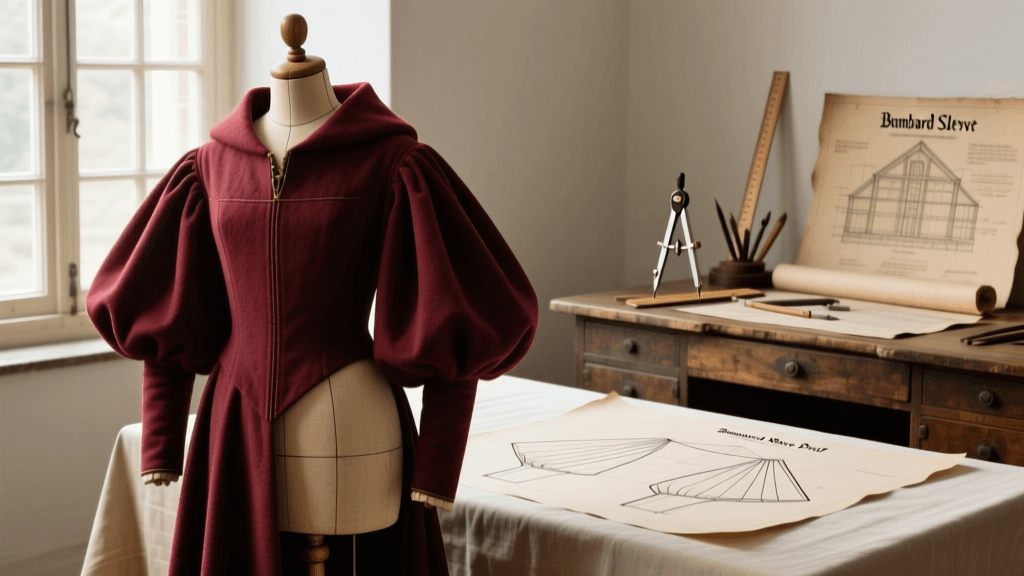
- The Bombard Sleeves: The most recognizable feature. These sleeves are cut with an enormous sweep at the hem, often featuring 'dagges' (decorative scalloped or leaf-shaped edges).
Sourcing Historically Accurate Textiles in 2026
The foundation of any credible medieval garment is the textile. In 2026, the global shift toward sustainable, biodynamic farming has serendipitously benefited historical costumers. Heritage mills in Yorkshire, Scotland, and Scandinavia are producing worsted wool broadcloths and meltons that closely mimic the dense, fulled fabrics of the 1400s.
Wool Broadcloth and Melton
For the outer shell, you need a 100% wool fabric that has been heavily milled (fulled) to obscure the weave and create a dense, weather-resistant cloth that holds a stiff pleat and drapes heavily. Look for fabrics weighing between 16 oz and 22 oz per yard. Avoid modern coating wools that contain polyester blends, as they will not hold the deep heat-set pleats required for the skirt and will fray unpredictably when cutting dagges.
Lining and Interfacing
Historical garments were almost universally lined. For a houppelande, a medium-weight tabby-weave linen (5.5 oz to 7 oz) is ideal for lining the bodice and sleeves. For the collar and the interior of the bombard sleeves, consider silk velvet or faux fur. The history of velvet in European courts is deeply tied to luxury and status; as detailed by the Victoria and Albert Museum's textile archives, silk velvet was a heavily regulated luxury import that signaled immense wealth, making it the perfect choice for the visible linings of a high-status Burgundian garment.
Drafting the Bombard Sleeve: A Step-by-Step Guide
The bombard sleeve is essentially a massive, curved cone. Drafting it requires understanding radial geometry rather than standard flat-pattern slopers. Here is how to draft this specific sleeve for a 2026 production.
Step 1: Take the Core Measurements
- Armhole Circumference: Measure the armscye of your fitted bodice block (e.g., 22 inches).
- Sleeve Length: Measure from the shoulder point down to the wrist, adding 2 inches for drape over the hand (e.g., 26 inches).
- Wrist Circumference: Measure loosely around the hand to ensure the sleeve can pass over it if closed, or determine the opening size if left open.
- Hem Sweep: Decide on the volume. A standard bombard sleeve hem can range from 60 inches to over 100 inches in circumference.
Step 2: The Radial Draft
Instead of a standard sleeve cap, the top of the bombard sleeve is drafted as a half-circle or a large curved arc. The circumference of this inner arc must match your armhole measurement (minus ease, as wool stretches). Using a compass or a digital drafting tool like CLO3D, draw an inner circle with a circumference equal to your armhole. From this inner arc, measure down the radius line by your sleeve length, and draw the outer arc. The outer arc's length will dictate your hem sweep. Because the fabric is cut on a curve, the hem will naturally flare out, creating the iconic bell shape without the need for side gussets.
2026 Fabric Yardage and Cost Breakdown
Constructing a houppelande requires a significant investment in yardage due to the cartridge pleating and massive sleeves. Below is a realistic cost and yardage table based on 2026 market rates for heritage textiles sourced from specialized historical fabric purveyors. Prices reflect premium, historically milled materials.
| Garment Section | Fabric Type | Yardage (60" width) | 2026 Avg. Cost/Yard | Total Est. Cost |
|---|---|---|---|---|
| Main Body & Skirt | 100% Wool Broadcloth (18oz) | 8.0 Yards | $65.00 | $520.00 |
| Bombard Sleeves | 100% Wool Broadcloth (18oz) | 3.5 Yards | $65.00 | $227.50 |
| Collar & Sleeve Linings | Silk/Rayon Velvet (Accent) | 2.5 Yards | $45.00 | $112.50 |
| Bodice & Skirt Lining | Medium Tabby Linen (5.5oz) | 10.0 Yards | $22.00 | $220.00 |
| Pleating Tape & Thread | Heavy Linen Tape & Silk Thread | N/A | N/A | $45.00 |
| Total Estimated Project Cost | $1,125.00 |
Assembly Techniques: Cartridge Pleating the Skirt
The magic of the houppelande lies in its pleats. Standard knife pleats or box pleats do not provide the correct tubular, organ-pipe silhouette seen in primary sources. You must use cartridge pleating (also known as gauging).
- Prepare the Edge: Finish the top raw edge of your massive skirt panels with a heavy linen tape or by folding it over twice. This provides a rigid anchor for the heavy wool.
- Mark the Dots: Using a specialized pleating ruler or a marking wheel, mark parallel rows of dots along the top edge. For heavy 18oz wool, space the dots 3/8 inch apart horizontally, and create 3 to 4 parallel rows vertically.
- Run the Threads: Using heavy, waxed linen buttonhole thread, run a whip stitch through the dots. Do not use standard polyester thread; it will snap under the tension of the heavy wool.
Pull and Secure: Pull the threads to gather the fabric into tight, uniform tubes. Bind the top edge to your finished bodice waistband using heavy whip stitches, securing each individual pleat to the band. This technique allows the skirt to stand out away from the body before dropping straight to the floor, perfectly mimicking the drape seen in the British Library's illuminated manuscript database, particularly in the mid-15th-century Burgundian romances.
Finishing Touches: Dagges and Accessories
To complete the 15th-century aesthetic, the edges of the bombard sleeves and the hem of the skirt should be finished with dagges. Because a properly fulled wool broadcloth does not fray, you can cut these edges raw. Use heavy cardstock to create templates of oak leaves, castles, or simple scallops, and trace them onto the fabric using tailor's chalk. Cut carefully with sharp shears.
No Burgundian houppelande is complete without the correct accessories. For men, a leather belt worn at the natural waist to blouse the bodice, and a complex draped chaperon hat. For women, a steeple hennin with a floating veil. By combining historically accurate textiles, precise radial drafting, and meticulous hand-finishing techniques, you can create a garment in 2026 that not only survives the rigors of modern historical interpretation but truly honors the master tailors of the Burgundian court.